
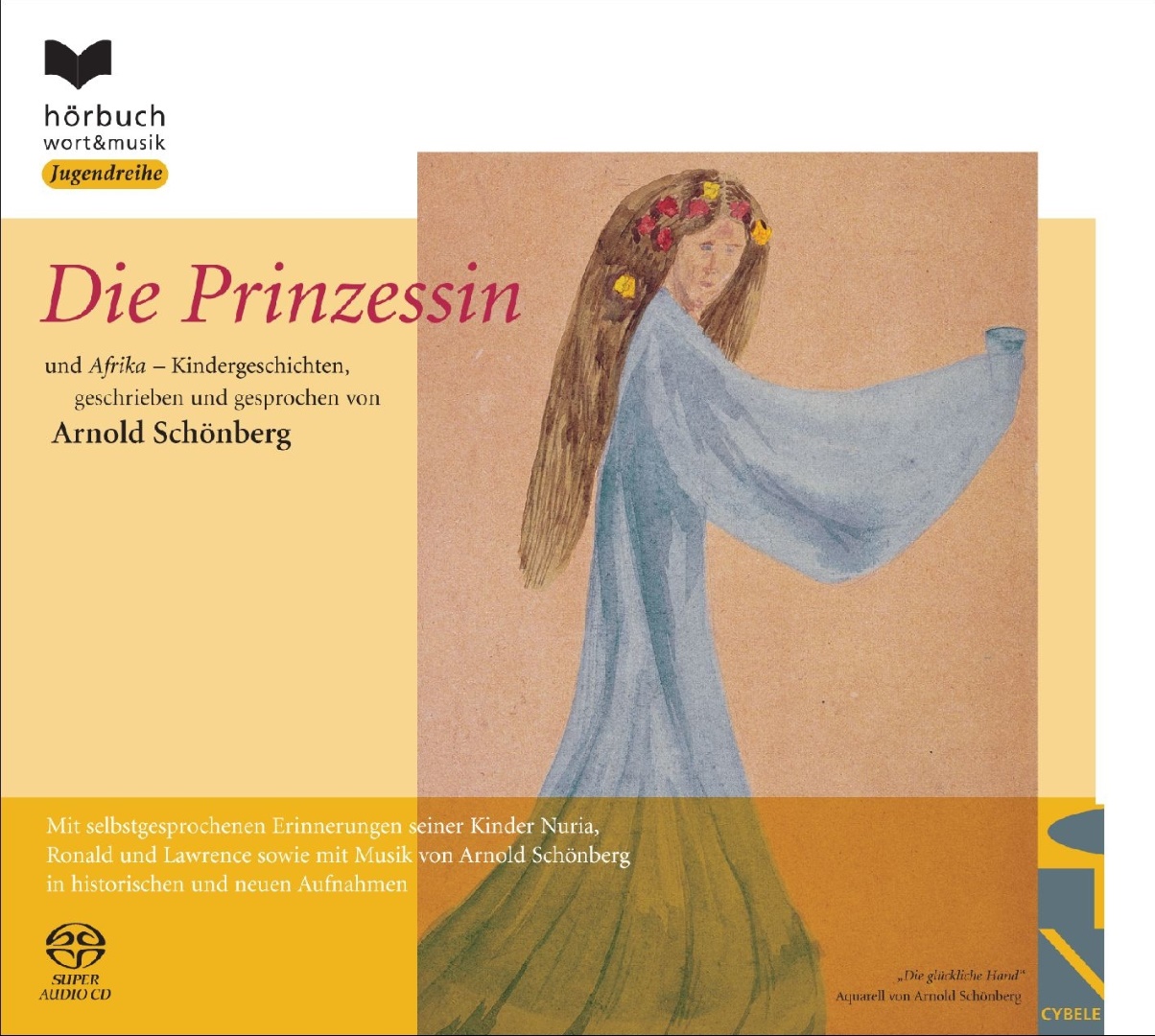
Cybele AB005 2008

5.0 surround DSD Stereo Classical music Word & language Classical modernism Contemporary music

To the description

Arnold Schönberg: Die Prinzessin

Contributors

Arnold SchönbergMirjam WiesemannNuria Schoenberg NonoRonald SchoenbergLawrence SchoenbergLorenzo LiebetanzTara WiesemannRomeo MerzDoelenKwartetPhilharmonisches Orchester der Hansestadt LübeckRoman Brogli-Sacher

Composer

Arnold Schönberg

Streaming & download

Short description

Arnold Schönberg: Die Prinzessin is devoted to Einleitung, Die Prinzessin (Beginn), Die Prinzessin (historisch), Die Prinzessin (neu) und Nullele Pullele (Nuria) by Schönberg, Arnold. Arnold Schönberg, Mirjam Wiesemann, Nuria Schoenberg Nono, Ronald Schoenberg, Lawrence Schoenberg, Lorenzo Liebetanz, Tara Wiesemann, Romeo Merz, DoelenKwartet, Philharmonisches Orchester der Hansestadt Lübeck, Roman Brogli-Sacher and others shapes the recording with clear contour, a feeling for tone colour and an eye for the inner dramaturgy of the programme. Chamber music, orchestral music shape the album’s profile and make the relations between form, gesture and space directly audible. A carefully produced Cybele edition that…

Details

With recollections spoken by his children Nuria, Ronald and Lawrence, and with music by Arnold Schönberg in historical and new recordings
Audiobook, words & music

Recommended for ages 12 and up

Arnold Schönberg – Nuria Schoenberg Nono – Ronald Schoenberg – Lawrence Schoenberg – Mirjam Wiesemann – Tara Wiesemann – Romeo Merz – Lorenzo Liebetanz (speaker)

Music by Arnold Schönberg (1874-1951):

New SACD recordings:
Verklärte Nacht op. 4 (1899) for string sextet, Kammersinfonie No. 1 op. 9 for 15 solo instruments (1906), Die Eiserne Brigade (1916) for piano quintet, String Quartet No. 3 op. 30 (1927), Nullele Pullele Variationen (1934) – fragment for string quartet (first recording)

Restored historical shellac and LP recordings from Arnold Schönberg’s private collection:
Suite op. 25 (1921/23) for piano, Suite op. 29 (1925) for E flat clarinet, clarinet, bass clarinet, violin, viola, cello and piano – String Quartet No. 3 op. 30 (1927), Trio op. 45 (1946) for violin, viola, cello

Musicians:
op. 4 / op. 30 / Eiserne Brigade / Nullele Pullele:
DoelenKwartet: Frank de Groot (violin I) – Laurens van Vliet, Maartje Kraan (violin II) – Karin Dolman (viola) – Hans Woudenberg (cello) – Anne Huser (viola II) – Floris Mijnders (cello II) – Maarten van Veen (piano)

op. 9: Philharmonisches Orchester der Hansestadt Lübeck:
Thomas Biermann (flute/piccolo) – Masao Fukuda (oboe) – Wolfgang Eickmeyer (cor anglais) – Eckhard Schmidt-Behrens (clarinet) – Bernd Rodenberg (clarinet) – Klaus Reichwein (bass clarinet) – Jakob Meyers (bassoon) – Dagmar Reinländer (contrabassoon) – Lizz Porter (horn) – Margarete Mengel (horn) – Carlos Johnson (violin I) – Daniela Dakaj (violin II) – Elisabeth Orr (viola) – Hans-Christian Schwarz (cello) – Stanislav Efaev (double bass)
Roman Brogli-Sacher (conductor)

op. 25: Niels Viggo Bentzon (piano)

op. 29: Gustave Plaquet (E flat clarinet) – Marcel Jean (clarinet) – Andre Dupont (bass clarinet) – Henri Bronschwak (violin) – André Focheux (viola) – Jacques Neilz (cello) – Jeanne Manchon-Theis (piano)
Max Deutsch (conductor)

op. 30: Kolisch Quartet: Rudolf Kolisch (violin I) – Felix Khuner (violin II) – Eugene Lehner (viola) – Benar Heifetz (cello)

op. 45: Koldofsky Trio: Adolf Koldofsky (violin) – Cecil Figelski (viola) – George Neikrug (cello)

Spoken-word direction: Vera Forester
Recording Producer, music direction: Ingo Schmidt-Lucas

ISBN: 978-3-937794-05-1

Booklet language: German (28 pages in a digipak)

Awards

ECHO Klassik 2009 — Classical music for children – youth

LEOPOLD — Media prize “Gute Musik für Kinder”, 2009/2010

hr2 — CD recommendation, 13 September 2008

Specifications

Catalogue number
Cybele AB005
Year of release
2008
Genre
Classical music, Word & language
Period
Classical modernism, Contemporary music
Instrumentation
Audiobook, Chamber music, Orchestral music
Label
Cybele Records
Barcode
809548012328
Booklet (pages)
28

Track listing

Contributors

Description

Arnold Schönberg: Die Prinzessin places Einleitung, Die Prinzessin (Beginn), Die Prinzessin (historisch), Die Prinzessin (neu) und Nullele Pullele (Nuria) at the centre. The programme is laid out not as a loose sequence but as an audibly articulated whole: different pieces, textures and states of sound enter into relation with one another and give the album a profile of its own.

The selection belongs to the field of Word & language; stylistically it leads into Contemporary music, classical modernism. Schönberg, Arnold is the decisive point of reference here. The booklet opens up the genesis of the works, their aesthetic premises and the connections between them, without reducing the music to mere commentary. Historical layers, formal ideas and personal spaces of expression remain present as an audible experience.

The scoring – Chamber music, orchestral music – is essential to what this production has to say. Stops, articulation, resonance and silence are treated as shaping forces. Where lines overlap, rhythmic impulses gather or tone colours merge into one another, the recording preserves transparency while letting the physical presence of the instruments and voices be felt.

Arnold Schönberg, Mirjam Wiesemann, Nuria Schoenberg Nono, Ronald Schoenberg, Lawrence Schoenberg, Lorenzo Liebetanz, Tara Wiesemann, Romeo Merz, DoelenKwartet, Philharmonisches Orchester der Hansestadt Lübeck, Roman Brogli-Sacher and others joins interpretative precision to a natural musical breath. The playing follows the character of each individual work while keeping the long line in view: fragile moments retain their tension, virtuoso passages remain intelligible, and the transitions between repose, movement and concentration acquire a convincing inner logic.

The technical realisation supports this kind of listening without overstating the effect. CD allows a finely graded presentation of dynamics, space and tone colour; the total playing time of 61:57 is deliberately proportioned. Individual voices, ensemble balance and reverberation are thus not merely documented but become experienceable as part of the musical architecture.

As is typical of Cybele, this edition combines careful work on repertoire, editorial context and attentive sound direction. It addresses curious listeners as much as connoisseurs: the immediate musical impression remains central, while repeated listening opens up further connections, details and perspectives.