
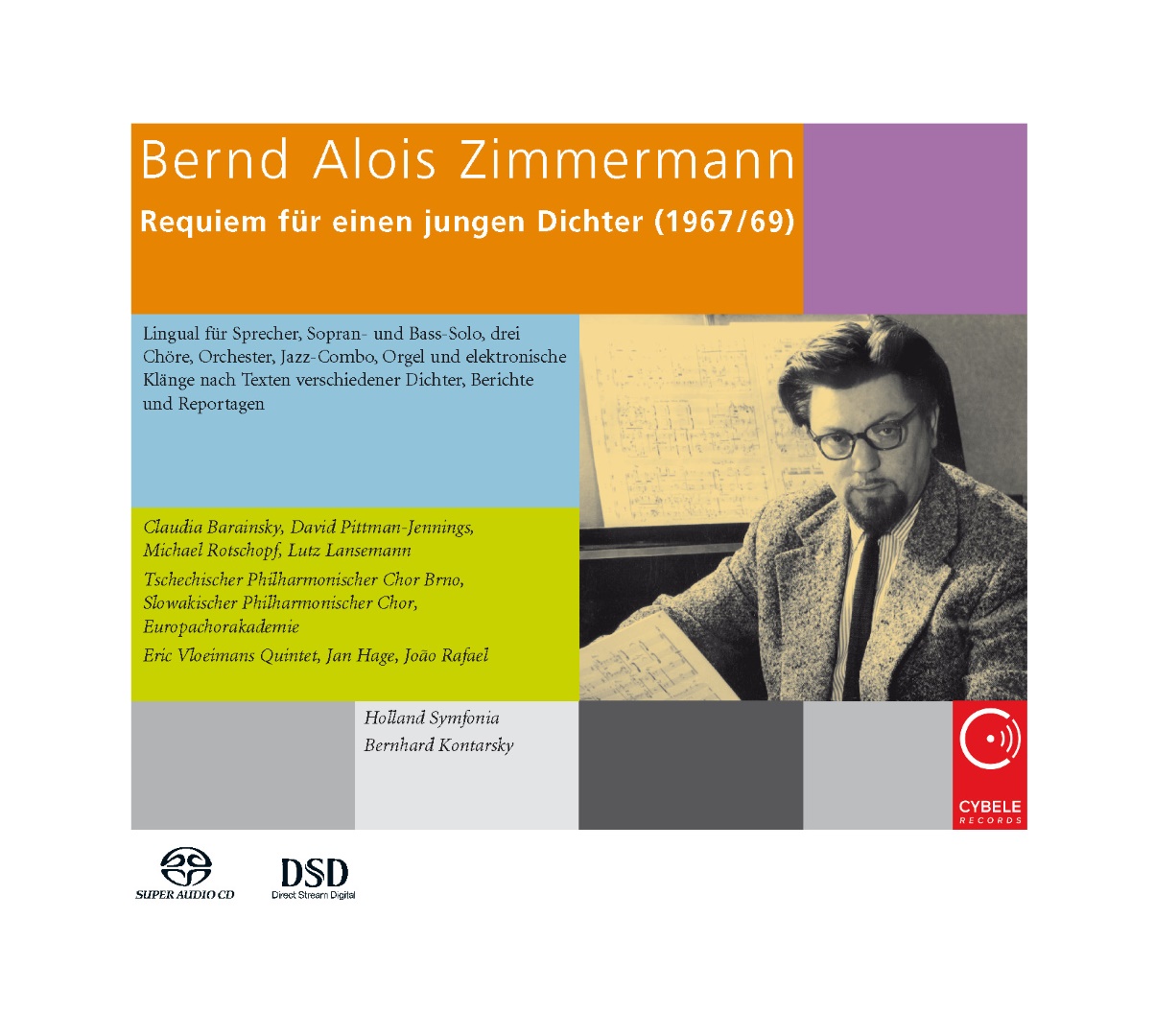
Bernd Alois Zimmermann, born in Bliesheim near Cologne in 1918, wrote his Requiem für einen jungen Dichter mainly between 1967 and 1969. It is sung and spoken in eight languages: alongside the Latin Mass for the Dead there are fragments by Ludwig Wittgenstein, James Joyce, Ezra Pound, Albert Camus, Kurt Schwitters, Hans Henny Jahnn and Konrad Bayer, historical recordings of speeches, for instance by Alexander Dubcek, Neville Chamberlain, Adolf Hitler and Pope John XXIII, and musical quotations ranging from Richard Wagner to the Beatles. The “young poet”, as Patrick van Deurzen writes in the booklet, stands for the Europe of the years 1920 to 1970; Zimmermann himself referred to Sergej Jessenin. Because of his illness he was unable to attend the premiere given by the WDR in Düsseldorf in 1969; on 10 August 1970 he took his own life.
The four parts run into one another. The Prologue and Requiem I come mainly from the tape, whose loudspeakers surround the audience; their duration of 39:37 is fixed, and the musicians follow the playback. Over low double basses and electronic sounds, Wittgenstein’s critique of language, Dubcek’s address to the Czech people and Molly Bloom’s monologue from “Ulysses” overlap until, after 13 minutes, the choir cries “Requiem” for the first time, supported by the note D in the wind. Requiem I sets principles such as the German Basic Law against recorded speeches whose words miss reality – Georg A. Papandreou’s cry “Democracy will prevail!” preceded a military dictatorship in 1967 – and leads into a Ricercar with texts by Bayer, Majakowskij and Jahnn.
With Requiem II the soloists, choirs and orchestra come to the fore. After the Rappresentazione the soprano sings the Elegia, “quasi blues”, with the jazz quintet; the short orchestral interlude Tratto leads to the ecstatic Lamento, centred on Majakowskij’s obituary for Sergej Jessenin, sung by soloists and choir and spoken by Speaker I, combined with the Kyrie and, at the end, a line from Schiller’s “Ode to Joy”. In the Dona nobis pacem all the means come together: quotations from Beethoven’s Ninth and “Hey Jude”, speeches from the Second World War, a montage of political demonstrations played in fortissimo, Bayer’s text “Wie jeder weiß” and a final outcry from all the performers.
The recording was made on 23 June 2005 at the Koorbiënnale Haarlem in the Concertgebouw Haarlem, which reopened with this concert after several years of restoration. It is based on a new version of Zimmermann’s two four-track playback tapes of 1969: Volker Müller digitised them at the WDR studio in 2000, and Joao Rafael synchronised and restored them so that the historical recordings can be understood again. As recommended in the score, the choirs were placed at the front, sides and back of the hall, and the tape was played over eight loudspeakers evenly spaced around the room; the SACD is the first surround recording of the Requiem to be released.
Bernhard Kontarsky conducts Claudia Barainsky (soprano), David Pittman-Jennings (baritone), the Tschechischer Philharmonischer Chor Brno, the Slowakischer Philharmonischer Chor, the EuropaChorAkademie, the Holland Symfonia, the Eric Vloeimans Quintet and Jan Hage (organ); Joao Rafael is in charge of sound projection. The speakers are Lutz Lansemann and Michael Rotschopf, who had already performed the Requiem under Michael Gielen in Salzburg, Edinburgh and New York. At the MIDEM Classical Awards 2010 the recording received the Recording of the Year Award and the Choral Award; it was on the Bestenliste 1/2009 of the Preis der deutschen Schallplattenkritik, and Diapason awarded it “5 Diapason”.