
“Immer neu intoniert” – Alban Berg and his music for Hanna Fuchs
On 14 May 1925 the Austrian composer Alban Berg (1885-1935) travelled from Vienna to Prague. The occasion was a performance of his “Drei Bruchstücke aus der Oper Wozzeck” (the première of the complete stage work would not follow until December of the same year in Berlin). What the musician did not suspect as he arrived in the Czechoslovak capital: this short stay would not only leave a deep mark on his emotional life but would also lastingly influence his further artistic development — and with it that of new music as a whole. The reason: in his Jewish hostess Hanna Fuchs-Robettin, sister of Franz Werfel and married to the industrialist Herbert Fuchs-Robettin, Berg met — and came to love — a woman who, as he later confessed, made “every stop of the heart speak” in him.
The love that flared up within a few days was returned, but remained unfulfilled — out of consideration for their respective spouses — and plunged the forty-year-old into a deep existential crisis. Fourteen “secret” letters from Berg to the distant beloved, written between 1925 and 1935 and rediscovered only in the 1970s in her estate, are the sole testimony. To this must be added the recognition, brought to light by musicologists bit by bit, of how deeply this passion marked the composer’s late work, down to its smallest ramifications. This is true above all of the “Lyrische Suite” written in 1925/26: outwardly dedicated to his Viennese colleague Alexander von Zemlinsky, the work survives in a presentation copy addressed to Hanna Fuchs whose intimate marginal notes leave nothing in doubt…
Change of scene: we are in the present. The journalist David, recovered from a long illness and looking for a new perspective on his life, meets the singer Simone. The young woman, with her passion for Alban Berg’s music, exerts a strong attraction on him and sets him in turn to research the composer’s life and his secret Prague beloved. Marked by several false starts and breaks, their shared journey through life finally leads from Zurich to a Croatia traumatised by civil war, where they hear that very violin concerto “Dem Andenken eines Engels” with which Berg’s life and work came to an end. – “Als hätte die Stille Türen” – a novel in search, as the blurb has it, “of the possibilities and limits of love, of its failures and its utopias” – a narrative in which past and present, the real and the fictional, the meeting of Alban Berg and Hanna Fuchs and a modern love story are artfully interwoven and mirrored in one another.
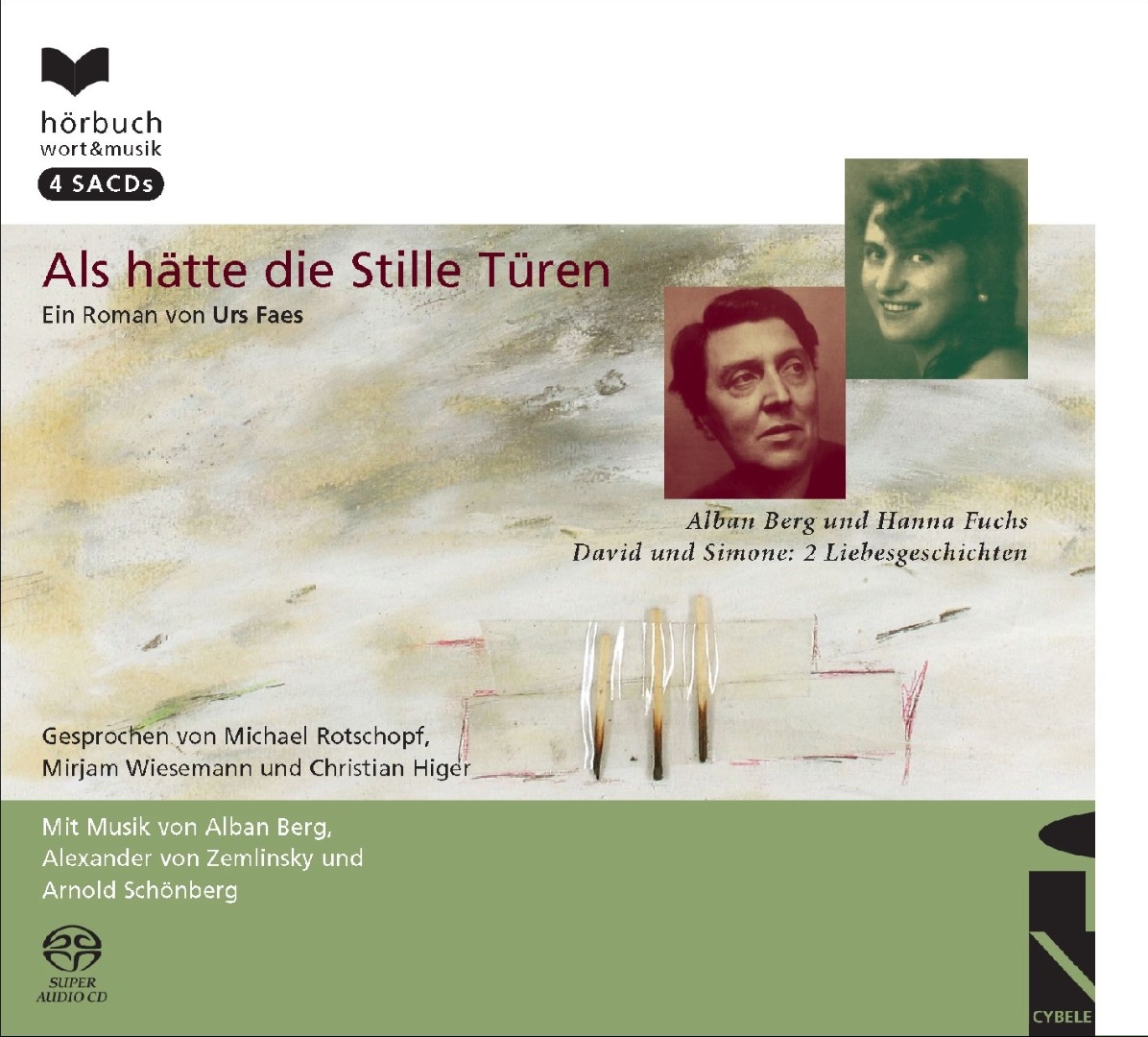
Cybele AB003 2006
5.0 surround DSD Stereo Classical music Word & language Classical modernism
Urs Faes: Als hätte die Stille Türen
Contributors
Michael RotschopfMirjam WiesemannChristian HigerDoelenKwartet
Composers
Alban Berg · Alexander von Zemlinsky · Arnold Schönberg
Streaming & download
Short description
Urs Faes: Als hätte die Stille Türen is devoted to Als hätte die Stille Türen – Kapitel 1, Als hätte die Stille Türen – Kapitel 2, Als hätte die Stille Türen – Kapitel 3, Als hätte die Stille Türen – Kapitel 4 und Als hätte die Stille Türen – Kapitel 5 by Berg, Alban & Schönberg, Arnold & Zemlinsky, Alexander von. Michael Rotschopf, Mirjam Wiesemann, Christian Higer, DoelenKwartet shapes the recording with clear contour, a feeling for tone colour and an eye for the inner dramaturgy of the programme. Ensemble shapes the album’s profile and makes the relations between form, gesture and space directly audible. A carefully produced Cybele edition that brings together repertoire, context and sonic presence.
Details
Alban Berg and Hanna Fuchs, David and Simone: two love stories
Novel (Suhrkamp-Verlag), unabridged on 4 SACDs
Music:
Alban Berg: Lyrische Suite for soprano and string quartet
Alexander von Zemlinsky: Maiblumen blühten überall op. 10 for soprano and string sextet
Arnold Schönberg: Verklärte Nacht op. 4 for string sextet
(Live recording of 14 September 2005, made during the Gergiev Festival Rotterdam)
Michael Rotschopf, Mirjam Wiesemann, Christian Higer (speaker)
Doelenkwartet: Frank de Groot (violin I) – Laurens van Vliet (violin II) – Karin Dolman (viola) – Hans Woudenberg (cello)
Hanneke de Wit (soprano) – Anne Huser (viola II) – Floris Mijnders (cello II)
Spoken-word direction: Vera Forester
Recording Producer, music direction: Ingo Schmidt-Lucas
ISBN: 978-3-937794-03-7
Booklet language: German (24 pages in a digipak)
Supported by the Kunststiftung NRW
Press reviews
Specifications
- Catalogue number
- Cybele AB003
- Year of release
- 2006
- Genre
- Classical music, Word & language
- Period
- Classical modernism
- Instrumentation
- Ensemble, Audiobook
- Label
- Cybele Records
- Barcode
- 809548011529
- Booklet (pages)
- 24