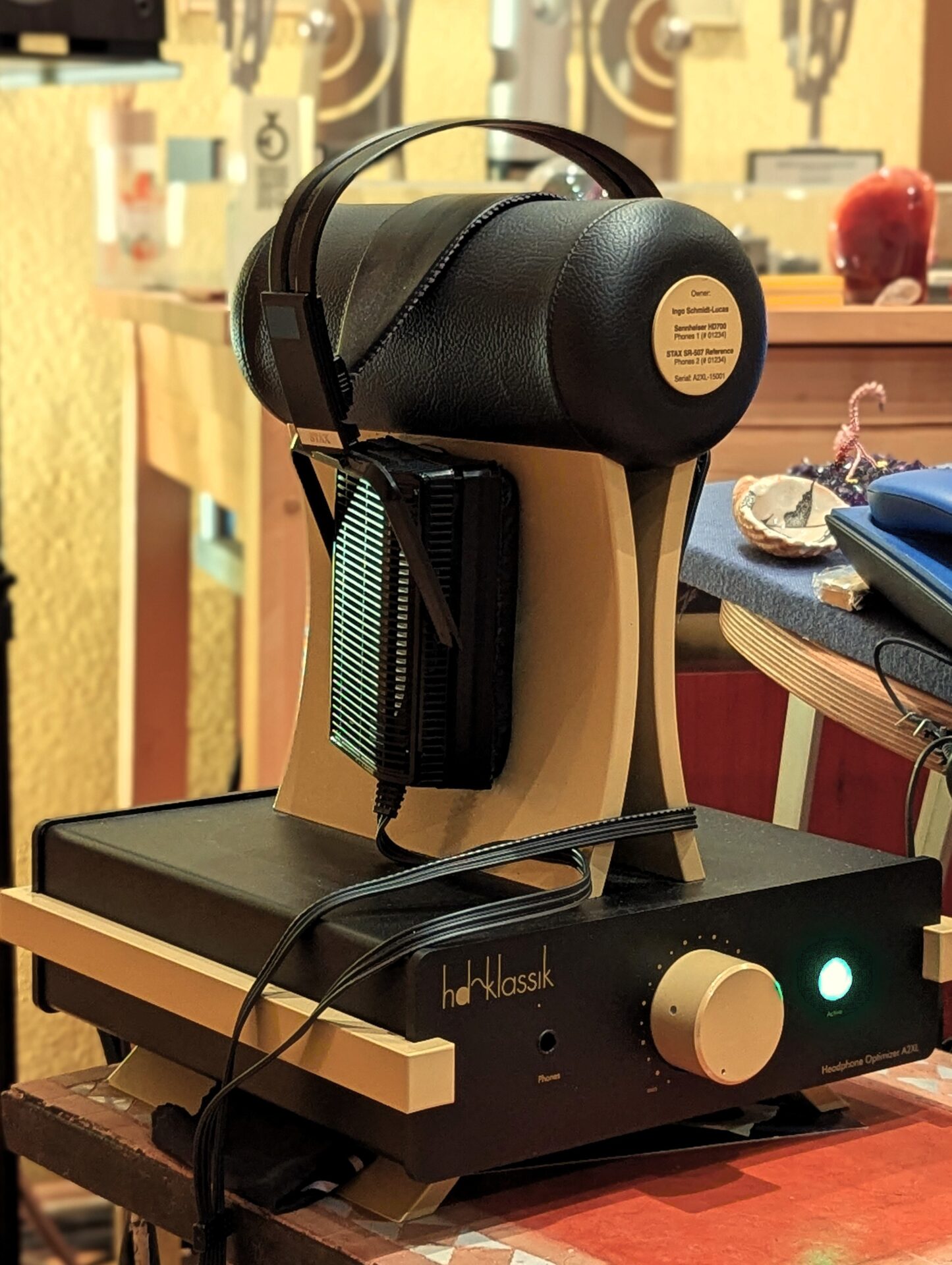
Headphone Optimizer Unit (HOU)
Analogue headphone amplifier with individual acoustic optimisation – for linear headphone reproduction
The hd-klassik Headphone Optimizer Unit (HOU) was developed in 2015 together with rd analog audio and presented at HIGH END in Munich. It has been part of the reference monitoring chain at Cybele Studio since 2015 – years before Dolby Atmos reached headphones via streaming services – for the sonic assessment of mixes and masters and for creating binaural 3D versions.
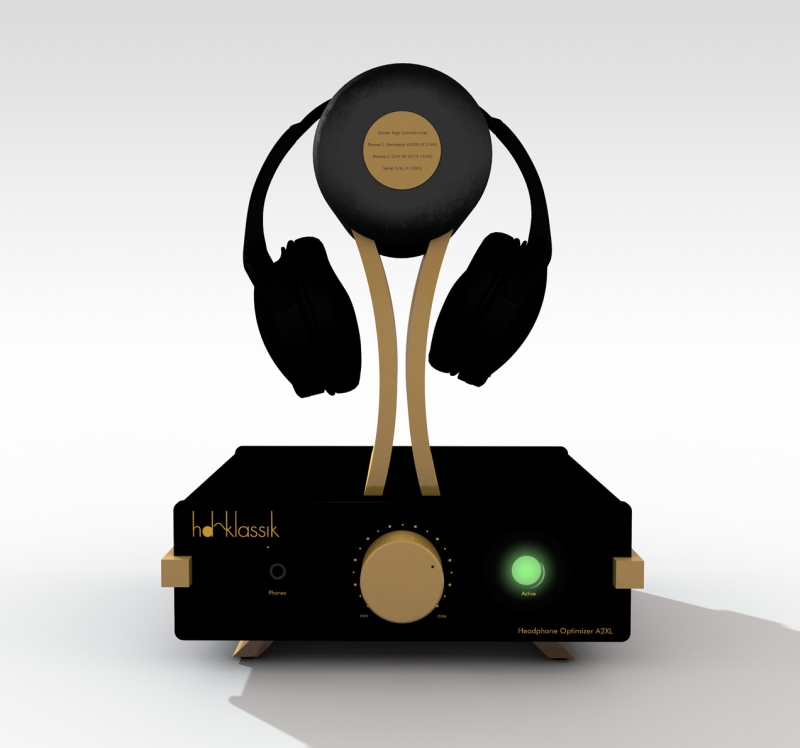
How it works
The HOU is an amplifier developed specifically for headphones. It individually compensates for the manufacturing tolerances and non-linearities of a specific pair of headphones: the headphones were measured precisely, so that headphones and HOU form one sonic unit.
The linearisation compensates for emphases and attenuations of the headphones in particular frequency ranges. The headphones therefore reproduce the recording closer to the original – which benefits recordings in 3D binaural stereo (dummy head) in particular, but also conventional stereo recordings.
The optimisation is entirely analogue – with no AD/DA conversion and no digital latency – and can be switched off at the push of a button at any time, allowing an immediate comparison between the familiar sound of the headphones and the linearised reference sound.
Awards


- German Design Award 2016 – Special Mention in the category “Excellent Product Design – Lifestyle & Fashion”
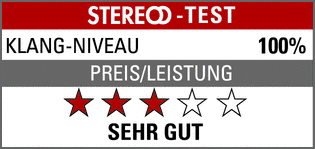
- STEREO 3/2016 – “Top Reference” with the highest sound rating (100 %) in the headphone amplifier category
- EAR-IN 1/2016 – “reference class”
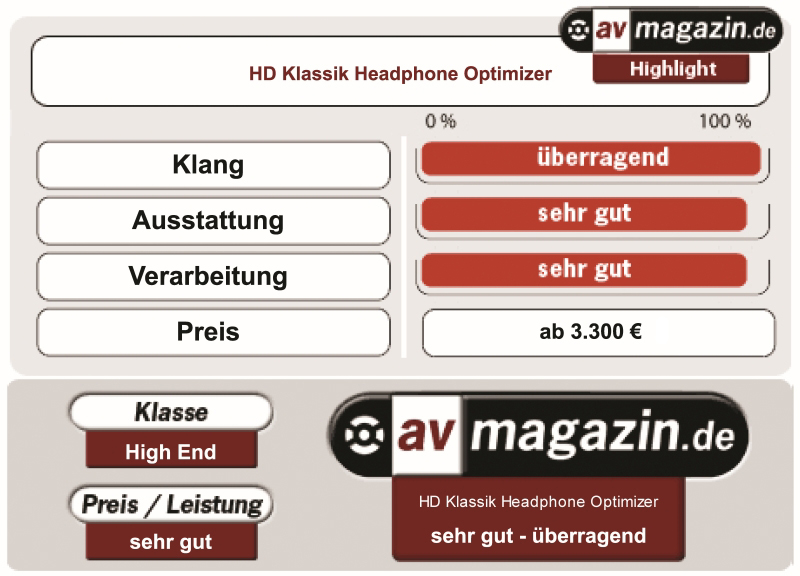
- AV-Magazin.de, September 2015 – “Highlight”
- Testberichte.de, September 2015 – “very good (1.0)”
Four versions
The HOU was built in four versions – each including the individual calibration of the headphones:
- HOU A1: one pair of headphones with a 6.35 mm jack plug
- HOU A1XL: one pair of headphones – either with a 6.35 mm jack plug or with its own driver amplifier (XLR connection, e.g. STAX)
- HOU A2: two pairs of headphones – alternating operation of two different headphones with 6.35 mm jack plugs
- HOU A2XL: two pairs of headphones – parallel operation of one pair with a 6.35 mm jack plug and one pair with its own driver amplifier (XLR connection, e.g. STAX)

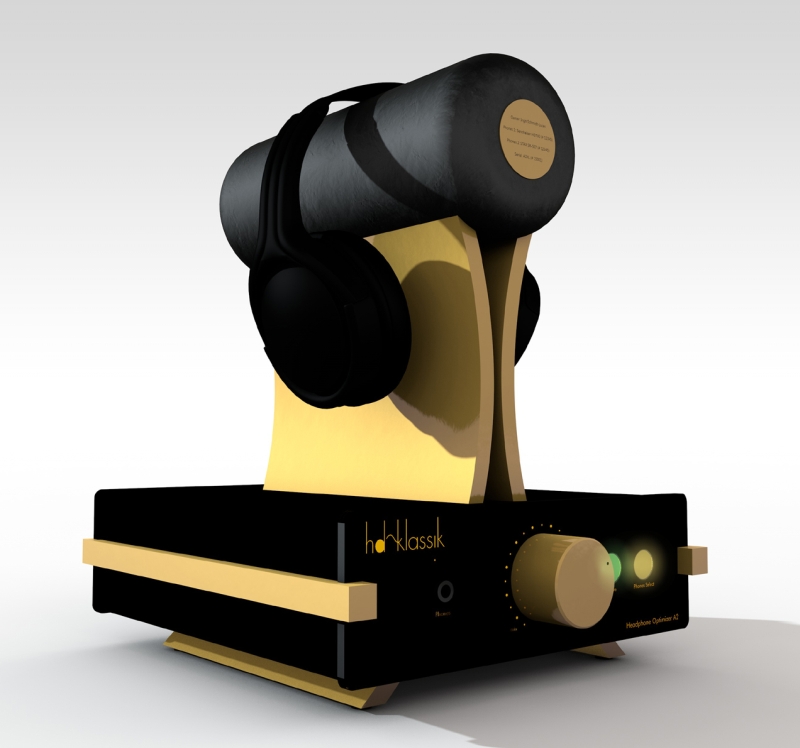
Special features
- Integrated, individually adjusted optimisation circuit in purely analogue technology – no AD/DA conversion, no digital latency
- Fine-stepped volume control via a relay-controlled Alps potentiometer, with channel tracking of < ±0.1 dB across the entire 100 dB control range
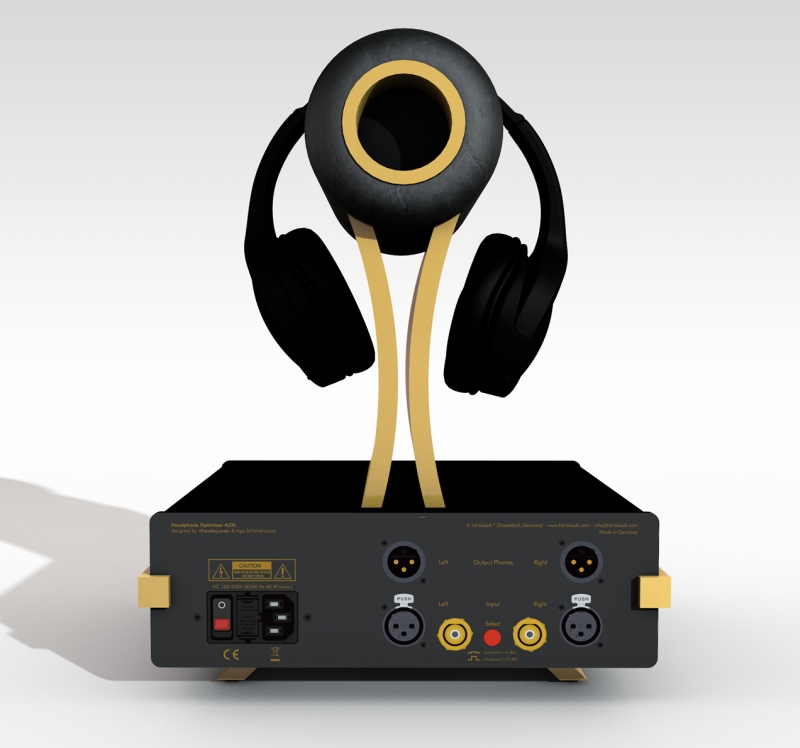
- Relay-controlled switching between balanced and unbalanced sources (XLR and RCA); balanced inputs and outputs via floating, galvanically isolating high-end transformers (Haufe/Lundahl)
- Integrated class A output stage for headphones connected to the 6.35 mm jack socket
- Owner’s plate naming the headphone model for which the HOU is calibrated
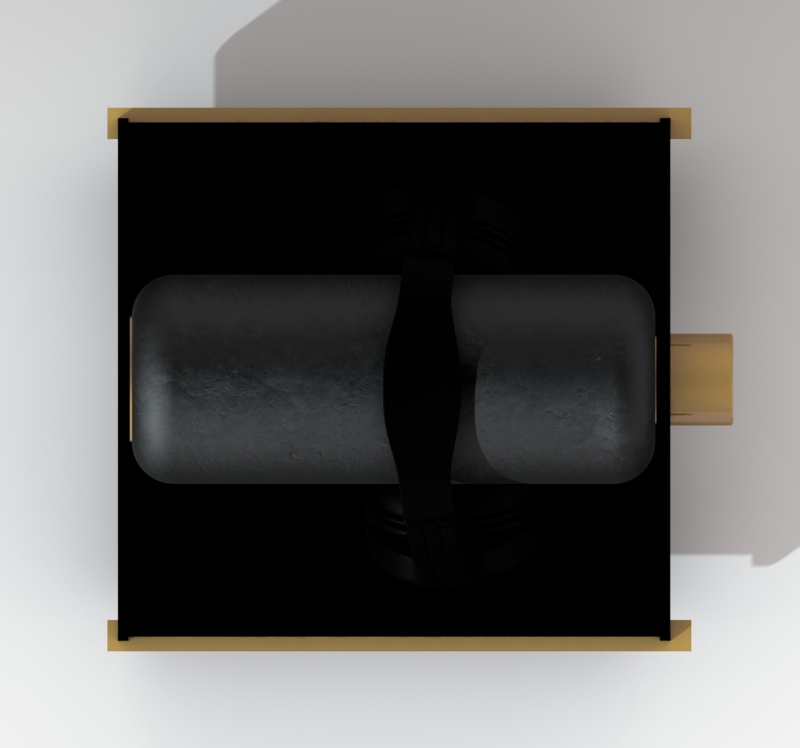
- Black-and-gold all-metal aluminium housing with headphone rest, made in Germany
- Integrated rest for two pairs of headphones; the cables can be stowed in the cavity of the leatherette rest at the back
- The unit came with a 60-page bilingual manual (German/English).
- On request, the HOU could be recalibrated when the customer changed headphones
Technical data
| Feature | Value |
|---|---|
| Frequency response (bypass) | 20 Hz – 100 kHz (+0.1 / −0.3 dB) |
| Distortion (THD+N, bypass) | < 0.01 % (bandwidth 10 Hz – 80 kHz, output voltage 3.5 V, load 32 Ω) |
| Crosstalk attenuation (bypass) | > 94 dB (20 Hz – 20 kHz, maximum gain) |
| Volume control | relays, 100 dB control range, channel tracking < ±0.1 dB |
| Signal-to-noise ratio (bypass) | > 104 dB / 107 dBA (maximum gain) |
| Signal-to-noise ratio (optimisation active) | > 96 dB (all EQ bands at zero) |
| RCA inputs | max. input level +14 dBu, impedance 9 kΩ |
| XLR inputs | balanced, floating Haufe transformer (galvanically isolated), max. input level +26 dBu, impedance 9 kΩ |
| Headphone output | 6.35 mm jack, class A output stage, load impedance min. 32 Ω |
| XLR outputs (A1XL, A2XL) | balanced, floating Lundahl transformer (galvanically isolated), load impedance min. 40 Ω |
| Power supply | AC 100 – 240 V, 50 – 60 Hz, power consumption max. 50 W |
| Dimensions (L × W × H) | approx. 300 × 280 × 370 mm |
| Weight | approx. 8 kg |
Individual calibration
Every pair of headphones was measured and linearised by hd-klassik individually and channel by channel. Customers sent in their headphones – after at least 20 hours of use – and received them back together with the fully adjusted HOU as one sonic unit. A personalised owner’s plate names the headphone model the unit is tuned to.
Why individual linearisation?
All commercially available headphones known to us exhibit non-linearities or tolerances across the entire audible frequency range between 20 Hz and 20 kHz. In some cases there are also level differences between the left and right channel of the same pair of headphones, which may vary in degree from one frequency to another.
The two unsmoothed frequency response measurements below show two high-quality, commercially available headphones of the same model (price range €200 – 300) without optimisation; the left and right channels are shown in different colours. The x-axis shows frequencies between 10 Hz and 20 kHz, the y-axis the measured levels – one division corresponds to 5 dB, i.e. almost a doubling or halving of loudness.
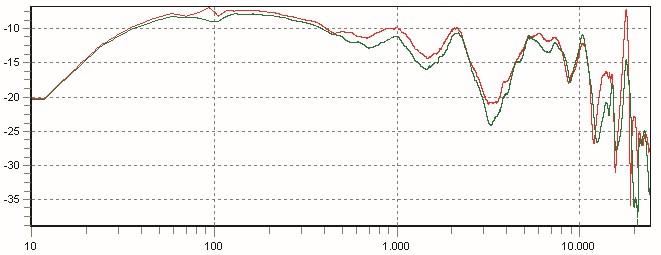
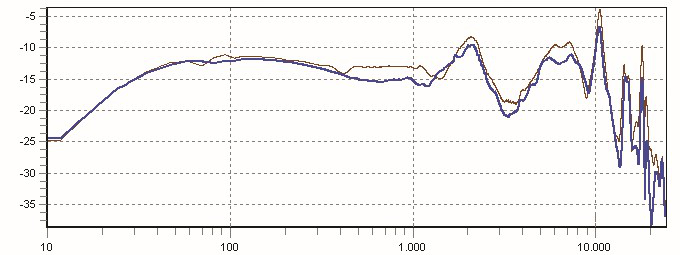
To compensate for these non-linearities, every pair of headphones was measured and linearised individually and channel by channel. Extensive listening tests with people from a variety of professions, aged between 16 and 76, repeatedly confirmed these benefits:
- Reproduction comes closer to the original sound of the recording.
- Listening fatigue is reduced. One possible explanation: the brain is relieved of correcting the sound colourations.
- The localisation of the instruments in a recording becomes better and more stable.
- The stereo image is perceived as wider; the unwanted “in-head localisation” is reduced.
Voices from the listening tests
“I don’t have the impression of wearing headphones at all – I feel the sound surrounding my head, almost like a surround experience. You are right in the middle of the music.”
Thomas Küpper, organ builder & voicer, Leun
“Linearised: pleasantly relaxed. Not linearised: constricted listening, as if through a funnel placed in front of the ears. The linearisation puts the spatial relationships right.”
Stephan Rieckhoff, principal cellist of the Orchestre de la Suisse Romande, Geneva
“The listening experience is impressive: great transparency of the structures and fascinating spatial depth.”
Lutz-Werner Hesse, composer & director of the Cologne University of Music, Wuppertal campus
“Quite apart from a better localisation of the instruments – which is there too – the amplifier brings a substantially richer sound; the volume of the room becomes tangible and audible. The sound detaches itself from the head, so to speak (the problem of conventional headphone listening).”
Rainer Kahleyss, classical music producer, owner of the labels Musicaphon & Cantate and of the company Klangfarben, Kassel
“The typical problem of headphone-based mixes – poor depth staging – was not confirmed on first listening! On this system I would certainly trust myself to judge depth staging neutrally.”
Till Schaarschmidt, School of Audio Engineering (SAE) – head of the audio department, Cologne
“The orchestral sound is less mushy and muddy; the individual instrumental groups sound more transparent.”
Elke Wisse, Dipl.-Ing. audio and video engineering & editor of ‘VDT Magazin’, Düsseldorf
“One has the impression of a more natural spatiality – almost like the difference between mono and stereo.”
Roland Knoke, pianist & school music teacher, Marburg
In use at Cybele Studio
At Cybele Studio the HOU is still part of the reference monitoring chain: the electrostatic STAX SR-L700 and SR-L500 “Earspeakers” are driven by the STAX SRM-727II driver amplifier and individually linearised in the analogue domain by the HOU.
This provides fully linear headphone reproduction for the sonic assessment of mixes and masters – and likewise for creating binaural 3D versions, i.e. the rendered binaural versions of Dolby Atmos and Auro-3D productions, where spatial positioning, depth staging and tonal balance have to be controlled precisely.