
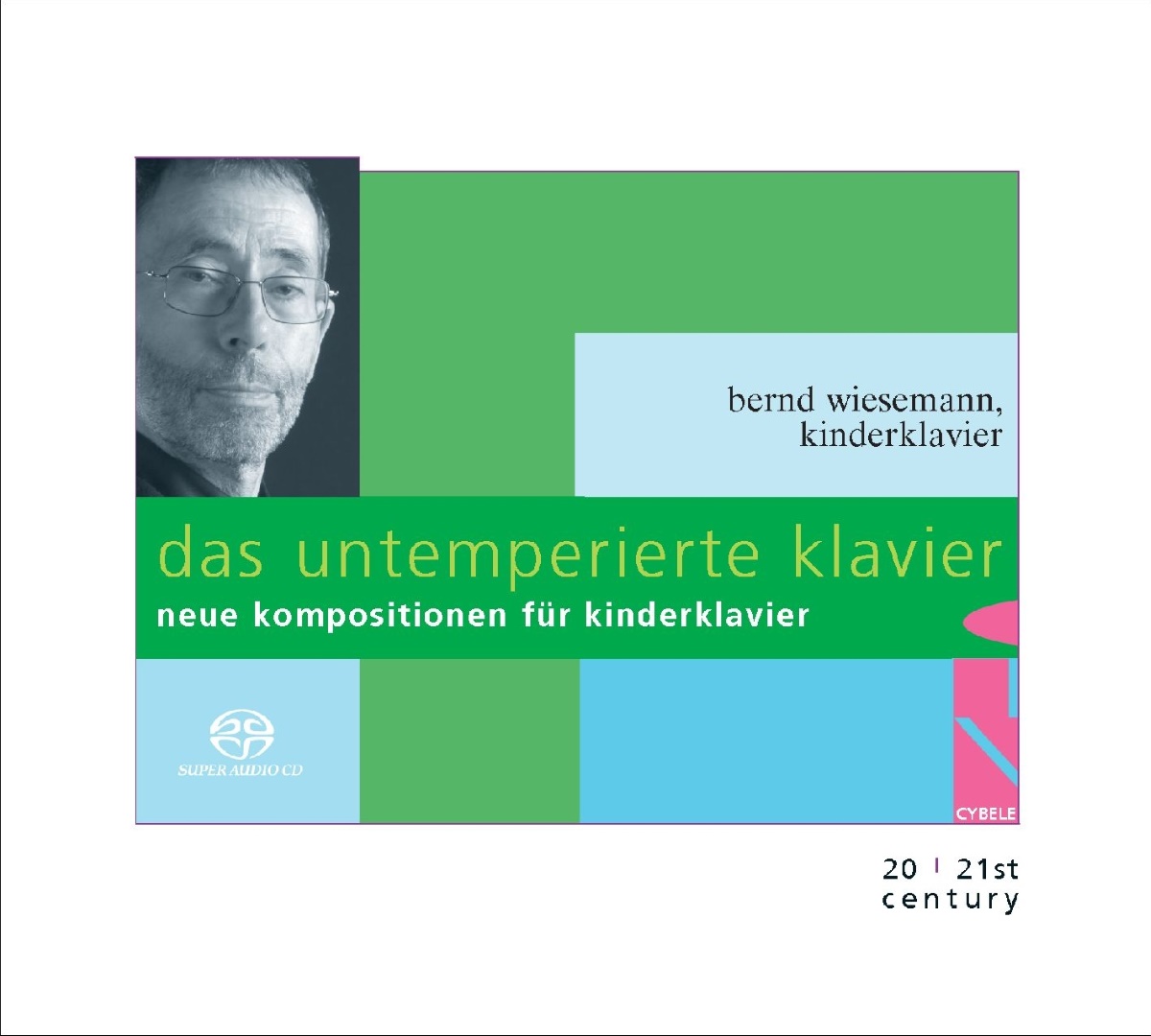
It began with rejection. John Cage fascinated him for many years, Bernd Wiesemann writes in the booklet, but before the fascination came irritation, and before irritation complete denial; he felt the same about Yves Klein and the dada and happening artists. In the mid-1960s he met the painter, goldsmith and poet Will Ameln, who set out to write a poem for every day of the year 1968; through him came the first encounters with Duchamp and Satie, and from there it was a short step to Cage.
In the mid-1970s some of his pupils founded a music theatre group in the spirit of Cage and Kagel and hired their teacher to play at parents’ evenings; he played Water Music, 4’33’’ and WAITING, and in those years first heard of Cage’s Suite for Toy Piano. For an action from Kagel’s Repertoire a chromatic toy piano was needed, which a member of the group finally found in a Munich shop for precious toys. That is where Wiesemann’s history with the instrument begins.
He wrote short pieces for it himself, which in turn prompted other composers to write their own, added Cage’s Suite to his repertoire and appeared with a forty-five-minute programme in libraries and bars, adult education centres and exhibitions — his way of bringing the toy piano and new music to people. In 1993 the composition student Andreas Kunstein and the then student of sound and image engineering Ingo Schmidt-Lucas took notice of him and his instrument and initiated a first CD of new music for toy piano.
This album continues the series. It gathers Läuten für den Zarewitsch by Oskar Gottlieb Blarr, mm³ for three toy pianos by Oscar van Dillen, PA-CA-TO by Michael Denhoff, the Drei Brombeeren by Kai Yves Linden, the Nocturne by Karl-Heinz Zarius, bitS & pieceS by Norbert Laufer, the Piece for Toy Piano by Heinz-Dieter Willke, Zuckerregen by Yasuko Yamaguchi, Wiesemann’s own Bauhaus Suite with five portraits on the names of Gunta Stölzl, Gertrud Arndt, Kitty Fischer, Monica Bella-Broner and Margarete Reichardt together with a tango for five Bauhaus artists, and finally trimer for toy piano and tape by Christian Banasik.
In the booklet the composers explain their pieces. Oskar Gottlieb Blarr wrote Läuten für den Zarewitsch after a journey to Russia on which the revived art of bell-ringing impressed him, as an epitaph for the Tsarevich Dmitry, murdered in 1591 at the age of nine. Oscar van Dillen uses in mm³ the three slightly differently tuned instruments and their audible mechanism, and Michael Denhoff’s PA-CA-TO combines passacaglia, canon and toccata: a sequence of notes alternating between white and black keys grows from one voice to eight.
The hybrid SACD runs to 68:53 in stereo and 5.1 surround; the booklet has 32 pages in German and English. The recording was made from 9 to 13 September 2003 in the Protestant church on Gräfrather Straße in Wuppertal.