
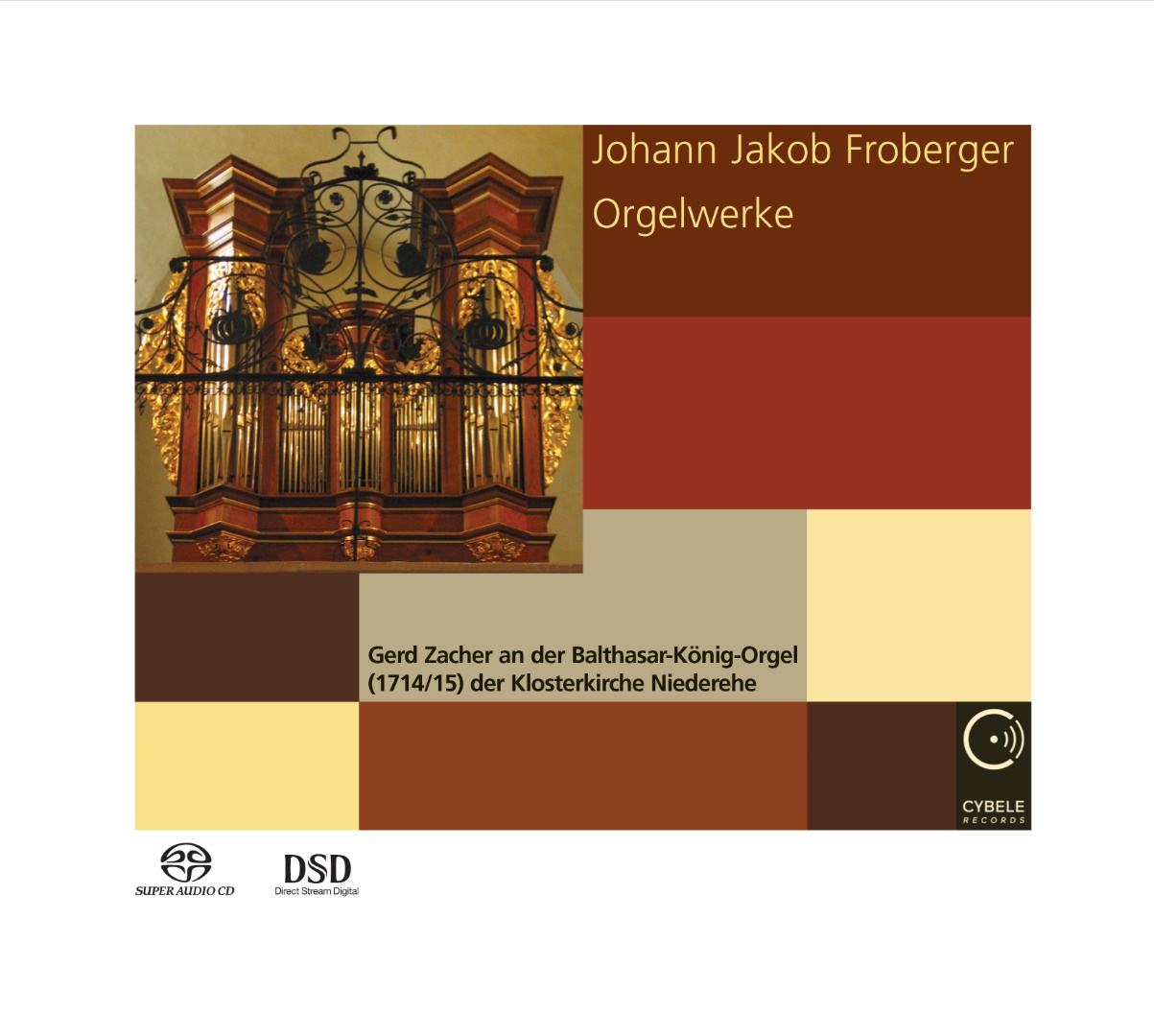
Johann Jakob Froberger: Orgelwerke places Johann Jakob Frobergers Toccaten, Fantasien, Capricci, Partiten, Lamenti und Ricercare at the centre. The programme follows no mere succession of separate titles but develops an arc of its own: formal proportion, sonic gesture and the transformation of movement into repose can be experienced as a continuous narrative. Gerd Zacher opens up this music with a reading that makes detail audible without losing sight of the larger whole.
Froberger, Johann Jakob is the compositional point of reference for this edition. Set against the horizon of Baroque music, it becomes clear how many shapes the language of sound, compositional technique and expression can take together. At a historical Balthasar König organ, Gerd Zacher meets the variety of Froberger’s language with alert freedom and a feeling for the speaking quality of every line. The selection leads not into a museum-like retrospective but into a living present of listening: structures become intelligible, the particularities of the works take on profile, and familiar as well as unexpected turns gain weight.
The scoring — Solo instrument, organ music, historical organ — decisively shapes the character of the album. Registration, resonance, breath, touch and silence are treated as musical forces. Where lines overlap, rhythmic impulses gather or tone colours merge into one another, the layout remains transparent. It is precisely this that creates the fine relations which open up further on repeated listening.
Gerd Zacher joins technical command to a clear, unforced musicianship. The playing follows the individual character of the works while maintaining an overarching dramaturgy: fragile moments lose none of their tension, virtuoso passages stay articulate, and strong contrasts are not put on display but developed out of the musical material itself. This gives the edition concentration and a convincing inner calm.
The recording carries this concept with particular attention to dynamics, space and tone colour. CD with a total playing time of 62:10 keeps the sense of closeness to the performance while making spatial dimensions intelligible. Individual voices and layers of sound stand out in relief; reverberation and silence become part of the musical architecture. The production thus joins documentary…