
Little is known about the life of Juan Bautista Cabanilles. He was baptised on 6 September 1644 in Algemesi near Valencia; his date of birth has not come down to us. After attending the seminary in Valencia, he was appointed second organist of the cathedral by the chapter in 1665 without having to prove himself against other candidates in examinations, as was otherwise customary in Spain. Soon afterwards he became sole cathedral organist; he was ordained priest in 1668 and from 1675 to 1677 was also responsible for the choirboys. Cabanilles died on 29 April 1712. Of the roughly 800 works he is said to have written, about a third are known today.
At the heart of his organ music are the tientos, in which he continued the Iberian tradition of Antonio de Cabezon, Correa de Arauxo and Rodrigues Coelho. The name derives from the Spanish verb “tentar”: to touch, to feel one’s way, to try out. A tiento is usually written in three to five parts and built largely contrapuntally on one or more themes; in its free design it resembles the fantasia and admits sharp dissonances, striking leaps and unusual harmonic progressions.
The first book brings together nine such pieces. Between two tientos llenos for the full plenum of the organ in the fifth and sixth tones stand five tientos in the first tone, together with one each in the third and fifth tones. Three pieces use the divided keyboard of the Spanish organ, whose bass and treble halves are registered separately: in the Tiento Partido de Dos Bajos de 1° tono two solo voices stand out in the left hand, in the Tiento 5° tono de Dos Tiples two in the right, and in the Tiento 1° tono Partido de Mano Derecha Sobre el Imno Ave Maris Stella the solo voice lies in the right hand.
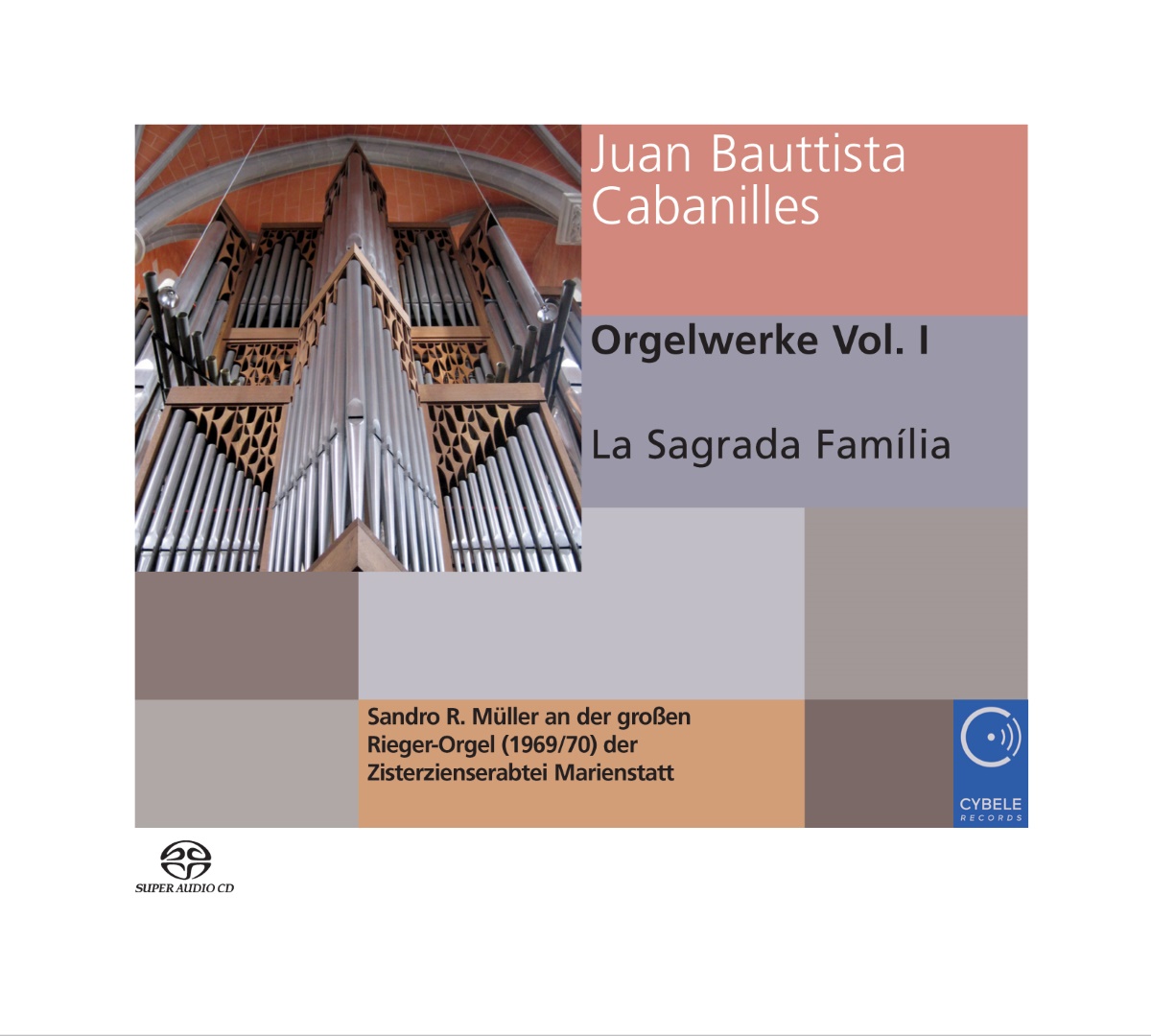
Sandro R. Müller selected and arranged the pieces of all four books himself. As Cabanilles’ scores give hardly any indications of tone colour or articulation, he derived the registration from the imagery of Spanish art of the 16th to 18th centuries and placed each book under one of the four symbolic figures of the Evangelists. The instrument is the great Rieger organ (1969/70) of the Cistercian abbey of Marienstatt in the Westerwald, whose historic Spanish trompeteria contains pipes dating from 1732.
According to the booklet, the trompeteria of Marienstatt is the only historic Spanish one of its kind outside the Iberian peninsula. Müller assigned a text to every piece of the cycle, most of them biblical. All four books were recorded in the same sessions: on 10 and 11 July and on 13 and 14 November 1995, produced by Ingo Schmidt-Lucas. The first book runs to 73:43.