
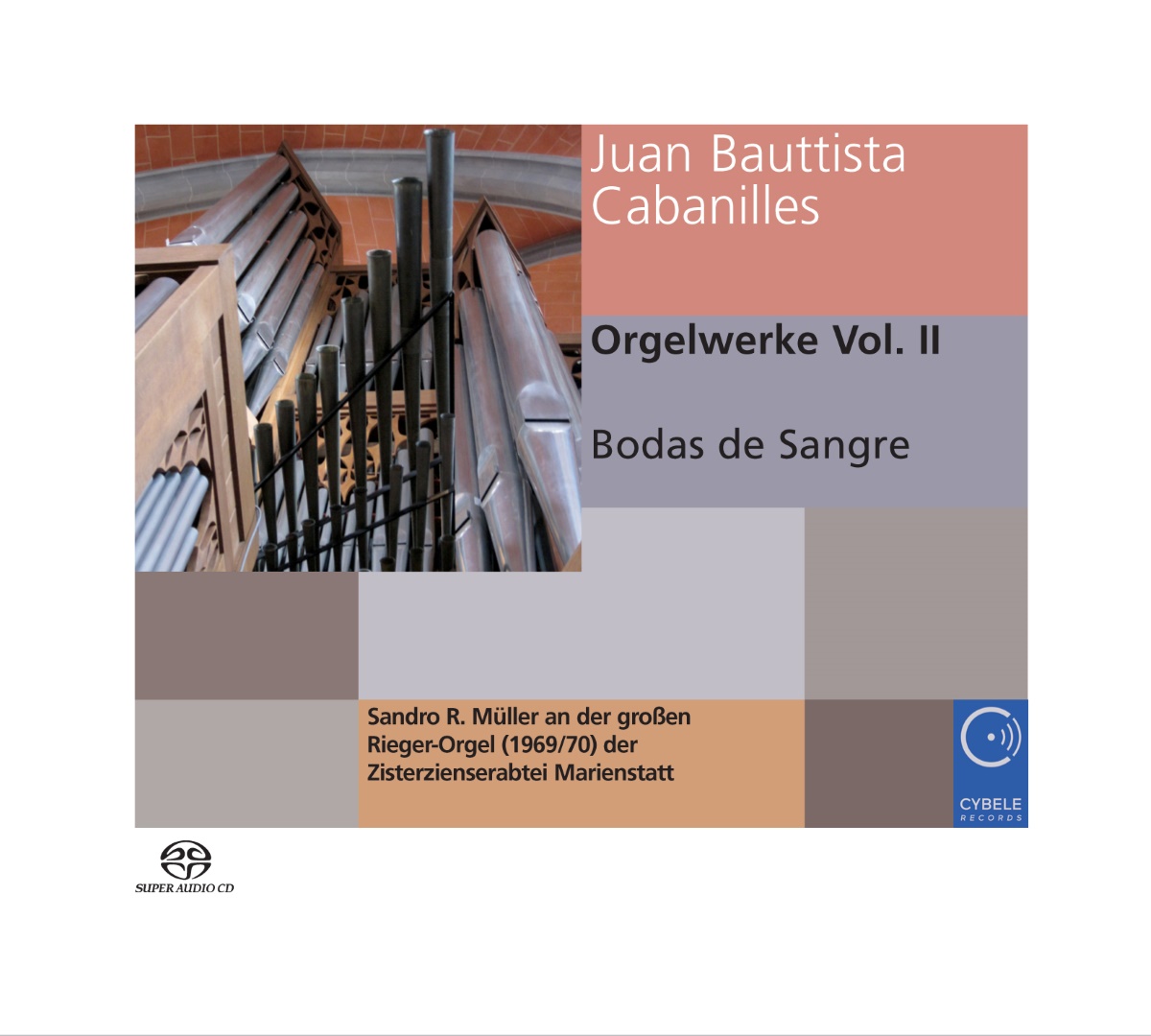
Alongside the tientos, the core of his organ music, Juan Bautista Cabanilles, organist of Valencia Cathedral from 1665, also wrote freer and dance-like pieces. The second book of Sandro R. Müller’s four-part cycle places them at the centre: of eleven pieces only two are tientos – the Tiento lleno 7° tono for the full plenum and the Tiento 6° tono Partido de Mano Izquierda, whose solo voice lies in the left hand, that is, in the bass half of the divided keyboard.
Three tocatas, two of them in the fifth tone, structure the programme; one of them opens it. The Pasacalles de 3° tono are variations on a recurring bass pattern, the Gallardas de 3° tono variations on the gallarda dance; at just over thirteen minutes they are the longest piece on the album. The name of the Gaitilla refers to the gaita, the bagpipe. There are also two short pieces entitled Paseos, one of them designated “Paseos de Cavanillas”, and the “Pedazo de Musica 5° tono”, lasting little more than a minute.
Müller conceived the four books as a cycle intended to reflect the theological cosmos of Spanish Catholicism; each stands under one of the four symbolic figures of the Evangelists. He derived the registration, for which Cabanilles himself left hardly any indications, from the religious imagery of Spanish art. The recording was made on the great Rieger organ (1969/70) of the Cistercian abbey of Marienstatt in the Westerwald with its historic Spanish trompeteria.
Little has come down to us about Cabanilles’s life. He was baptised on 6 September 1644 in Algemesi near Valencia; no date of birth is known. After the seminary in Valencia the cathedral chapter appointed him second organist in 1665 — without the examination against rival candidates that was otherwise usual in Spain. Soon afterwards he was sole cathedral organist; in 1668 he was ordained priest, and from 1675 to 1677 he also took charge of the choirboys. He died on 29 April 1712. Of the roughly 800 works he is said to have written, about a third are known today.
The seventeenth-century Spanish organ he wrote for has a divided keyboard: the bass and treble halves can be registered separately, so that a solo voice can step out of the texture — on this album in the Tiento 6° tono Partido de Mano Izquierda. According to the booklet, the trompeteria of Marienstatt is the only historic Spanish one outside the Iberian peninsula; its pipes date from 1732. The recording was made on 10 and 11 July and on 13 and 14 November 1995; the second book runs to 61:35.