
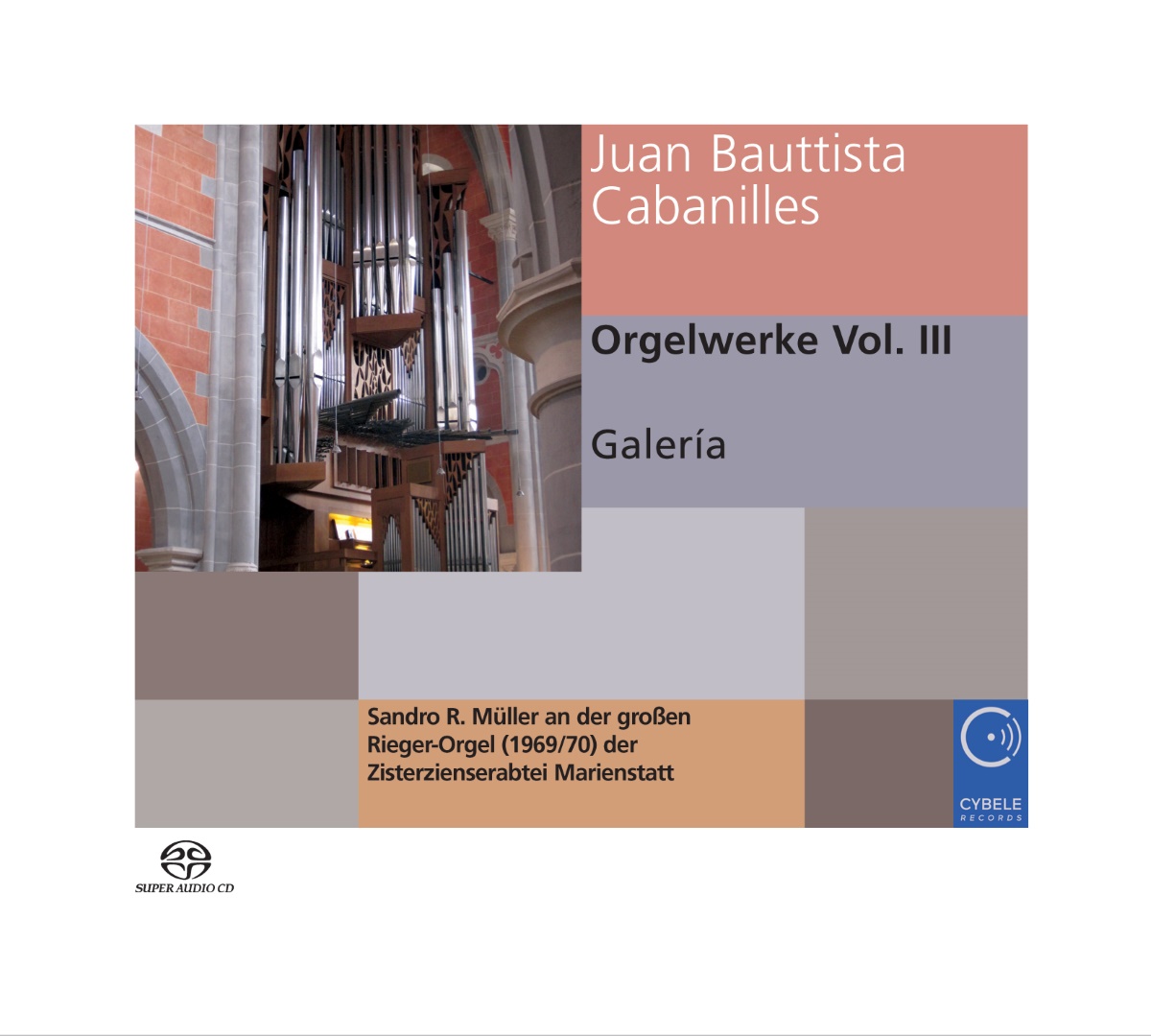
The batalla is the battle piece of Spanish organ music: with fanfare-like signals and repeated notes it imitates a combat. Sandro R. Müller places the Tiento de Batalla 5° tono Punto Baxo by the Valencian cathedral organist Juan Bautista Cabanilles (1644–1712) at the beginning of the third book of his four-part cycle.
Dance variations and tientos then alternate: two pasacalles in the fourth and first tones, gallardas in the eighth tone, two tientos de falsas in the eighth and second tones – their name refers to the accumulated dissonances, the “falsas” – and two tientos for divided keyboard, in which the solo voice lies once in the right hand and once in the left. The close is the Tiento de 8° tono, lleno, at 14:36 minutes the longest piece on the album. The additions “Punto Baxo” and “punto alto”, which two of the pieces carry in their titles, denote in Iberian organ practice the lower and the higher transposition of a tone respectively.
Müller compiled the cycle himself and gave each of the four books one of the four symbolic figures of the Evangelists as a motto. Because Cabanilles’ works have come down to us almost without indications of registration and articulation, he transferred the religious and mystical imagery of Spanish art of the 16th to 18th centuries to the tone colours of the organ. Together with the producer Ingo Schmidt-Lucas he chose the great Rieger organ (1969/70) of the Cistercian abbey of Marienstatt in the Westerwald; it has a historic Spanish trompeteria with pipes dating from 1732. The nine pieces of this book stand in seven different tones.
Cabanilles, baptised on 6 September 1644 in Algemesi near Valencia, became second and soon sole organist of Valencia Cathedral in 1665 and remained so until his death on 29 April 1712; he was ordained priest in 1668. Of the roughly 800 works attributed to him, about a third are known today. The tiento, which he took over from Antonio de Cabezon, Correa de Arauxo and Rodrigues Coelho, remains the principal genre in this book too: in three to five voices, built contrapuntally on one or more subjects, and as free in layout as a fantasia.
According to the booklet, the trompeteria of the Marienstatt Rieger organ is the only historic Spanish one outside the Iberian peninsula; its pipes date from 1732. It gives the opening batalla piece its tone. Müller assigned a text to every piece of the cycle, most of them biblical. The recording was made on 10 and 11 July and on 13 and 14 November 1995; the third book runs to 71:26.