
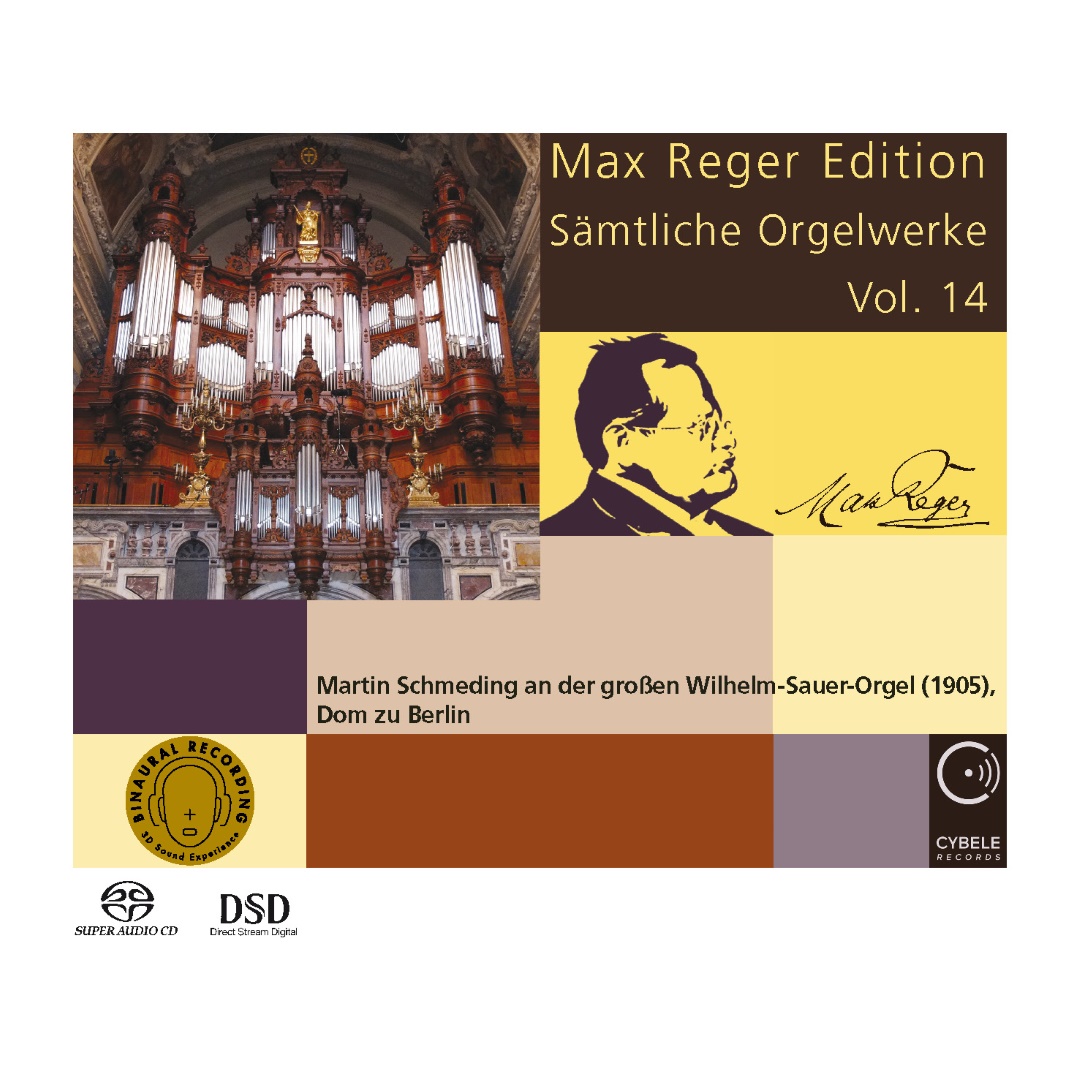
Around 1900 Max Reger led German organ music into a new dimension. His works join the contrapuntal tradition of Johann Sebastian Bach to late-Romantic harmony and to the orchestral possibilities of the great pneumatic instruments. Even in the densest chromaticism, motivic work, voice leading and formal proportion remain the load-bearing forces.
Vol. 14 of the complete edition is devoted to the Sonate fis-Moll op. 33 and the Monologe op. 63, Hefte 1 und 2. The Sonate op. 33 leads from fantasy and intermezzo into a great passacaglia. The first eight Monologe answer with Präludium, Fuge, Canzone, Capriccio, Introduction, a second Passacaglia, Ave Maria and Fantasie.
Martin Schmeding lays bare the complex web of voices without losing the music’s long breath. Chorale-bound sections take on the contour of speech, free forms gain dramatic direction, and even massive climaxes remain clearly articulated. His interpretation joins analytical precision to the physical energy that Reger’s music unfolds in a church.
One basic idea of the edition is to assign the groups of works, on historical and sonic grounds, to instruments from Reger’s own era. His dynamic markings and changes of registration can thus be understood as parts of the composition. Fernwerk, swell division, foundation-toned combinations and powerful reeds shape transitions, contrasts and climaxes. The choice of organ therefore offers no nostalgic backdrop but direct access to Reger’s musical thinking.
The Wilhelm-Sauer-Orgel (1905), Berliner Dom is a historically telling partner in this. Foundation-toned stops, characteristic reeds and finely graded dynamic transitions show how closely Reger’s compositional technique is bound up with the German organ building of his time. Crescendo, distant effect and the ability to blend become components of the form rather than effects added afterwards.
The production opens up this relationship in classic stereo, in 5.1 surround and in a purist 3D binaural recording for headphones. Both the architecture of the music and the spatial layering of the instrument thus become tangible. Vol. 14 is a portrait in works in its own right and at the same time part of the seventeen-volume survey.