
Around 1900 Max Reger gave German organ music a new scale. His works join the contrapuntal tradition of Johann Sebastian Bach to the harmonic tension of late Romanticism and to the orchestral possibilities of the great pneumatic, late-Romantic instruments. Even in the densest chromaticism, form, voice leading and motivic development remain the load-bearing forces.
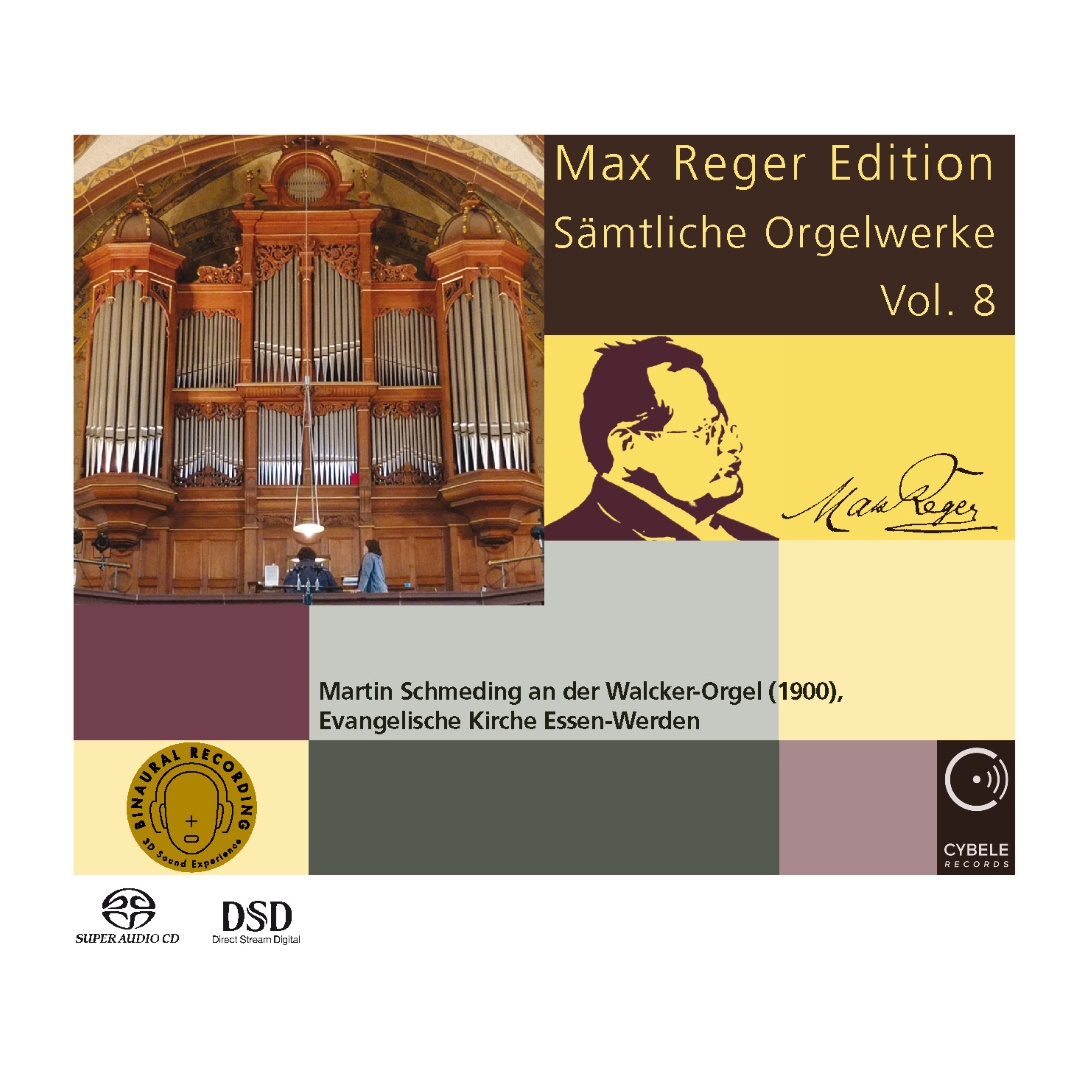
Vol. 8 of the complete edition is devoted to Choralvorspiele op. 67 Heft 3, Suite g-Moll op. 92 and Variationen und Fuge über „Heil, unserm König Heil!“ WoO IV/7. The last seventeen chorale preludes of op. 67 are combined with the seven-movement Suite in G minor and a set of variations. Miniature, suite and grand festive form show three scales of Reger’s formal thinking on one and the same historical instrument.
Martin Schmeding lays bare the complex web of voices without losing the music’s long breath. Chorale-bound sections take on the contour of speech, free forms gain dramatic direction, and even massive climaxes remain articulated. His interpretation joins analytical precision to the physical energy that Reger’s music unfolds in a church.
One basic idea of the edition is to pair each block of repertoire with an instrument that comes as close as possible to the music in date, tonal ideal and performance practice. Dynamic markings and changes of registration can thus be not only realised technically but understood as historically plausible. Crescendo, distant effect, the blending of foundation stops and the power of the reeds become components of the form, making clear why Reger conceived his organ works so closely out of the sound of the instruments of his era.
The Walcker organ (1900) of the Evangelische Kirche Essen-Werden is a historically telling partner in this. Foundation-toned stops, characteristic reeds and finely graded dynamic transitions show how closely Reger’s compositional technique is bound up with the German organ building of his time. The instrument functions not as a neutral sound source but as a sounding document of the very aesthetic world from which the compositions arose.
The Cybele production offers three listening perspectives: classic stereo, 5.1 surround and a purist 3D binaural recording for headphones. Both the architecture of the music and the spatial layering of the instrument thus become intelligible. Vol. 8 forms a portrait in works in its own right and at the same time one building block of the seventeen-volume edition of Reger’s complete organ works.