
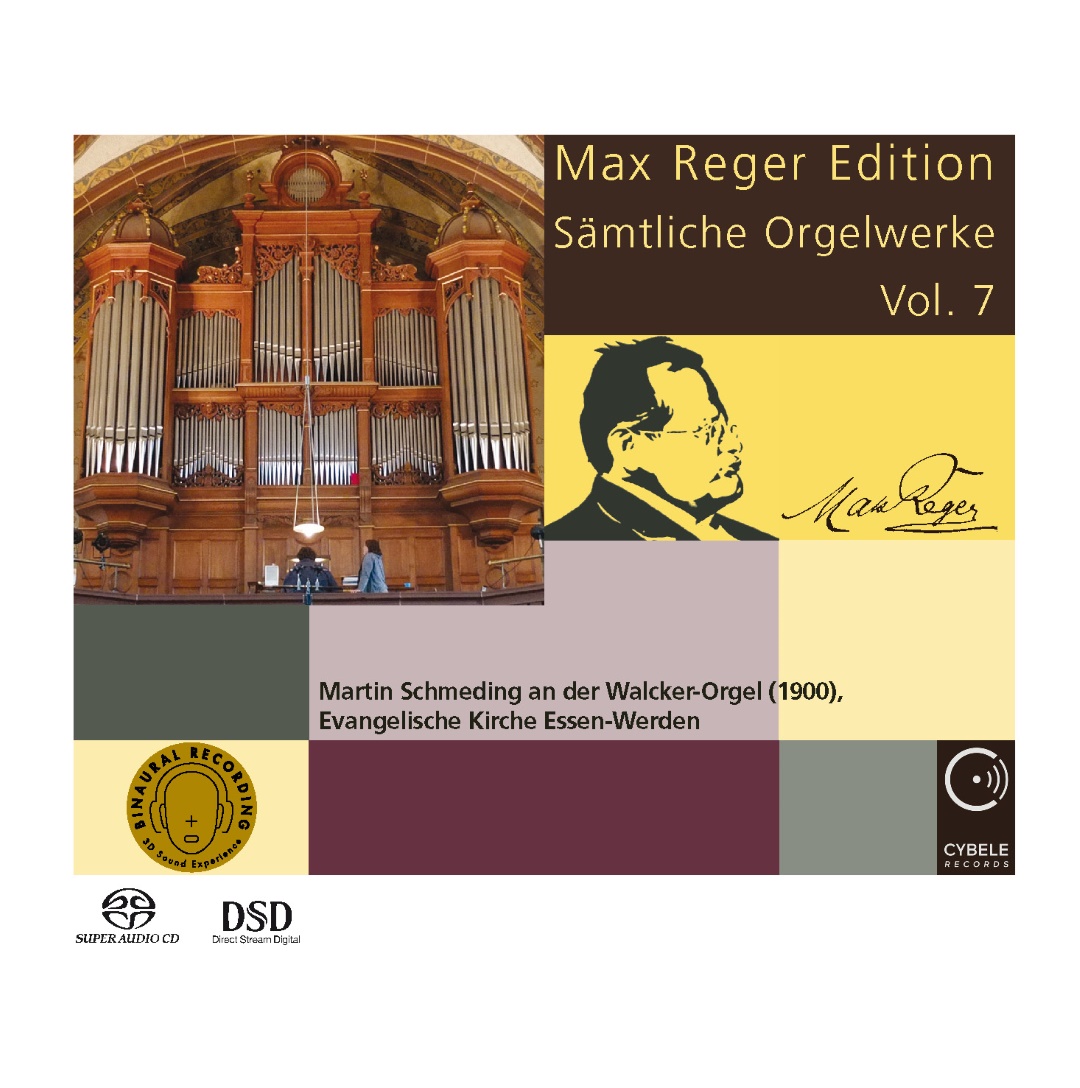
A chorale melody may emerge from preparatory voices, sound richly ornamented, or appear in staggered canonic entries. Vol. 7 of the Max Reger Edition is devoted to these different ways of joining melody and polyphony. The 15 chorale preludes of the first book of op. 67 are followed by the Vier Präludien und Fugen op. 85 and the Postludium in d-Moll WoO IV/12. Martin Schmeding plays the Walcker organ of 1900 in the Evangelische Kirche Essen-Werden.
The chorale preludes take their cue from models in Bach’s Orgelbüchlein and his Leipzig Chorales. In Allein Gott in der Höh’ sei Ehr!, Aus meines Herzens Grunde and Herzlich thut mich verlangen, imitative voices prepare the entry of the melody with motifs drawn from the respective chorale line. Christus, der ist mein Leben shapes the upper voice with expressive ornamentation above a harmonically animated texture in the lower parts. Herr Jesu Christ, dich zu uns wend treats the chorale melody in canon. Each of the familiar hymns thus receives a shape of its own in texture and in sound.
Aus tiefer Not schrei ich zu dir, Ein’ feste Burg ist unser Gott and Freu’ dich sehr, o meine Seele also belong to this first book, which ends with Jauchz, Erd, und Himmel, juble! Intended for use in worship, the pieces nevertheless call for careful leading of the individual voices. Calling them easily playable preludes describes a lower technical threshold than that of the great chorale fantasies; even in these shorter forms the workmanship remains demanding.
The Vier Präludien und Fugen op. 85 of 1904 shift the emphasis towards free contrapuntal writing. The pairs stand in C sharp minor, G major, F major and E minor. Their characters differ markedly: the chromatically coloured first fugue is followed by a scherzo-like second with finely divided articulation. The third and fourth fugues take their bearings from an evenly conducted polyphony after older models. The preludes too range from the expressive Romantic character piece to the pastoral miniature. The sequence unfolds a spectrum in which strict part-writing can take on very different kinds of movement.
The short Postludium in d-Moll of 1904 closes the programme with a form more concentrated still. An introduction of broken chords is followed by a fugato which, towards the end, takes up the motifs of the opening again. This return creates a self-contained course within a few minutes.
The Essen Walcker organ has a specification in the style of German late Romanticism. Among its individual colours the two free reeds Clarinette and Cor anglais stand out, placed on the second and third manuals. They are available both for solo lines and for combinations with other stops. The DSD production documents the instrument in stereo and 5.1 surround as well as in a 3D binaural version for headphones.