
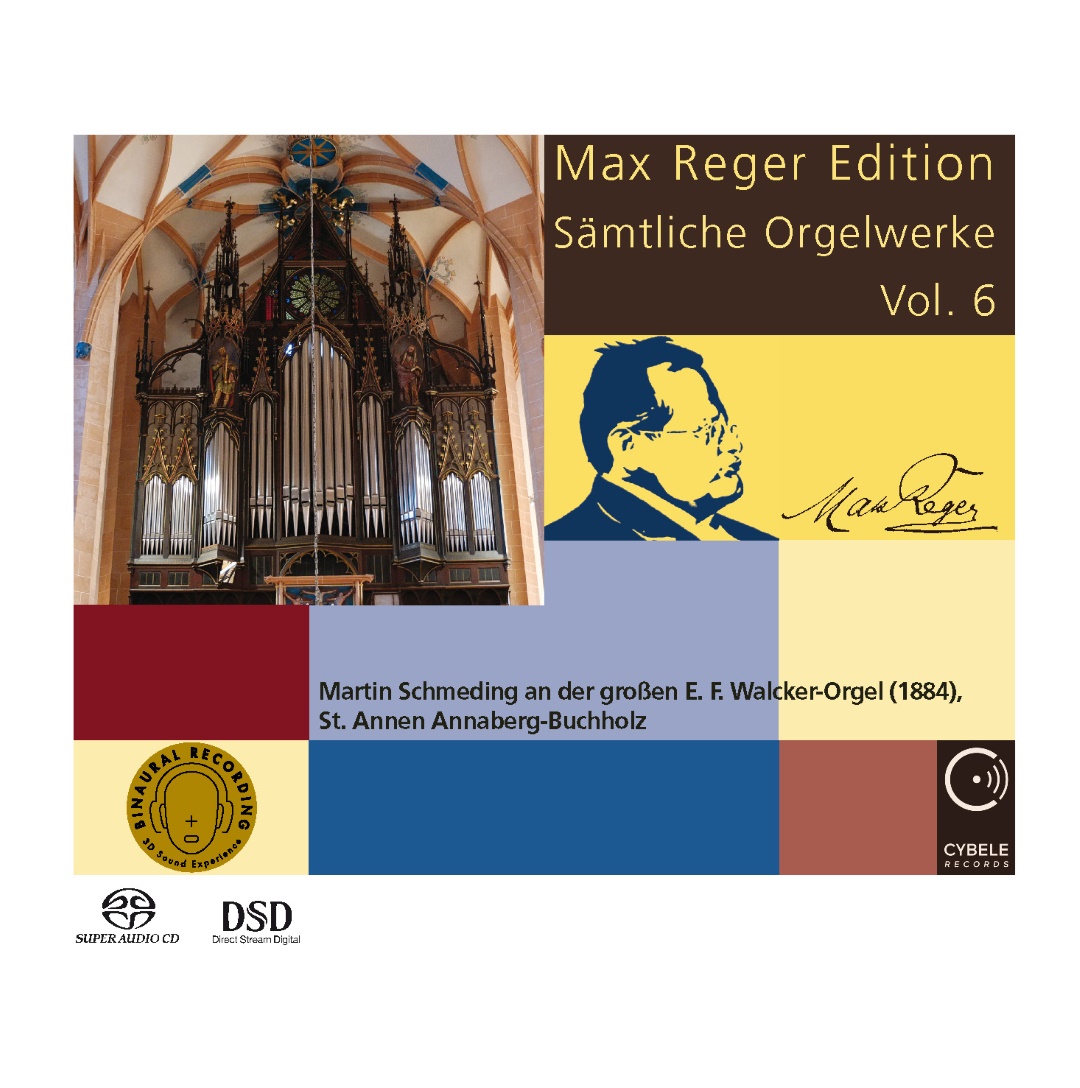
Cybele 3D-051506

Cybele 3D-051506 2016

3D binaural stereo 5.0 surround DSD Stereo Classical music Romantic music 1:19:30

To the description

Max Reger Edition. Sämtliche Orgelwerke (Vol. 6)

Contributors

Martin SchmedingOrganist

Composer

Max Reger

Short description

The Drei Stücke op. 7 and the Suite in e-Moll op. 16 show Reger’s early engagement with baroque forms: virtuoso gestures, artful fugues and chorale quotations combine with Romantic harmony and dynamics. The programme is completed by the Präludium und Fuge in fis-Moll op. 82, Band IV, Nr. 1 und 2, arranged for organ by the composer from his own piano music. Martin Schmeding plays the E. F. Walcker organ of 1884 in St. Annen Annaberg-Buchholz. Three manuals and a widely spanned range of stops give these different forms their historical acoustic space.

Details

Format
Hybrid-SACD

Resolution
DSD64 / 2.8224 MHz 1 bit

Total playing time
79:31

Channels
Stereo, 5.0 Surround, 3D-Binaural-Stereo

Performer and instrument
Martin Schmeding – E. F. Walcker organ (1884), St. Annen Annaberg-Buchholz

Programme
Drei Orgelstücke op. 7, Romanze und Ave Maria aus op. 82 Band IV sowie Suite e-Moll op. 16

Awards

International Classical Music Awards (ICMA) — Nomination

Specifications

Catalogue number
Cybele 3D-051506
Year of release
2016
Genre
Classical music
Period
Romantic music
Instrumentation
Organ
Label
Cybele Records
Barcode
809548016029
GTIN
4099885250057
Booklet (pages)
58

Track listing

13 tracks · 1:19:30

  1. 01 Drei Stücke für Orgel Op. 7 (1892) – Nr. 1: Präludium und Fuge in C-Dur: Präludium Composer: Max Reger (1873-1916) Performer: Martin Schmeding 2:57
  2. 02 Drei Stücke für Orgel Op. 7 (1892) – Nr. 1: Präludium und Fuge in C-Dur: Fuge Composer: Max Reger (1873-1916) Performer: Martin Schmeding 6:03
  3. 03 Drei Stücke für Orgel Op. 7 (1892) – Nr. 2: Fantasie über 'Te Deum laudamus' Composer: Max Reger (1873-1916) Performer: Martin Schmeding 10:11
  4. 04 Drei Stücke für Orgel Op. 7 (1892) – Nr. 3: Fuge in d-Moll Composer: Max Reger (1873-1916) Performer: Martin Schmeding 7:50
  5. 05 Präludium und Fuge fis-Moll Op. 82 Bd. IV Nr. 1 u. 2 (1912) – Präludium Composer: Max Reger (1873-1916) Performer: Martin Schmeding 2:54
  6. 06 Präludium und Fuge fis-Moll Op. 82 Bd. IV Nr. 1 u. 2 (1912) – Fuge Composer: Max Reger (1873-1916) Performer: Martin Schmeding 2:45
  7. 07 Suite in e-Moll Op. 16 ('Den Manen Johann Sebastian Bachs') (1895) – Introduktion und Fuge: Introduktion Composer: Max Reger (1873-1916) Performer: Martin Schmeding 2:26
  8. 08 Suite in e-Moll Op. 16 ('Den Manen Johann Sebastian Bachs') (1895) – Introduktion und Fuge: Fuge Composer: Max Reger (1873-1916) Performer: Martin Schmeding 12:09
  9. 09 Suite in e-Moll Op. 16 ('Den Manen Johann Sebastian Bachs') (1895) – Adagio assai Composer: Max Reger (1873-1916) Performer: Martin Schmeding 8:02
  10. 10 Suite in e-Moll Op. 16 ('Den Manen Johann Sebastian Bachs') (1895) – Intermezzo Composer: Max Reger (1873-1916) Performer: Martin Schmeding 5:46
  11. 11 Suite in e-Moll Op. 16 ('Den Manen Johann Sebastian Bachs') (1895) – Trio Composer: Max Reger (1873-1916) Performer: Martin Schmeding 3:31
  12. 12 Suite in e-Moll Op. 16 ('Den Manen Johann Sebastian Bachs') (1895) – Intermezzo da capo Composer: Max Reger (1873-1916) Performer: Martin Schmeding 3:00
  13. 13 Suite in e-Moll Op. 16 ('Den Manen Johann Sebastian Bachs') (1895) – Passacaglia Composer: Max Reger (1873-1916) Performer: Martin Schmeding 11:56

Description

The sixth volume of the Max Reger Edition sets two early organ cycles against a later arrangement of his own piano music. The Drei Stücke op. 7 of 1892 and the Suite in e-Moll op. 16 of 1895 lead from clearly recognisable baroque models to an increasingly independent union of counterpoint, chorale and Romantic expression. The Präludium und Fuge in fis-Moll op. 82, Band IV, Nr. 1 und 2, add two terse pieces of 1912 to this perspective. Martin Schmeding plays the programme at the E. F. Walcker organ of 1884 in St. Annen Annaberg-Buchholz.

Opus 7 comprises a Präludium und Fuge in C-Dur, the Fantasie über Te deum laudamus and a Fuge in d-Moll. Broken triads and forward-driving movement in the first work recall Bach’s early organ music; interpolated suspension figures and free passages alter the initially familiar gesture. In the fantasy the Gregorian hymn is first presented in four parts. Variations follow, with contrary motion, ornamentation and fugatos. The closing double fugue works out its two subjects separately and inserts a short toccata before combining them.

The Suite op. 16 bears the dedication Den Manen Johann Sebastian Bachs — to the shade of Johann Sebastian Bach. Its first movement joins the dotted rhythm of a baroque overture to weighty chords and an extended triple fugue. In the second movement the ornamented melodic line of the Romantic character piece meets Protestant chorale quotations: Es ist das Heil uns kommen her, Aus tiefer Not and O Haupt voll Blut und Wunden. The alternation of solo line, dense texture and four-part chorale governs the course of the music here.

The scherzo-like Intermezzo sets against this a more agile play with registration and changes of manual; a lyrical trio interrupts the movement. A passacaglia forms the conclusion. Its figurative climaxes are articulated by slowing interpolations and a section in the major. The subject may also appear in the upper voice, accompanied by an independently led lower line. At the end the music returns to the gestures of the opening introduction.

The Präludium und Fuge in fis-Moll come from the piano collection Aus meinem Tagebuch and were transcribed for the organ by Reger himself. The lyrical prelude and the terse, contrapuntally worked fugue set a different measure beside the extended early cycles: the form contracts, while the union of cantabile line and polyphonic craft remains.

The Annaberg Walcker organ has mechanical action, three manuals and numerous flute, string and reed stops. In the restoration completed in 1995 the 55 surviving stops were preserved and additions carried out after historical models. The instrument sounds in the space of the late Gothic hall church of St. Annen. The DSD recording offers stereo, 5.0 surround and a 3D binaural version for headphones.

Concert calendar

Cybele 3D-051506