
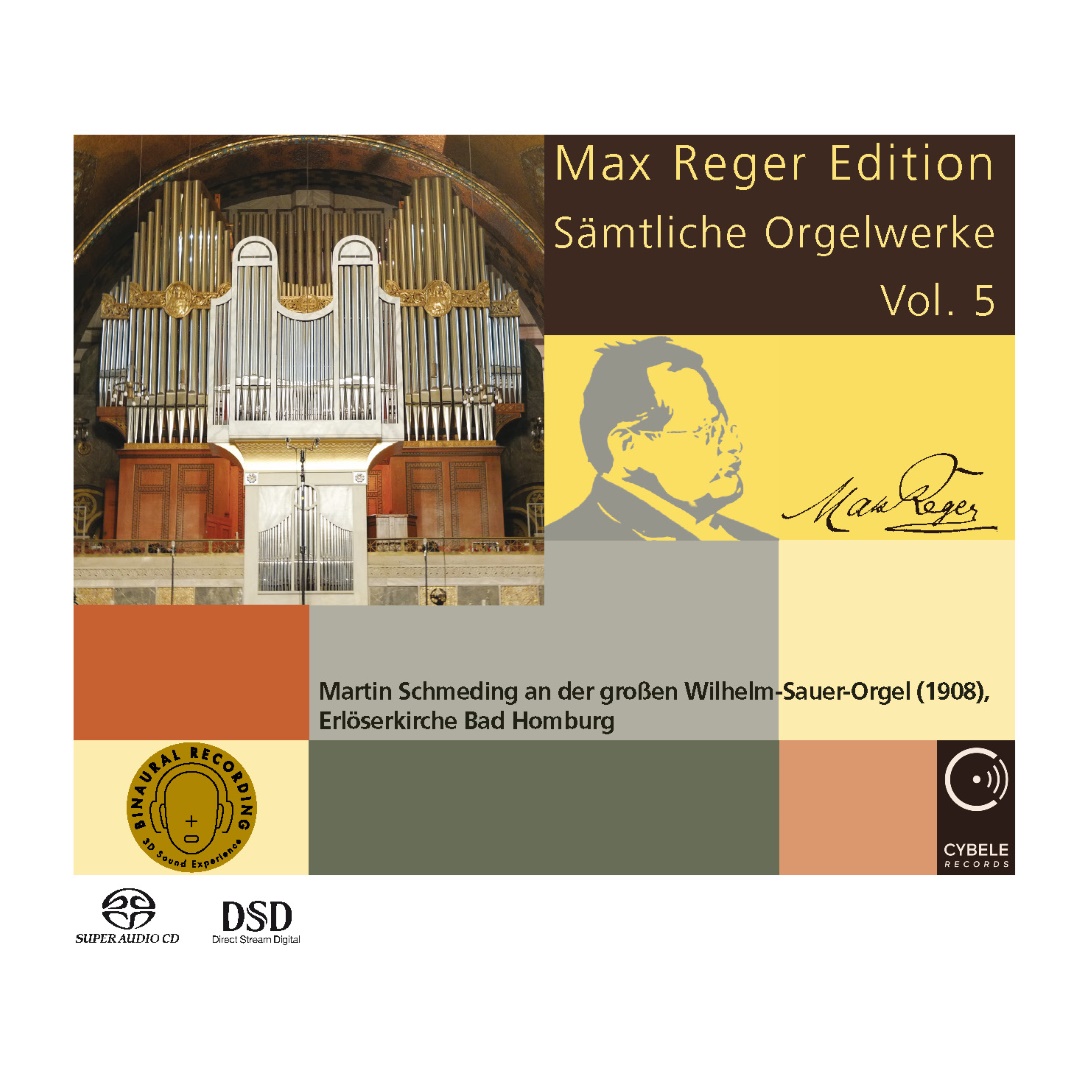
Chorale-based miniatures and free character pieces make up the fifth volume of the Max Reger Edition. It combines the 13 chorale preludes op. 79b with both complete books of the Zwölf Stücke op. 59. Martin Schmeding plays the 25 pieces at the Wilhelm Sauer organ of 1908 in the Erlöserkirche Bad Homburg. Liturgical references, contrapuntal work and forms equally at home in Romantic piano music alternate throughout the sequence.
The Kompositionen für Orgel op. 79b were written between 1901 and 1904. The collection gathers mainly chorale preludes which had previously been written individually for practical church anthologies. Their starting point is the familiar repertoire of hymn tunes. Reger treats them in a variety of textures: short fugatos and canonic interweavings stand beside workings of the melody in the soprano, tenor or bass. Taking his cue from baroque models, he places at the centre the relationships between a leading chorale line and its accompanying voices.
Ach Gott, verlass mich nicht opens the sequence, Warum sollt ich mich denn grämen closes it. Between them stand Ein’ feste Burg ist unser Gott, Morgenglanz der Ewigkeit and Nun danket alle Gott, as well as chorales on death and resurrection. Two melodies even appear twice each: Mit Fried und Freud ich fahr dahin and Herr, nun selbst den Wagen halt. The small scale of the individual pieces makes differences in voice leading and layout particularly easy to compare.
The Zwölf Stücke op. 59 of 1901 open up a further field. In the first book a prelude and fugue frame a sequence of Pastorale, Intermezzo, Canon and Toccata. Historical forms and Romantic characters alternate. The Toccata in d-Moll is followed by the Fuge in D-Dur, whose course aims at an intensification of dynamics and tempo. The second book begins with Kyrie eleison, Gloria in excelsis and Benedictus; after Capriccio and Melodia, the Te Deum stands at the close. The liturgical titles thus combine with a broad spectrum of free organ pieces.
A ternary layout recurs in these smaller forms: a contrasting middle section shifts the musical perspective before the opening returns in altered shape. Within these manageable dimensions there is still room for different kinds of movement, cantabile lines and fully worked-out polyphony. Pastorale, Intermezzo, Capriccio and Melodia are close to the Romantic piano character piece in their layout as well.
For this the Sauer organ offers stops such as Konzertflöte, Aeoline and Oboe, along with numerous further flute, string and reed colours. Its Fernwerk is a particular feature: through a long duct its sound travels from above the organ into the chancel. The DSD recording captures the instrument in its church in stereo, 5.1 surround and 3D binaural stereo; the dummy-head version is intended for headphones.