
By 1897 Max Reger’s situation had come to a head: his pieces met with rejection, at times vehement, his publisher Augener dropped him, and among musicians he passed for the “mad Reger”. A catastrophic year as a military volunteer had gone before, ruining him physically and financially. His sister Emma persuaded him to return to the family home in Weiden, and there, freed from existential pressure and under the impression of intensive reading, the most productive phase of his organ writing began: “the compositions grow like the purest weeds”. Adalbert Lindner, Reger’s first teacher, repeatedly surprised him in these months reading and studying spiritual texts and melodies. The formal model was the recently published fantasy on “Wie schön leuchtet der Morgenstern” Op. 25 by the Berlin organist Heinrich Reimann, with its sequence of introduction, variations and fugue.
Of the Fantasia for Organ on the chorale “Ein’ feste Burg ist unser Gott” Op. 27 Reger himself wrote that, keeping the chorale melody as a cantus firmus, he illustrated every verse musically; it was, he said, “the best music I have written so far”. The first verse interlocks a fanfare-like opening, block-like chorale interpolations and a quasi-baroque trio texture, setting the two levels of the text side by side: Christ as hero and saviour, and the enemy who causes affliction and fear. In the second verse the chorale lies in the tenor of the pedal, surrounded by elegiac manual figures and interrupted by the chordal blocks of the opening. A gradual crescendo leads to the third verse, which illustrates “death and the devil” with a double pedal and torn-off chord sequences; after a brief pianissimo the closing fugato issues in a chordal apotheosis. Karl Straube called the fantasy a colossal work and the most brilliant yet written on this chorale.
That Op. 27 and the fantasy on “Freu’ dich sehr, o meine Seele!” Op. 30 were conceived as a contrasting pair is clear from their original designations as Opp. 27a and 27b; a motivic link comes in addition, for the recurring interlude of Op. 30 is the opening of “Ein’ feste Burg” in the minor. Lindner compared the two as an embodiment of the shining, heroic and life-affirming on the one hand, of the sullen, the painful and mortal fear on the other. After a cheerful, almost baroque figured opening that dissonant clusters immediately interrupt, Reger turns in the first verse, at the words “sorrow and woe”, to a chromatic and harmonically dense style. The verses are often broken off in mid-line: coloured melodic ornamentation, furious outbursts with double pedal, sighing motifs, chromatic extinction. Only the triple canon on the cantus firmus brings a conciliatory close.
Op. 40, written a year later, is likewise a contrasting pair. The fantasy on “Wie schön leucht’t uns der Morgenstern” leads from an eruptive, fragmented introduction through two evenly paced crescendi to the first fugue in Reger’s chorale fantasies, which is quickly linked to the chorale melody; its focal point is the coloured setting of the third verse, which Karl Straube had suggested. So as not to weaken the final effect, Reger left the last verse of the original text unset. According to Straube, the work was written to push Reimann’s fantasy on the same chorale aside. The fantasy on “Straf mich nicht in deinem Zorn!”, added in the autumn of 1899, Reger called “a miserably difficult piece of music” that his inclination towards mysticism would not let turn out any easier. It is built in small units, with abruptly changing moods; the connecting element is the chromatic descending three-note sequence of the opening, which Reger uses in all his chorale fantasies as an illustration of sin, guilt and deprivation. A fugal section is absent here, probably because of the melancholy of the text.
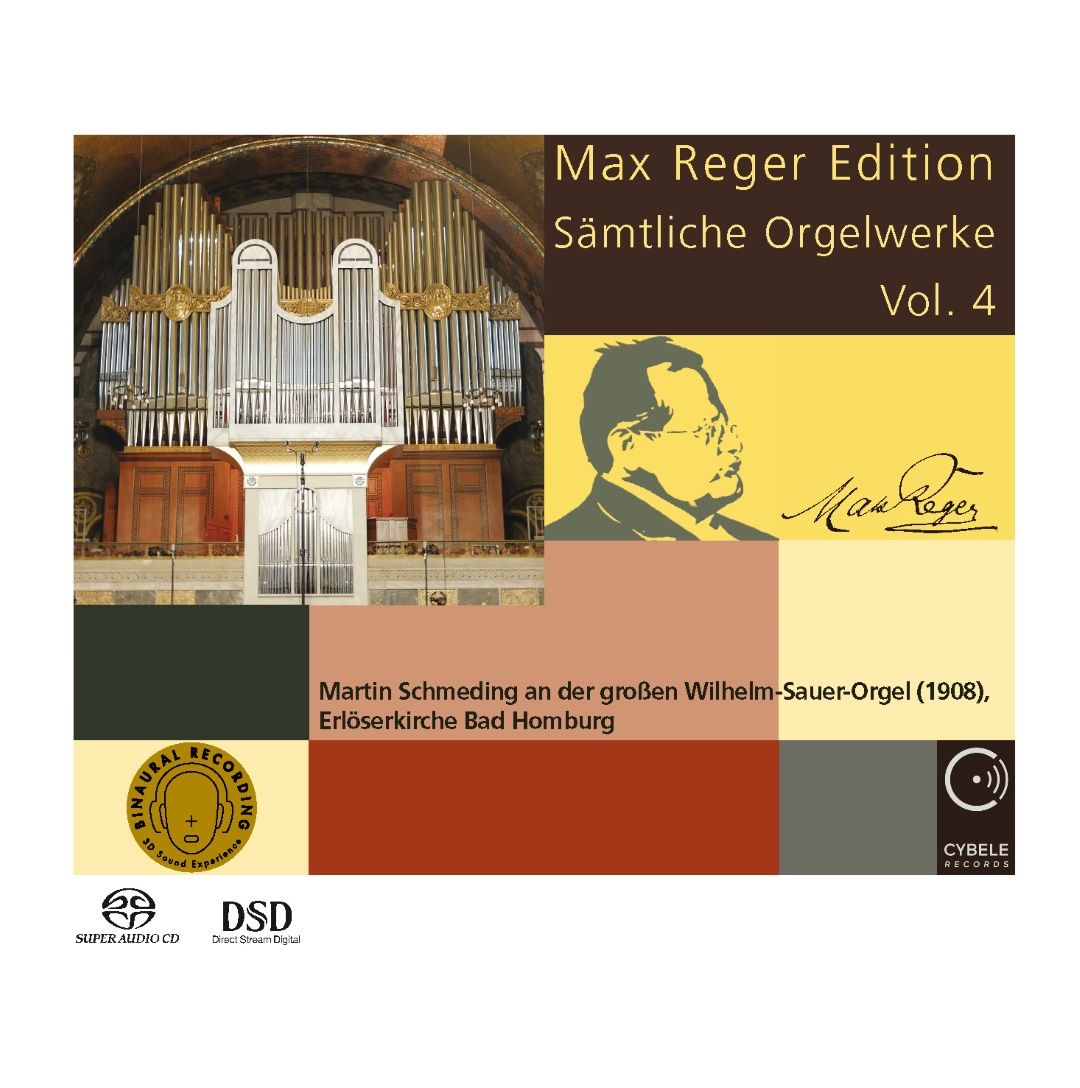
The volume was recorded from 22 to 24 March 2015 in the Erlöserkirche in Bad Homburg, one of the most important Wilhelmine churches, combining Art Nouveau, Romanesque Revival and Byzantine elements. The Wilhelm Sauer organ Op. 1020 of 1908 has a feature that makes some sounds seem to come from far above: the echo division, in its own case above the main organ, whose sound is fed through a long channel and emerges in the sanctuary at the other end of the church. Not everything ran smoothly: when the setter board used to store registrations burned out, the organ builder Thomas Küpper drove to Göttingen that same night to fetch a replacement from the manufacturer. Marie Schmeding and Tomasz Zebura assisted as registrants. The recording was nominated for the International Classical Music Awards (ICMA).