
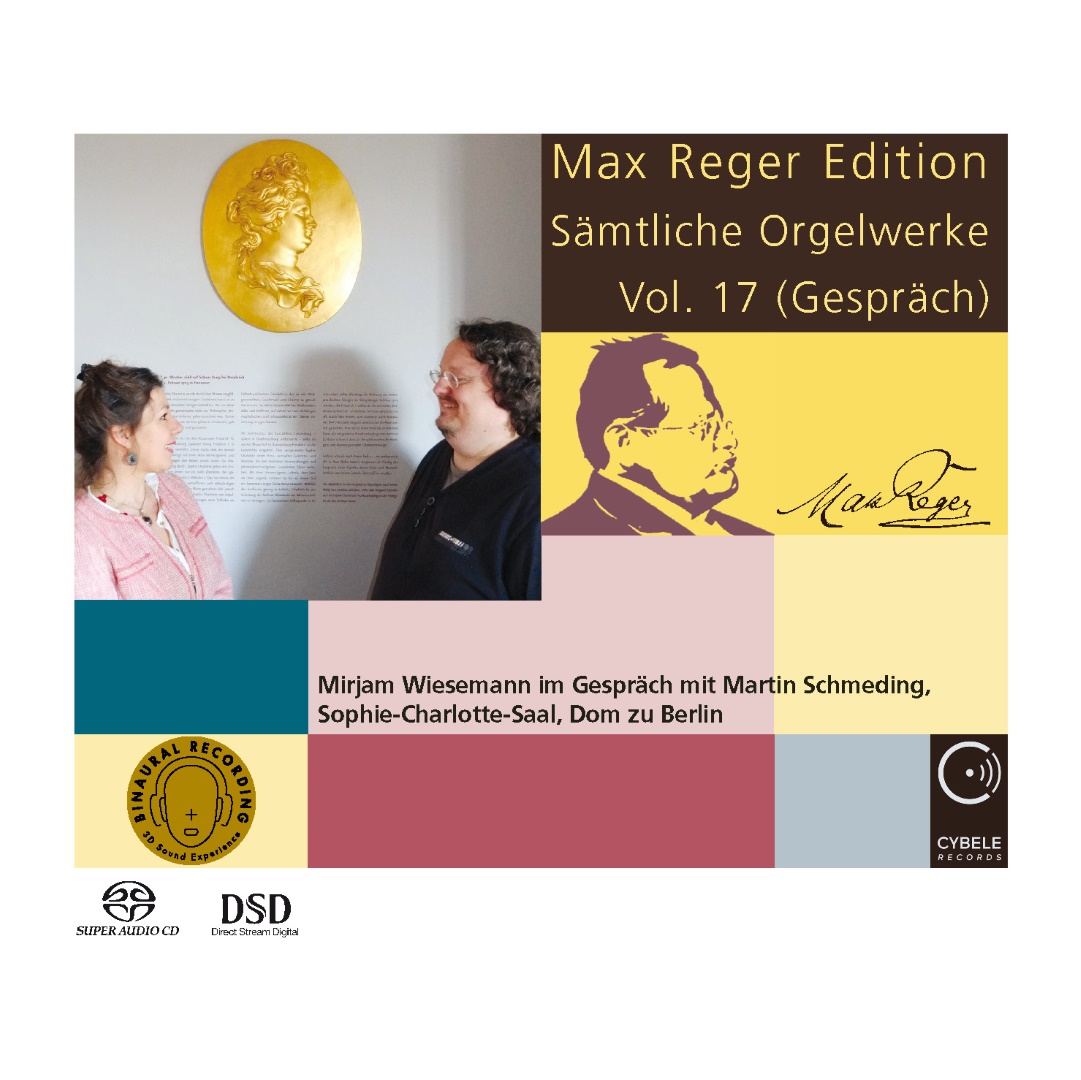
For sixteen musical volumes Martin Schmeding travelled to historic organs across Germany to record Max Reger’s complete organ works. The seventeenth volume sets a deliberately personal full stop: a conversation recorded in the Sophie-Charlotte-Saal of Berlin Cathedral, right beside the Wilhelm Sauer organ on which Vol. 14 was recorded.
Mirjam Wiesemann asks about the beginning: how did the idea of a complete recording come about, and why Reger? The talk turns to Max Reger the man, to his successes in his lifetime and his way of dealing with criticism, and to his special relationship with the organ. A second strand concerns the organ journey itself: which instruments were chosen and why, what distinguishes each of them, why organs by Sauer and Walcker in particular — and which have become the performer’s personal favourites.
Schmeding tells of the preparation, of artistic and logistical challenges, of unusual recording conditions, of sublime moments and of mishaps. He speaks about the sound ideal of Reger’s time and the restoration of the instruments, about church, organ, religiosity and spirituality, about the people and places he met on this journey, and about his favourite pieces. And he answers the question whether Reger’s organ works are something for collectors and organ enthusiasts — or also for the generally interested listener.
The journey led across Germany and exclusively to instruments of German late Romanticism: to the Wilhelm Sauer organ of St Petri Cathedral in Bremen (1894/1905), to the Walcker organs of the Lutherkirche in Wiesbaden (1911), of St Annen in Annaberg-Buchholz (1884) and of the Protestant church in Essen-Werden (1900), to Sauer organs in the Erlöserkirche in Bad Homburg (1908), the Michaeliskirche in Leipzig (1904), the Lutherkirche in Chemnitz (1908), the monastery church in Doberlug (1874), the Trinitatiskirche in Finsterwalde (1908), the collegiate church of Neuzelle (1906), Berlin Cathedral (1905) and the Thomaskirche in Leipzig (1889/1908), and to the Ladegast-Sauer-Eule organ of St Nikolai in Leipzig. Together the edition comprises 19 hours and 24 minutes of music.
Eberhard Friedrich Walcker and Wilhelm Sauer were the formative figures of German organ building in that period — their instruments are the sound Reger wrote for. The conversation therefore returns again and again to the relationship between organ and room, to the original unities that have survived, and to the question of what the restorations have changed in that sound. The complete edition was produced with the kind support of the Max Reger Institute / Elsa Reger Foundation.
The conversation was recorded on 9 January 2016 at Berlin Cathedral, where the journey for this edition began and ended. The complete edition was nominated for the International Classical Music Awards.