
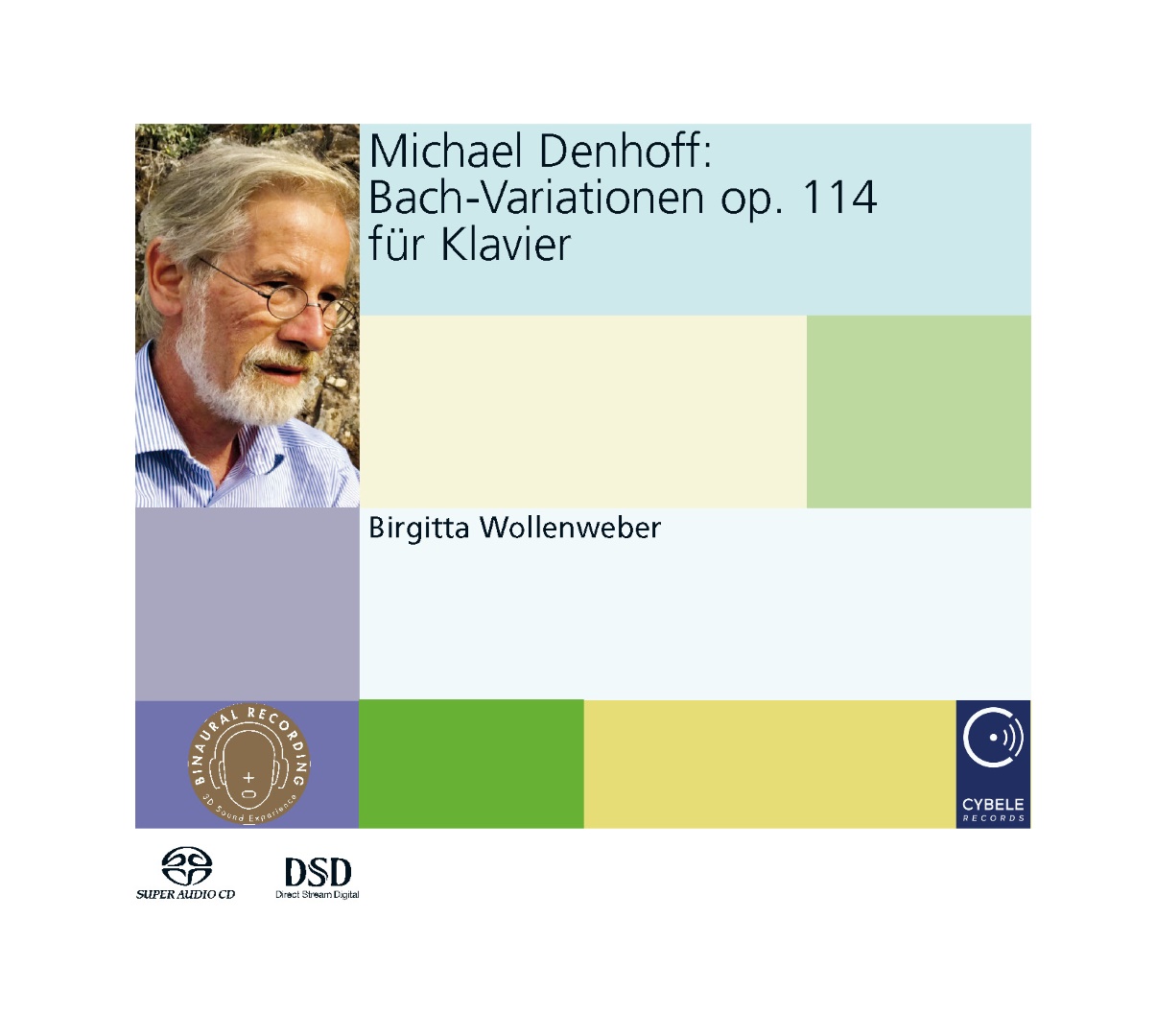
I believe that great music always has a spiritual context, Michael Denhoff says in the booklet. Listening to or playing Bach is for him almost like praying; his own music serves to praise God only in the way the painter Alexej von Jawlensky put it: all art is a search for God. That search led the composer and cellist, born in Ahaus in 1955, again and again to Bach’s cello suites. As the theme of his Bach Variations op. 114 he chose the Sarabande from the fifth suite, whose radical restraint and breathtaking melodic line he regards as the inner core of all six suites.
In transferring it to the piano Denhoff added a countersubject to the single-voice Sarabande — a bass line that had long been in his mind while playing and that he now wrote out: entirely tonal, but with its harmonic boldness brought to the fore. It continues where Bach left off. The theme is thus already a variation, and since the closing repeat of the Sarabande is one too — as Bach’s Aria is in the Goldberg Variations — there are thirty variations in the end, although Denhoff wanted to remain modestly behind Bach with 28. The impulse came from a recording: when I heard the final recording of the Goldberg Variations by Glenn Gould, a wish grew inside me to create something comparably amazing and comprehensive. That was in 1981; at 26 he did not yet feel mature enough.
The 28 variations belong together and are to be played attacca. Denhoff groups them as seven times three variations plus seven fantasy variations — in Christian number symbolism seven stands for divine perfection, three for the trinity, and the fantasy variations expand the groups of three into groups of four. He mirrors this completeness in the pitch material as well: in the fantasy variations he uses exactly those notes that Bach does not use in the corresponding bar of the Sarabande, a kind of harmonic negative form. To Bach’s canonic technique he responds with interval variations: in every fourth number, from the second onwards, one particular interval is constitutive — third and sixth, fifth and fourth, second and seventh. Precisely the constraints he imposes on himself Denhoff regards as the key to a higher form of freedom.
The cycle is at the same time a series of dedication pieces; the moment of dedication is an essential motivation for Denhoff. The hommages are not meant as labels but aim at a succinct feature of the music of each dedicatee. Variation 15, mezzo tempo for Helmut Lachenmann’s eightieth birthday, takes up the “filter swing” technique from his piano cycle Ein Kinderspiel. The central fourth and most extensive fantasy variation is for György Kurtag’s ninetieth birthday and is at the same time Denhoff’s answer to Kurtag’s dedication piece …interrotto… for his own sixtieth. Alongside them stand performers of his music such as Birgitta Wollenweber and Martin Tchiba, visual artists such as Wolfgang Ueberhorst and close members of his family. The last variation, Fantasia VII, tranquillo, is dedicated to the painter and priest Herbert Falken; its duality of movement and stasis has almost the weight of a finale before the Sarabande closes the circle.
Birgitta Wollenweber, to whom one of the variations is dedicated, recorded the cycle in April 2017 in the Krönungskutschensaal of the Hochschule für Musik Hanns Eisler in Berlin.