
The booklet opens with Charles Tournemire’s own preface to the cycle. He describes the 51 offices of L’Orgue Mystique as a collection for the church year, grouped into the three great cycles of Christmas, Easter and the time after Pentecost, and gives every office the same sequence: Prélude à l’Introït, Offertoire, Elévation, Communion and Pièce terminale. Each piece is based on Gregorian chant, which he paraphrases freely; he sought to preserve its suppleness and mystical depth and to combine the medieval garlands of melody with the resources of polyphony. He found encouragement at the Abbey of Solesmes, and the impulse came from his friend, the organist Joseph Bonnet. Though intended above all for the liturgy, the music was also to find its place in the concert hall.
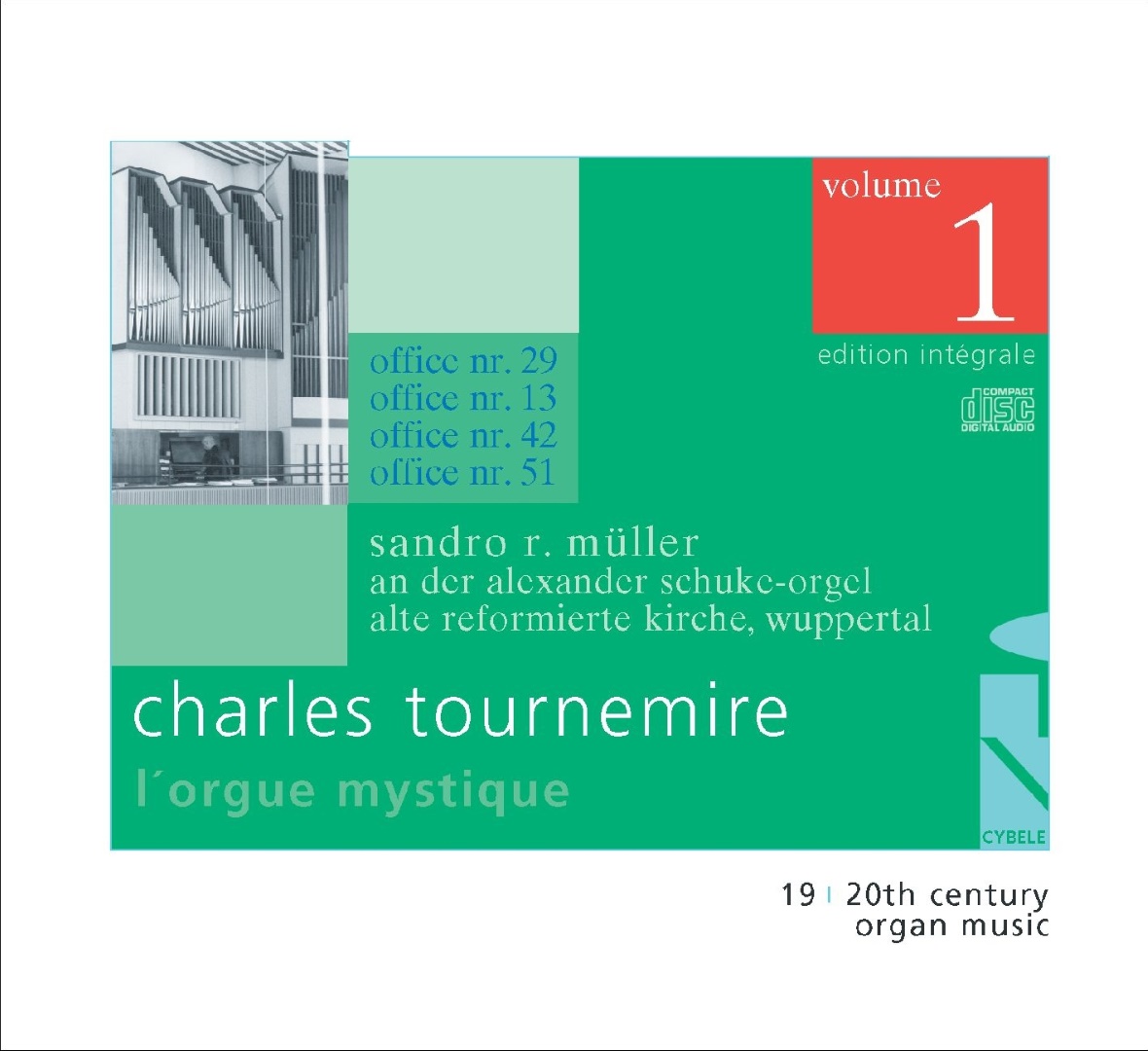
The four offices on this volume come from two of the three cycles. Office No. 13 (La Sexagésime) for Sexagesima Sunday, dated 5 December 1929, belongs to the Cycle de Pâques Op. 56 and closes with a Fresque. The other three are part of the Cycle après la Pentecôte Op. 57. Office No. 42 (La Nativité de la Vierge) for the Nativity of the Virgin is dated 26 May 1930; its Pièce terminale Prélude et Louanges is, at eleven minutes, the longest piece on the CD. Office No. 29 (IVe Dimanche après la Pentecôte) for the 4th Sunday after Pentecost, dated 23 December 1930, ends with the Alleluia N°.1. Office No. 51 (XXIIIe Dimanche après la Pentecôte) for the 23rd Sunday after Pentecost, the last of the cycle, is dated 5 February 1932 and closes with a Fantaisie sur le Te Deum et Guirlandes Alleluiatiques.
The booklet deliberately does without detailed commentaries, since the variety of the underlying texts and melodies would go beyond its scope. Instead it refers to the Graduale Romanum, the Antiphonale Monasticum and Bernadette Lespinard’s 1971 study of L’Orgue Mystique; the settings, it says, are anything but descriptive: this is absolute music in the truest sense of the word. Only after 29 years as an organist, the introduction notes, did Tournemire dare to devote six years in seclusion to this work alone, which in scope can only be compared with Johann Sebastian Bach’s cantatas. Born in Bordeaux in 1870, Tournemire studied with César Franck and Charles-Marie Widor, became titular organist of Sainte-Clotilde in 1898 and professor at the Paris Conservatoire in 1919; he died at Arcachon in 1939.
Sandro R. Müller, born in Wiesbaden in 1955, studied the organ with Gerd Zacher at the Folkwang Hochschule in Essen from 1979. Since 1980 he has been organist of the Alte Reformierte Kirche in Calvinstraße, Wuppertal-Elberfeld, and its Alexander Schuke organ. On this instrument of 1968, with two manuals and 27 stops, he recorded the first volume of the complete edition in July 1994; the mixtures and the Cymbel were not used.