
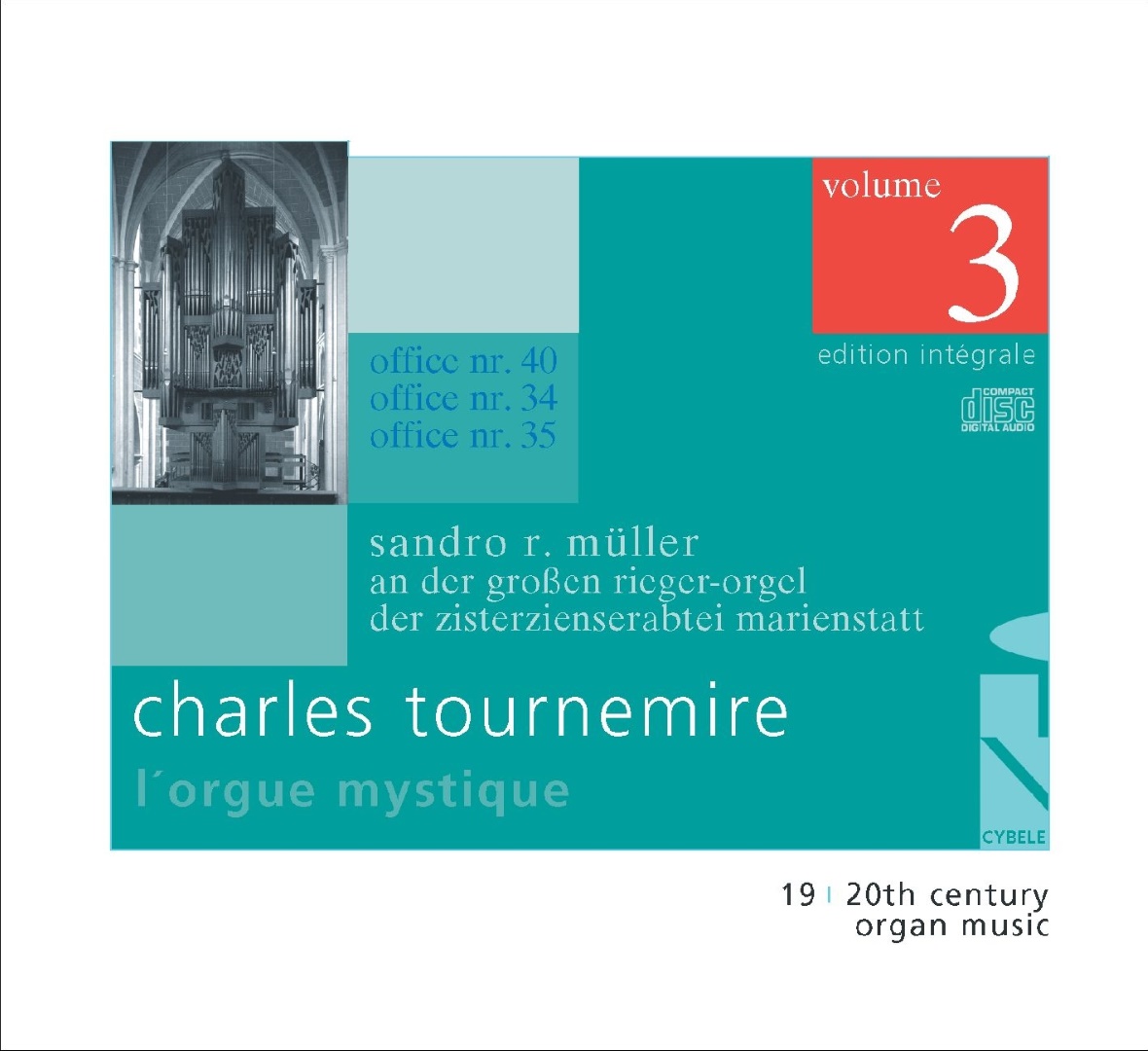
Charles Tournemire wrote the 51 offices of L’Orgue Mystique between 1927 and 1932, in complete seclusion. Each office is an organ Mass for a Sunday or feast day whose five movements – Prélude à l’Introït, Offertoire, Elévation, Communion and Pièce terminale – freely paraphrase Gregorian chants of the day. In this way, as Brother Jakob Schwinde O.Cist. writes in the booklet, the cycle closely links Tournemire’s artistic ideal with the experience of the feasts of the church. All three offices on this volume belong to the Cycle après la Pentecôte Op. 57. Schwinde devotes most of his text to the feast of the Assumption, its history since the fifth century and Tournemire’s setting.
Office No. 35 (Assomption), dated 4 February 1928, is dedicated to Tournemire’s friend Joseph Bonnet, organist of Saint-Eustache in Paris, whose Cavaillé-Coll organ he had in mind when writing his often very precise registrations. The Offertoire is a slow three-part procession in whose pauses the Gregorian melody sounds as if from afar. The Elévation on the antiphon “Sub tuum praesidium” rests on a bass line of exactly 36 notes, twelve times three, twelve being the traditional number of Mary; in this recording the notes are marked by strokes of the Glockenspiel. Only the Pièce terminale breaks into festive jubilation: the Paraphrase-Carillon combines the hymn “Ave maris stella” in the upper voices with the antiphon “Salve Regina” in the bass and leads into a Largo that ends in D major; in the recording a swelling Cimbelstern is meant to evoke the opening gate of heaven. Messiaen demanded that every organist should play this piece on the feast day.
Schwinde calls the offices for the 9th and 14th Sundays after Pentecost less spectacular, because their Gregorian melodies are far less familiar than the Marian ones. The first four movements of Office No. 34 (IXe Dimanche après la Pentecôte), dated 16 March 1931, are among the simplest in the whole cycle. The Pièce terminale, Supplications et Fugue modale, is by contrast extended: a tower of stacked chromatic lines collapses onto a threefold C sharp, followed by a four-part fugue on the Alleluia jubilus of the day, one of four modal fugues in L’Orgue Mystique, which leads into an extremely quiet epilogue. Office No. 40 (XIVe Dimanche après la Pentecôte), dated 29 May 1931, closes with the Choral N° 5, a freely ornamented chorale melody based on the Alleluia of the day. Schwinde reads its heavy bass notes set against the triplets and sextuplets of the upper voices as an image of the contrast between God and Mammon in the Sunday Gospel.
Sandro R. Müller recorded this volume in July 1995 at the Cistercian Abbey of Marienstatt in the Westerwald, on the large Rieger organ of 1969/70 with Rückpositiv, Hauptwerk, Schwellwerk and Brustwerk; the stops of its Spanish division were not used. Iris Fischer and Brother Jakob Schwinde assisted with the stops. Ingo Schmidt-Lucas, producer and sound engineer, worked with only two microphones.