
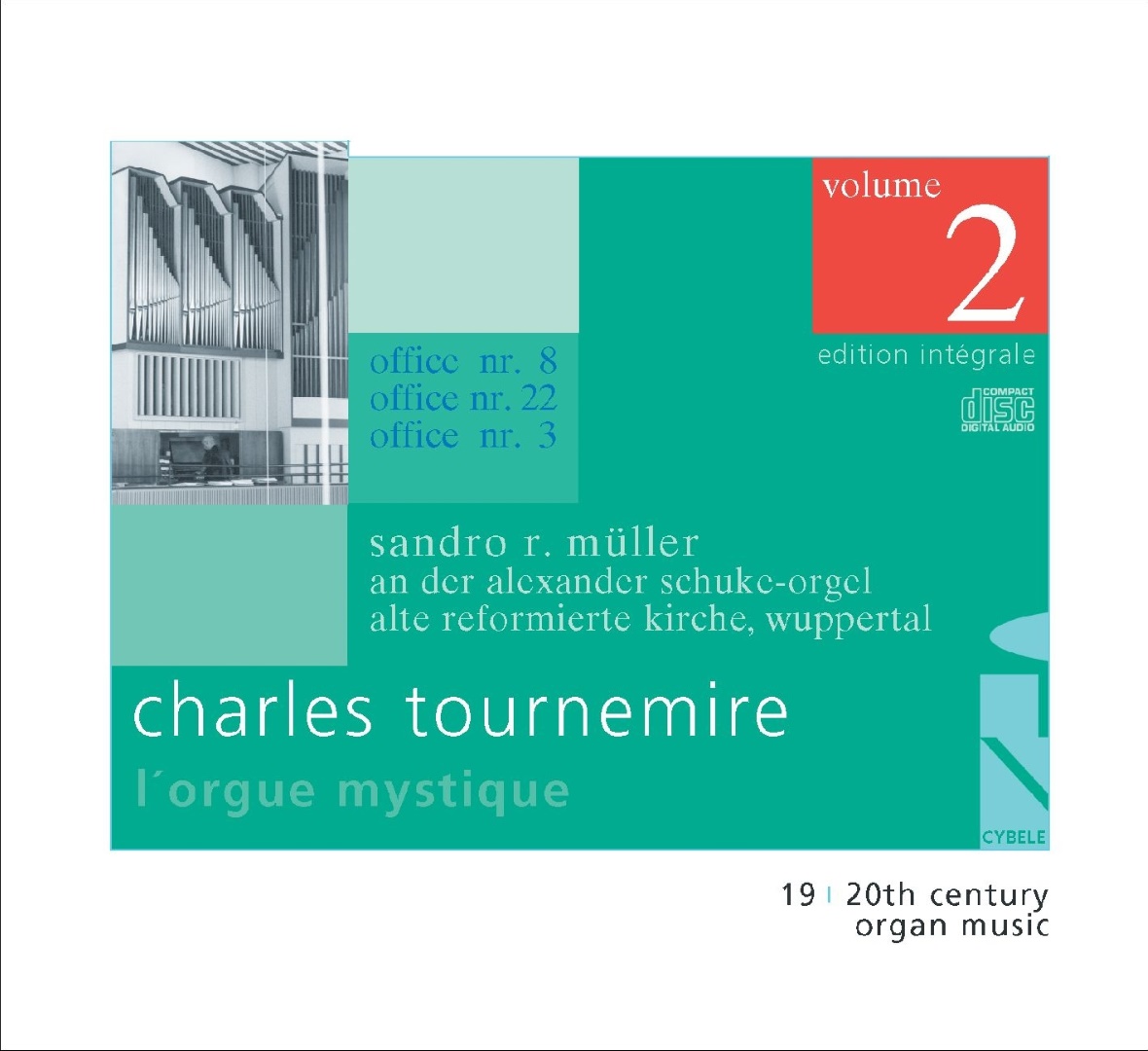
“A Musician between Aesthetics, Liturgy and Mysticism” is the title of Brother Jakob Schwinde’s essay in the booklet. He recalls that Charles Tournemire, a pupil of César Franck and Charles-Marie Widor, has been largely forgotten, although Olivier Messiaen may be regarded as his spiritual foster son. Unlike the better-known “Gothiques” of Widor or Léon Boëllmann, L’Orgue Mystique does not merely allude to Gregorian chant; the chant is the sole foundation of an entire cycle of works. Tournemire, he writes, does not quote the themes literally: he often uses only parts of the liturgical text, rearranges them and highlights particular points of meaning. He leaves out the Gradual, Tract and Alleluia, but usually lets their motifs flow into the Pièce terminale, and the Elévation is always based on a motif from the Liturgy of the Hours of the day.
Office No. 3 (Noël), dated 13 December 1927 and thus from the first year of work on the cycle, belongs to the Cycle de Noël Op. 55 and refers to the third Christmas Mass, “Puer natus”. In the Prélude à l’Introït Tournemire places the second part of the text first, “Cuius imperium super humerum eius”: dominion over the world rests on the shoulders of a child. The Elévation echoes the antiphon “Lumen ad revelationem gentium” from the feast of the Purification. The Paraphrase that forms the Pièce terminale combines an Alleluia jubilus almost identical to that of Easter with the Christmas hymn “A solis ortus cardine” and the “Te Deum laudamus”. At the end the hymn remains on a single note for 33 bars – in popular belief the number of Jesus’ years – and not on the organ’s lowest C but on C sharp, for Schwinde a pointer to the Cross, since in German the sharp sign is called “Kreuz”.
Office No. 8 (Ier Dimanche après l’Epiphanie), dated 15 May 1929 and also from the Cycle de Noël, is for the Sunday on which the feast of the Holy Family fell from 1920. The Elévation and Communion take up the story of the twelve-year-old Jesus in the Temple; in the Communion the final note hovers over everything for seven bars. In the Fantaisie Choral Tournemire shapes a freely invented chorale from the antiphon of second Vespers, which on its third appearance is almost engulfed by the “Jubilate” of the Offertory. Office No. 22 (Ve Dimanche après Pâques) from the Cycle de Pâques Op. 56, dated 22 October 1930, ends with a three-part piece on the Alleluia of the day: Grave, Fugue libre et Postlude. Schwinde hears in it a life of Jesus, from his divine origin through his earthly life – the fugue subject appears nine times, three times three – to the Resurrection and his return to the Father.
Sandro R. Müller recorded the three offices in August 1994 at the 1968 Alexander Schuke organ, which he has played as organist of the Alte Reformierte Kirche in Wuppertal-Elberfeld since 1980; Angelika Kozinowski-Werler assisted with the stops.