
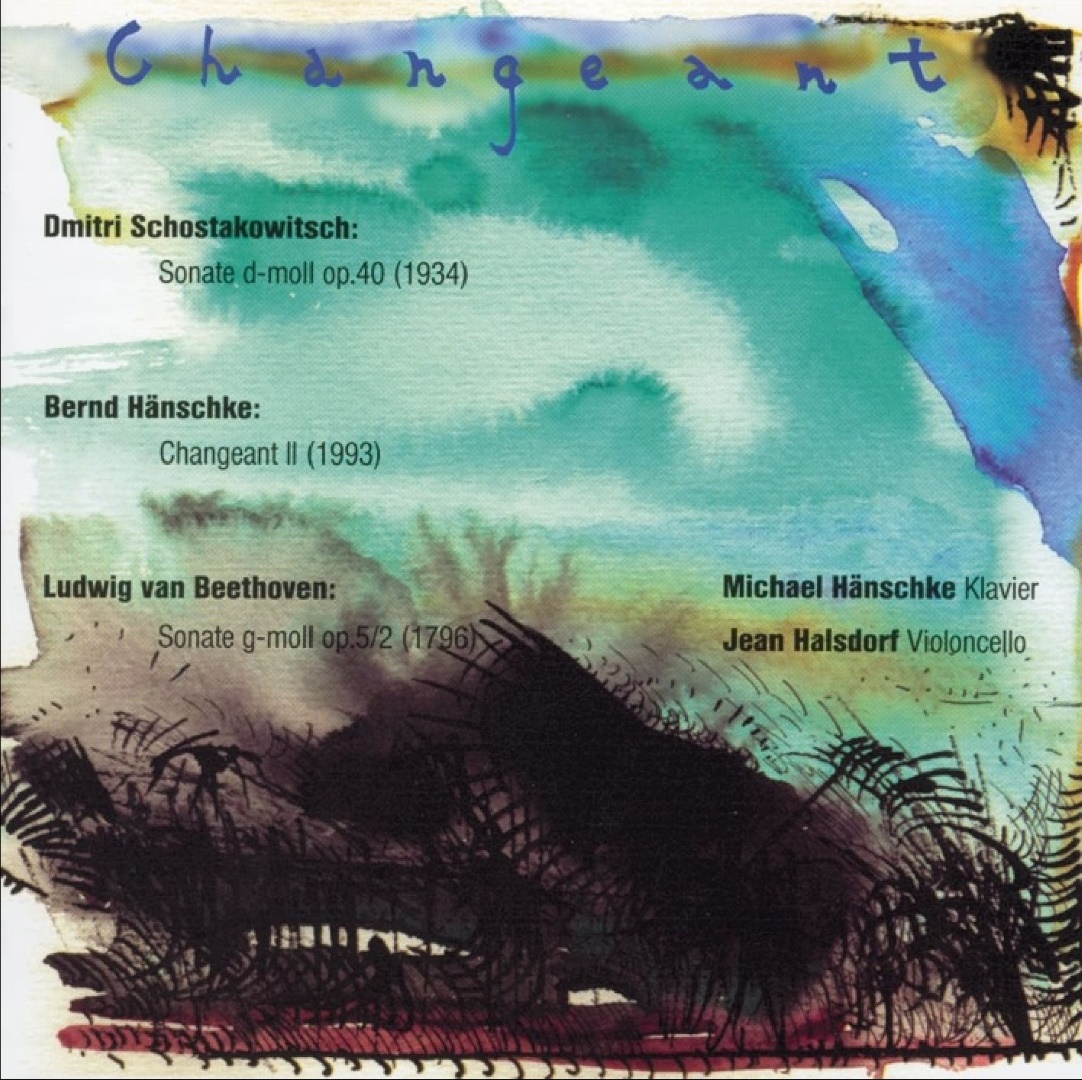
The Halsdorf–Hänschke duo came into being in 1991 more or less by chance: Jean Halsdorf needed an accompanist for a concert, and the pianist Michael Hänschke was recommended to him. The brief collaboration became a lasting one; in 1994 the two won first prize at the International Chamber Music Competition “Palma d’Oro” in Finale Ligure. Halsdorf, born in Luxembourg in 1969, studied with Maria Kliegel in Cologne, with Franco Maggio Ormezowski at the Accademia Nazionale di Santa Cecilia in Rome and with Ivan Monighetti in Basel. Hänschke, born in Moers in the same year, studied from 1990 to 1995 in Pavel Gililov’s master class at the Cologne Musikhochschule and became pianist of the Henze-Kammerensemble in 1990.
Ludwig van Beethoven composed the Sonata in G minor Op. 5 No. 2 for piano and cello in 1796, at the age of 26; it was first heard at the Berlin court in the summer of the same year. Together with its sister work in F major, written at the same time, it frees the cello from its traditional role of supplying the harmony and places it beside the piano as an equal partner. Both sonatas are dedicated to the Prussian King Friedrich Wilhelm II; when Beethoven played them to him with the cellist Jean Louis Duport, he received a snuffbox filled with gold louis d’or. For the last movement of the sonata in G minor Adolph Bernhard Marx demanded a player “with a strong arm”.
Dmitri Schostakowitsch wrote his Sonata in D minor Op. 40 for cello and piano in 1934, at the age of 28, in a happy period: newly married, after the successful launch of his opera “Lady Macbeth” in Leningrad and before the hostility and political storms of the following years. The sonata, dedicated to his friend the cellist Viktor Kubatzki, is his first major chamber work. Its classical basic attitude is surprising, in stark contrast to works of the same period, a suite for jazz orchestra and the ballet “The Limpid Stream”.
Bernd Hänschke, born in Duisburg in 1948, studied school music and composition in Cologne and from 1980 to 1983 in Hans Werner Henze’s master class; he founded the Henze-Kammerensemble (1989) and the Moerser Tage Neuer Musik (1993). “Changeant II” (1993) for cello and piano is his first work for a classical chamber ensemble. The title refers to the form: the material presented at the beginning passes through a series of states, imaginary scenes as it were. The piece relates to Pablo Neruda’s poem “Joaquin’s Departure” without following its course; the listener is invited to experience a story of his own. The recordings were made in April 1995 in the chamber music hall of the Martinstift in Moers.