
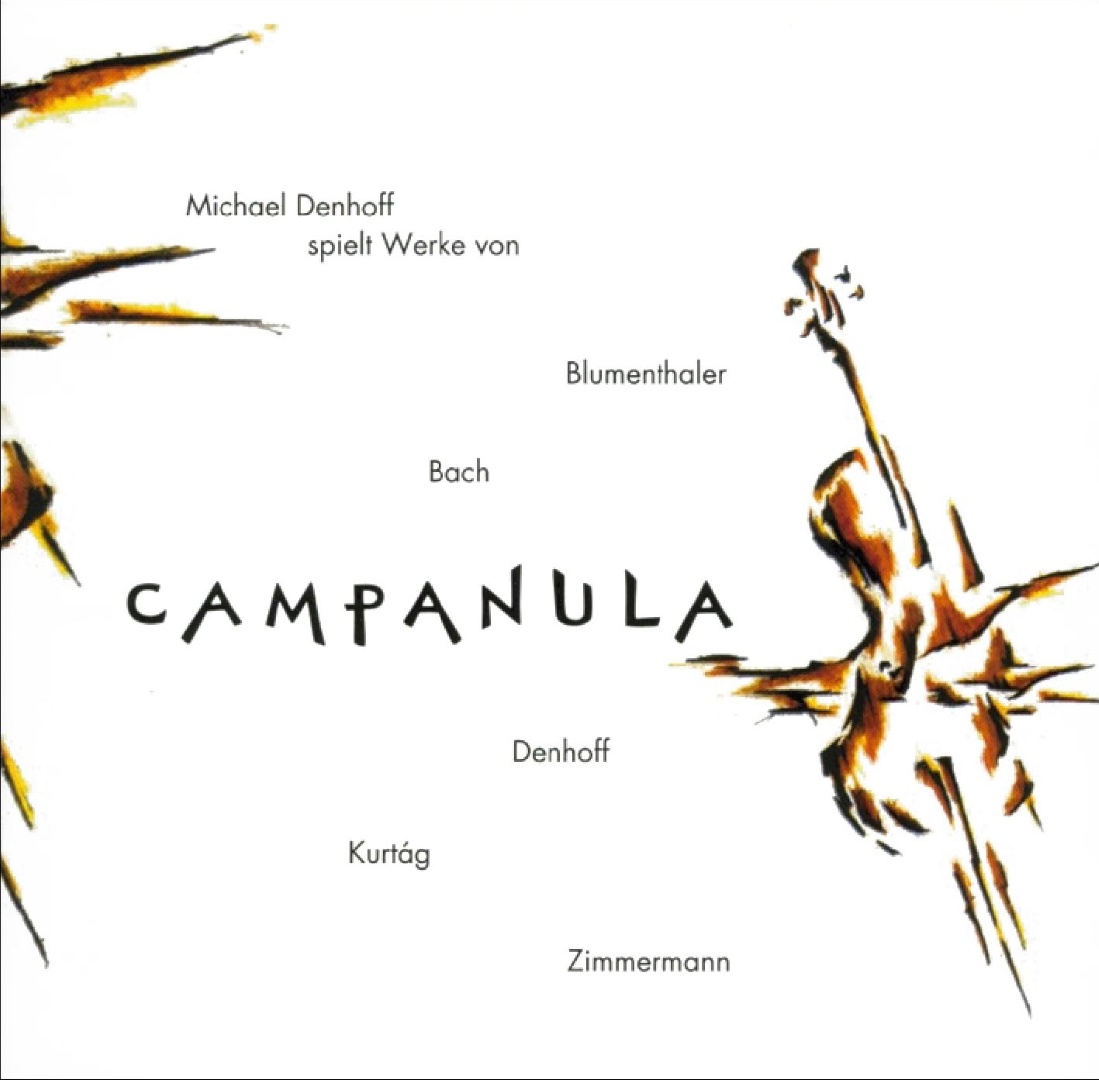
With the campanula the instrument maker Helmut Bleffert achieved a serious enrichment of the string family. Completed in 1985 after several years of development and acoustic and physical investigation, the instrument takes up the idea of resonating strings familiar from the viola d’amore or the baryton and carries it further in its own way. The tuning of its four playing strings in fifths and its scale length relate the campanula to the cello.
Sixteen resonating strings, tuned diatonically from F to g’, run parallel on both sides of the fingerboard and can be retuned when needed; their supporting effect on tone and overtones is far more evident than in the baryton, thanks to the construction. The outline of the body resembles a longitudinal section through a bellflower — that shape, and the comparison with the overtone spectrum of bells, gave the instrument its name. The sound is rich in overtones, warm and soft, as if pedalled.
Michael Denhoff, composer and cellist, was the first musician to champion the instrument, from 1985 onwards. He insists that the sonic qualities of the campanula should not be played off against those of the cello — it is an instrument in its own right; but because of its pedal effect and its colour it is particularly suited to baroque repertoire, as a possible alternative to the viola da gamba or the cello.
This first album accordingly begins with Bach: the Prelude from the Suite No. 2 in D minor BWV 1008, with the Sarabande from the Suite No. 5 in C minor BWV 1011 following later. Between them stand Volker Blumenthaler’s Canto of 1984, Denhoff’s five-part Wenn aber… (Monolog II, in memoriam C. S.) of 1987, Bernd Alois Zimmermann’s Four Short Studies from 1970, the year of his death, and György Kurtag’s short piece Janos Pilinszky, Gerard de Nerval of 1986. At the end comes Denhoff’s Circula el tiempo of 1994 in a version for four campanulas: in a fully digital playback procedure the performer recorded four different versions, which were then edited separately and mixed together digitally.
Kurtag expressly recommended transferring his piece to the campanula after getting to know the instrument through Denhoff. Blumenthaler’s Canto, originally conceived as the final section of a longer work for cello, is likewise heard in an authorised version; its long drawn-out melodic notes set the resonating strings vibrating. Zimmermann wrote his studies in the spring of 1970 at the suggestion of Siegfried Palm. The recording was made from 15 to 18 May 1995 in the Heilig-Geist-Kirche in Hochdahl.
Denhoff’s Wenn aber… calls for a scordatura in which the G string is tuned down to E flat; the composer calls the piece a requiem for a former pupil and friend. Denhoff, who studied cello with Siegfried Palm among others, won the Cologne Bernd Alois Zimmermann composition competition in 1986 with Y sobre los instantes for three campanulas, the first original work for the instrument. The CD runs to 54:03.