
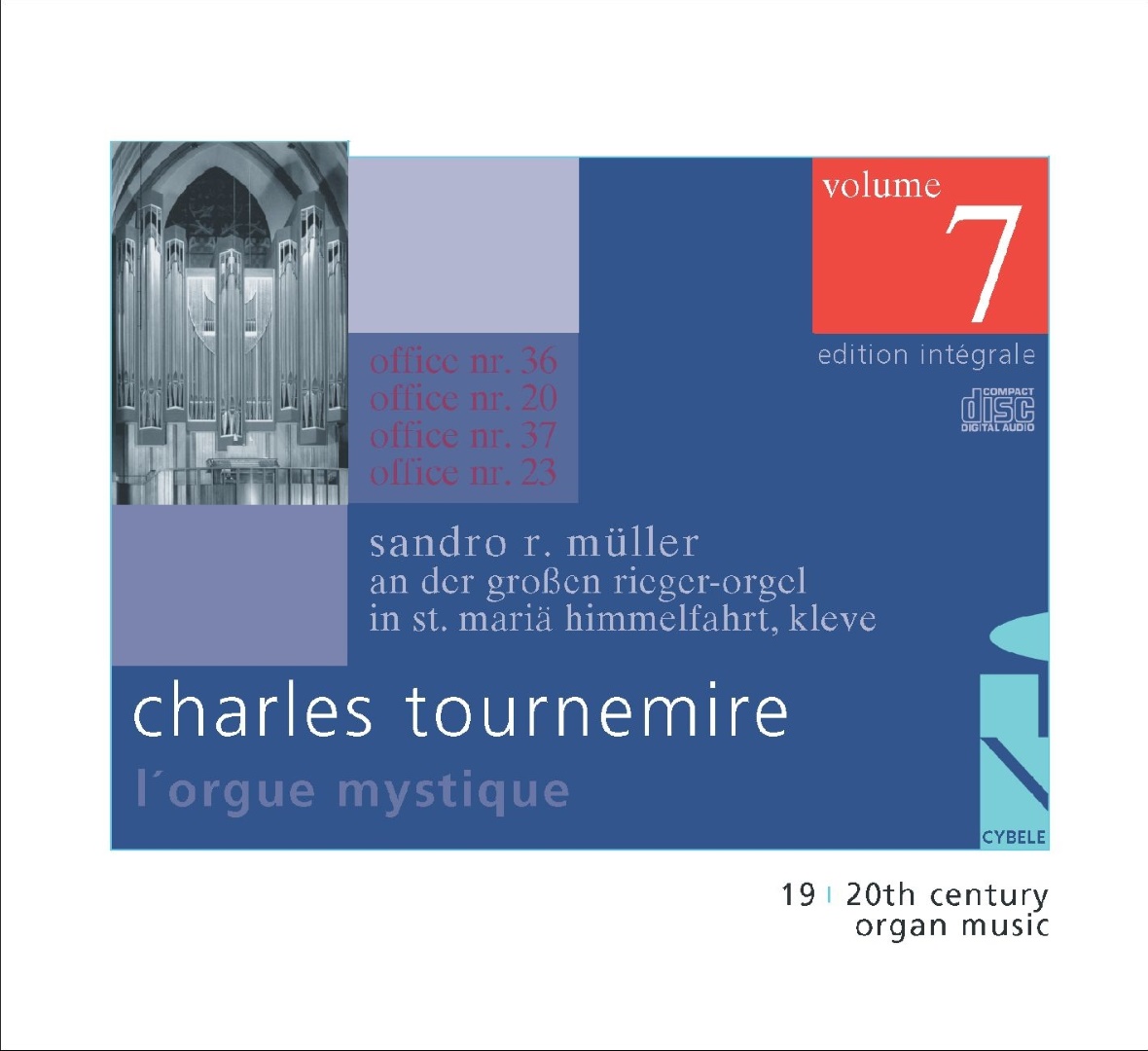
The 51 offices of L’Orgue Mystique are organ music for the Mass: between 1927 and 1932 Charles Tournemire wrote for every Sunday or feast day a Prélude à l’Introït, an Offertoire, an Elévation, a Communion and a Pièce terminale on the Gregorian chants of the day. How closely the cycle is bound up with the Benedictine Abbey of Solesmes is shown by this volume: Office No. 23 (L’Ascension) is dedicated to Dom Charles Letestu, the organist of Solesmes. Since 1837, above all through its first abbot Dom Prosper Guéranger, the abbey had pioneered the renewal of Gregorian chant, and besides Tournemire, Father Laurentius M. Schlieker OSB notes in the booklet, several French composers drew inspiration from its liturgy.
The two Sunday offices from the Cycle après la Pentecôte Op. 57 were written in the spring of 1931. Office No. 36 (Xe Dimanche après la Pentecôte), dated 1 April, follows the parable of the Pharisee and the tax collector: in the Elévation the Gregorian melodic formulas eventually move only downwards. The Choral N°. 1 on the Gradual “Custodi me Domine” is a four-part chorale with three variations, the last two of which join in a great crescendo over a pedal point on C. Office No. 37 (XIe Dimanche après la Pentecôte), dated 18 April, refers to the healing of the deaf-mute. The Elévation is a short canon in a high register, the Communion a cheerful pastorale, and the Choral N°. 2 on the Alleluia “Exsultate Deo” follows a three-part chorale reminiscent of Dietrich Buxtehude and Johann Sebastian Bach with a dance-like movement.
Tournemire wrote Office No. 20 (Saint Josef), dated 18 April 1930 and from the Cycle de Pâques Op. 56, for an additional feast of St Joseph that was celebrated from 1914 to 1956 on the Wednesday of the second week after Easter. The Communion condenses into a nine-part cluster of sound; the Postlude Choral on the hymns “Te Ioseph celebrent” and “Iste quem laeti” combines sonata form and rondo in a wave-like crescendo. In Office No. 23 (L’Ascension), dated 7 November 1928, a decrescendo marks all five movements. The Offertoire, a canon for several trumpet voices, presupposes according to Schlieker an organ that does not exist, with all manuals and the pedal in separate swell boxes. The Elévation passes by like a cloud of sound with two cluster chords, and in the Paraphrases sur un choral, a large rondo, the hymn “Salutis humanae sator” returns as a refrain.
This volume was recorded from 30 June to 3 July 1997 in the Stifts- und Propsteikirche St. Mariä Himmelfahrt in Kleve. The organ was built by Rieger of Schwarzach in 1992 with mechanical slider chests and 45 stops on three manuals and pedal. Sandro R. Müller, organist of the Alte Reformierte Kirche in Wuppertal-Elberfeld since 1980, performs as an organist and pianist and increasingly devotes himself to composition.