
Why does Schubert sound like Schubert? Christian Zacharias asked the half-joking question at a lecture concert in Essen, and in the booklet Thomas Günther takes it as an occasion to trace what is particular to this music. Unlike Beethoven’s, he writes, it flows from melody: almost all the slow movements and many of the moderato first movements stand close to song, joined by the dance characters of Schubert’s Viennese surroundings. Yet the seemingly simple is constantly transformed — sudden pauses, unforeseen harmonic turns, the reinterpretation of major as minor, throbbing basses and murmuring inner voices that comment on the affect of the moment.
The Piano Sonata No. 4 in A minor D 537 was written in 1817, when Schubert was not quite twenty. Its first movement still preserves the traditional duality of themes, yet hardly presses towards a climax, coming to rest instead in a striking pause; rather than intensifying the material, Schubert lets the development turn to a melodic episode in A flat major, a remote key, out of which a waltz-like apotheosis leads back to the recapitulation. He returned to the rondo of the second movement in E major at the end of his life: its melody underlies the finale of the late Sonata in A major D 959. The closing movement sets rocket-like scales against a placating chordal motif, like two speakers of different temperament, until an abrupt major chord ends the argument.
The Piano Sonata No. 18 in G major D 894 of 1826 was the third of Schubert’s sonatas to find a publisher — who, faced with the unusually spacious first movement, renamed the work as four separate pieces; to many music lovers it is still known as the “Fantasie”. The opening Molto moderato e cantabile has the widest dynamic range of all Schubert’s piano works, from ppp to fff, and first spreads out an almost static sonority before the development rises in fortissimo through G minor and then B flat minor to a climax in C minor. The Andante in D major answers in song-like tone but is threatened by hard chords and rumbling bass trills; the Menuetto and Trio are among Schubert’s most popular pieces and circulated separately as early as the nineteenth century. In the expansive closing rondo, almost hidden in the second episode, lies one of the most intimate melodies of his piano music.
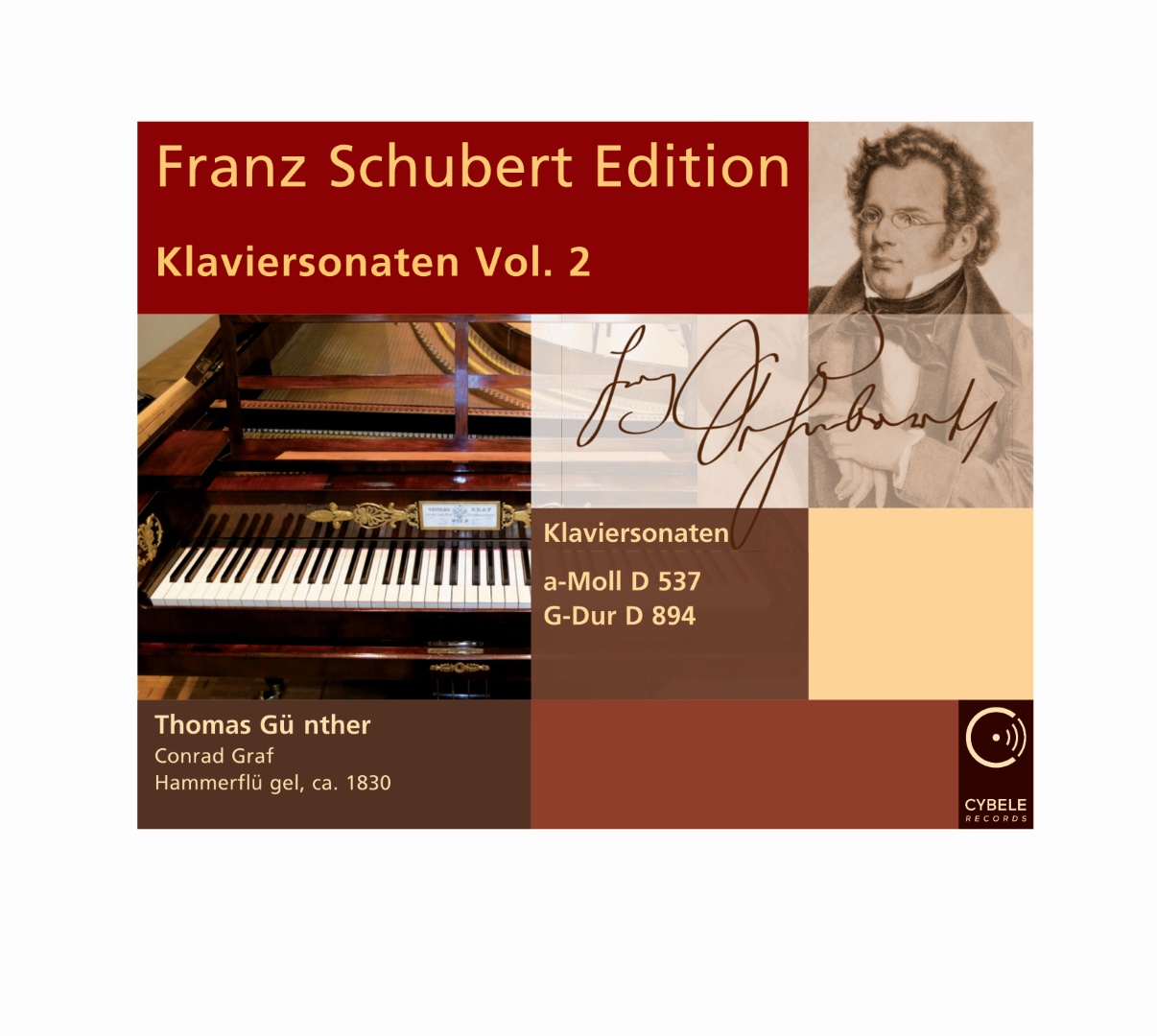
The Hungarian Melody in B minor D 817 of 1824 stands close to the Moments musicaux. Schubert took up the same idea in far more lavish form in the four-hand Divertissement à la hongroise D 818; in the repeats Thomas Günther adopts ornaments and figurations from that version. The instrument is a fortepiano by Conrad Graf, with clearly distinguishable registers, a singing middle range and the moderator pedal that makes the sound not merely softer but distant. Thomas Günther, professor at the Folkwang University of the Arts in Essen since 2007, has worked with Cybele Records since 2003; his engagement with Schubert’s sonatas began with an encounter with a historical fortepiano.