
From the 1950s onwards Astor Piazzolla turned the somewhat outdated dance known as tango into a modern genre: he deconstructed its models, brought in influences from folk music, Baroque, classical music, klezmer, chanson, jazz and rock, and created the tango nuevo. For a long time he struggled against the prejudice that tango was the music of the underworld and had no place on the concert platform; when, after studying with Alberto Ginastera, he went to Nadia Boulanger in Paris, he therefore at first concealed his tango background, until Boulanger encouraged him to acknowledge it. The three-part suite “La Camorra”, named after the Neapolitan mafia organisation, dates from his last creative period; it appeared in 1989 on the album “Camorra”, the last of three recordings with the American producer Kip Hanrahan. The title can be read as a look back at his youth in New York, where mafiosi came and went in his father’s barber shop in Greenwich Village, but also as a self-confident reversal of a stigma. “La Camorra I” (1988) begins proudly, swaggering and restless, with sombre colours, noise effects and energetic glissandi, between which touching melodies assert themselves.
Piazzolla wrote the group of pieces “Soledad”, “Fugata” and “Tangata” in 1969 for the ballet “Silfo y Ondina” by the choreographer Oscar Araiz, which was never realised. “Soledad” moves to the swaying pulse of a shadowy milonga before the bandoneon enters with a wistful theme; in “Fugata” four voices enter one after another on the principle of the Baroque fugue, and the piece becomes increasingly percussive – in Italian the title means “driven away”. In “Tangata” the bandoneon theme from “Soledad” returns in a solemn guise. “Adios Nonino” was written in 1959 during a dark period: attacked by tango purists as a traitor and without the hoped-for recognition in New York either, Piazzolla learned of the death of his father Vicente, affectionately known as Nonino. Not least this piece brought about his international breakthrough in the 1960s. “Romance del Diablo” (1965) is the introspective piece of a devil trilogy written, together with “Tango del Diablo” and “Vayamos al Diablo”, for a concert in New York; it begins with hazy layers of fourths from which a sensual, elegant theme emerges.
Santiago Cimadevilla, the Argentine-born bandoneonist of the quintet, wrote “Ecos” (2024) for the International Bach Festival Canarias in Las Palmas on Gran Canaria. The melody with which the bandoneon begins derives from the main theme of the first movement of Bach’s Harpsichord Concerto in D minor BWV 1052, at first in inversion and with a gesture immediately reminiscent of Piazzolla; in a fugue, tango passages and cadenzas Piazzolla’s stylistic features emerge more and more clearly, and at the end Bach’s theme appears in its original form. The Chilean pianist Gabriel Nunez Arancibia tells a story of emancipation in “Nueva Tanda no. 1: Epopeya de la Liberacion de una Mujer”, premiered by the Fracanapa New Tango Quintet in Magdeburg in 2022. In “Ilusion” a dancer discovers the fascination of tango but is hurt by her partner’s overly tight grip; “Desvelo” (“Insomnia”) depicts her conflict between her love of tango and the embrace that prevents her from expressing herself. In “El Abrazo Roto” she resists another confining embrace and finally dances freely on her own.
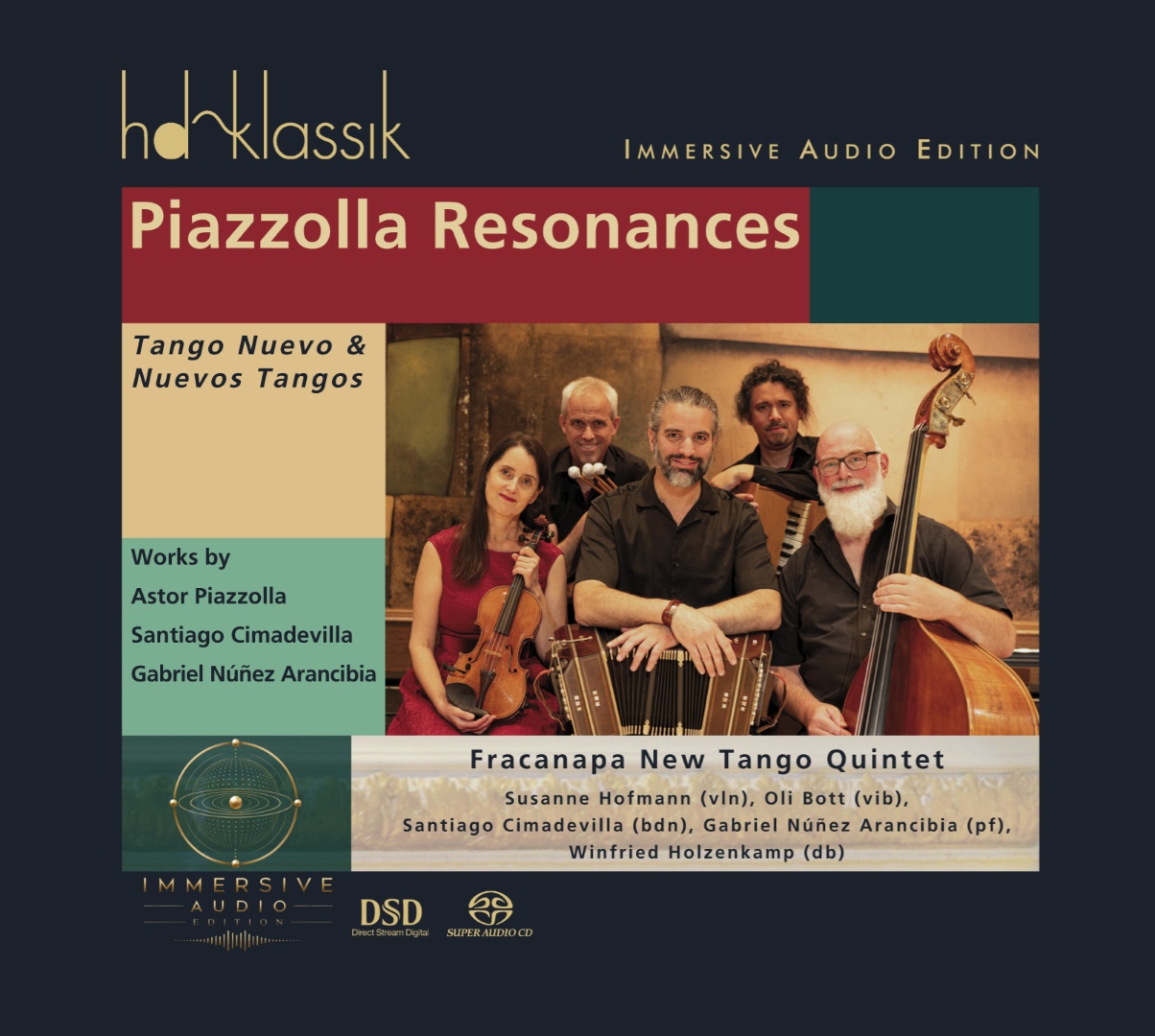
The violinist Susanne Hofmann, co-principal second violin of the Magdeburgische Philharmonie, founded the quintet in 2007 after encounters with Argentine musicians and an intensive exploration of Piazzolla’s music. She is joined by Oli Bott (vibraphone), who studied with Gary Burton at Berklee College of Music in Boston and lives in Berlin, Santiago Cimadevilla (bandoneon), who teaches at Codarts Rotterdam, Gabriel Nunez Arancibia (piano), who has lived in France since 2016, and Winfried Holzenkamp (double bass), who as a DAAD scholar in Buenos Aires played in the Orquesta Escuela de Tango under Emilio Balcarse and studied tango double bass. The recording was made in June 2025 at the Stadthalle in Meinerzhagen; the album appeared in hd-klassik’s Immersive Audio Edition.