
* 31 January 1797 in Vienna (Himmelpfortgrund), died on 19 November 1828 in Vienna; composer; he received his first lessons from his father and from Michael Holzer, entered the imperial court chapel as a choirboy in 1808 and attended the Stadtkonvikt until 1813; from about 1812 he studied counterpoint with Antonio Salieri. From 1814 to 1816 he worked as an assistant teacher at his father’s school; in 1816 he gave up the post and from then on lived as a freelance composer in precarious circumstances. In the summer of 1818 and again in 1824 he was music tutor to the Esterhazy family in Hungary. Within his circle of poet, painter and musician friends the Schubertiaden came into being, at which his works were first heard. His output comprises some six hundred Lieder, nine symphonies, piano sonatas and piano pieces, string quartets and quintets, an octet and trios, masses and sacred works as well as operas and Singspiele, most of which remained unperformed during his lifetime. He was buried in the Währinger Ortsfriedhof and later transferred to the Vienna Zentralfriedhof. In the Cybele catalogue his music is represented on four albums. In 1995 Bernd F. Marseille recorded the Piano Sonatas in A minor D 784 and in B flat major D 960 on a Steinway D concert grand at the Erholungshaus of Bayer AG in Leverkusen; the album appeared in 1997. In 2006 Thomas Günther opened the Franz Schubert Edition with the Sonatas in A minor D 845 and in A major D 959 on a historic fortepiano; in 2025 there followed the Sonatas in A minor D 537 and in G major D 894 as well as in E major D 157, in F sharp minor D 571 and in A major D 664.
Franz Schubert
Composer
Recordings on Cybele
-
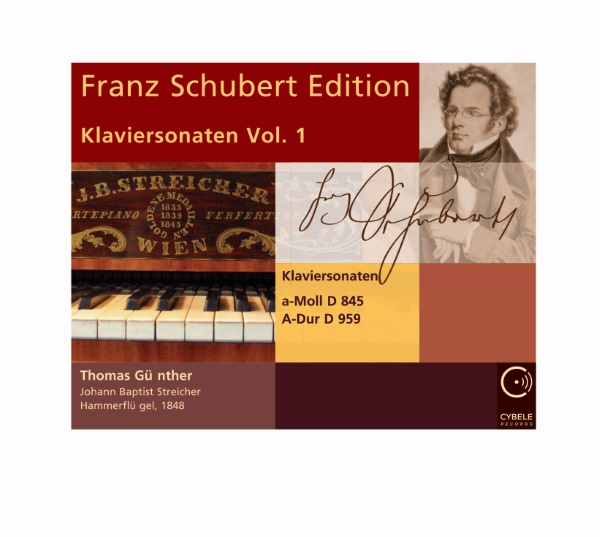
Franz Schubert Edition: Piano Sonatas Vol. 1: Sonatas in A minor D 845 and in A major D 959
-
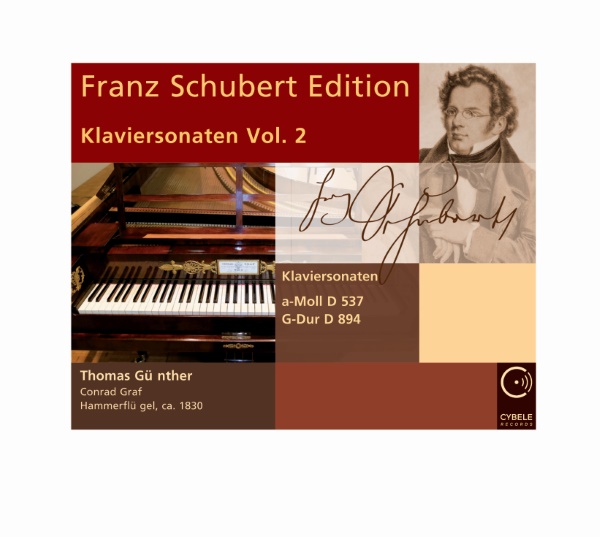
Franz Schubert Edition: Piano Sonatas Vol. 2: Sonatas in A minor D 537 and in G major D 894
-
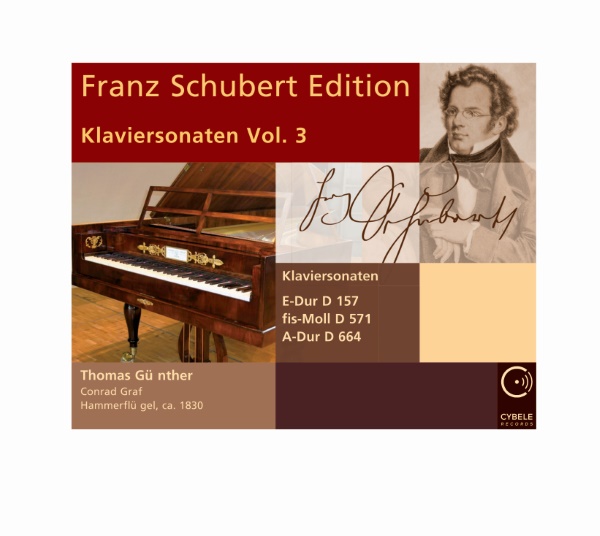
Franz Schubert Edition: Piano Sonatas Vol. 3: Sonatas in E major D 157, in F sharp minor D 571 and in A major D 664
-
Franz Schubert’s Piano Sonatas D 784 and D 960