
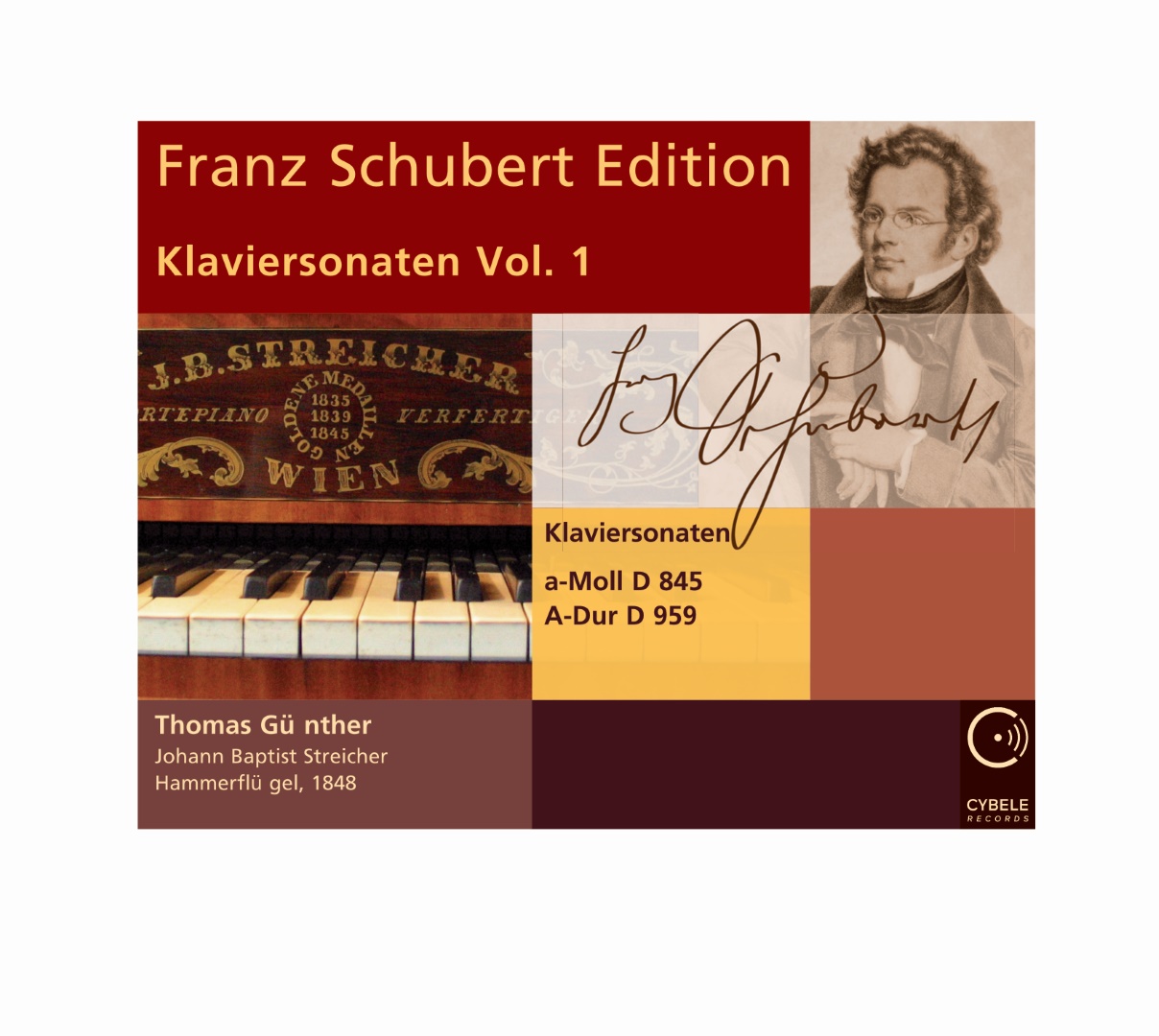
In the late 1970s, as a piano student, Thomas Günther heard a fortepiano recital on a Viennese Brodmann of 1815 with five pedals; his reaction to this first encounter with “original sound”, as he writes in the booklet, vacillated between estrangement and fascination. Only twenty years later, listening to Andreas Staier and Malcolm Bilson, did the connection between instrument, repertoire and pianistic approach make sense to him. In July 2004 he sat down at a fortepiano himself for the first time — the Streicher of this recording, which he had agreed to play at its presentation. The first touch of the keys was almost a shock: far more power was needed to elicit sounds from the instrument than he had expected. Over time his tempi slowed, because the instrument, and even each individual note, needs longer to develop its sound fully.
The great Sonata in A minor D 845 Op. 42 of 1825 was the first sonata to appear in print in Schubert’s lifetime. In the opening movement Günther hears a rhetorical, declamatory gesture; the lapidary main theme, often stated in unison, stands close to the sonata fragment in C major D 840, the so-called Reliquie, and to the middle section of the song Totengräbers Heimweh D 842. The development begins wanly, as if from a distance, in ppp, before a shimmering tapestry of tremoli leads to a climax that seems to burst the movement’s sonic frame. The Andante con variazioni, which Schubert is said to have played often among his friends, is technically among the most demanding music he wrote: five variations on a melody bedded on pedal points, dramatically intensified in the minor variation and finally transformed into an apotheosis of dance in 9/8 time. The stubborn Scherzo works with note repetitions, syncopations and irregular periodicity, the trio by contrast with an almost naive peacefulness. The Rondo is a short, restless perpetuum mobile into which the martial drums of the first movement suddenly return.
In the Sonata in A major D 959 Op. posth. of 1828 the Andantino is preceded by a monumental opening movement which, after a resolute, almost defiant opening gesture, presents one of those singing themes that show the song composer Schubert at the height of his mastery. The Andantino itself, a modest 3/8 movement of crotchets and quavers that darkens as far as semihemidemisemiquavers, disturbed Günther on first hearing and struck him almost as new music; the reprise after this catastrophe lays over the melody, built essentially of sighing motifs, a sweetness that merely papers over the deepest resignation. The Scherzo plays with rapid arpeggios in swiftly changing registers, the trio carries the listener off into a peaceful world beneath whose surface dangers seem to lurk. The Rondo spins out in “heavenly lengths” a melody Schubert had used eleven years earlier in the middle movement of his Sonata in A minor D 537; after a whirling, virtuosic stretta the main motif of the first movement returns and closes the circle.
Among fortepiano players the name Streicher enjoys an outstanding reputation: during the hundred years of the firm’s existence in Vienna, three generations of the family produced some 8600 instruments, beginning with Nannette Streicher, daughter of the Augsburg organ and instrument builder Johann Andreas Stein, and her husband Johann Andreas Streicher, a boyhood friend of Friedrich Schiller. Their son Johann Baptist took over the firm in 1833. The grand of this recording, Op. No. 4261/751 of 1848, is at 246 cm the larger of two models and, with its Anglo-German action, its frame dampers and its case veneered in flamed mahogany, was more expensive than the standard model with Viennese action. It is built almost entirely of wood, spans seven octaves with 85 keys and is one of the first Streicher grands with an iron pressure bar to improve the sound of the treble. Alexander Langer describes in the booklet how the instrument, unplayable for years with a cracked soundboard in a house on Lake Constance, was restored in his Klagenfurt workshop and tuned to a1 = 440 Hz, the Viennese pitch around 1848.
Thomas Günther studied at the Folkwang-Hochschule in Essen and at the Hochschule der Künste in Berlin and owes important impulses to the Schnabel pupils Maria Curcio and Konrad Wolff. In 1983 he appeared as a soloist at the Berliner Festwochen for the first time and made his début at the Berliner Philharmonie with Beethoven’s Fifth Piano Concerto; John Cage, Dieter Schnebel and Juan Allende-Blin are among the composers who entrusted first performances to him. Besides the piano music of the Russian Futurists and of the German-Jewish generation in exile, the keyboard music of Bach has occupied him particularly since the late 1980s; he has taught at the Folkwang-Hochschule since 1990. He recorded the two sonatas from 4 to 8 September 2005 in the Kreuzkirche in Duisburg; the instrument was maintained by Tamara Sucher of Klagenfurt.