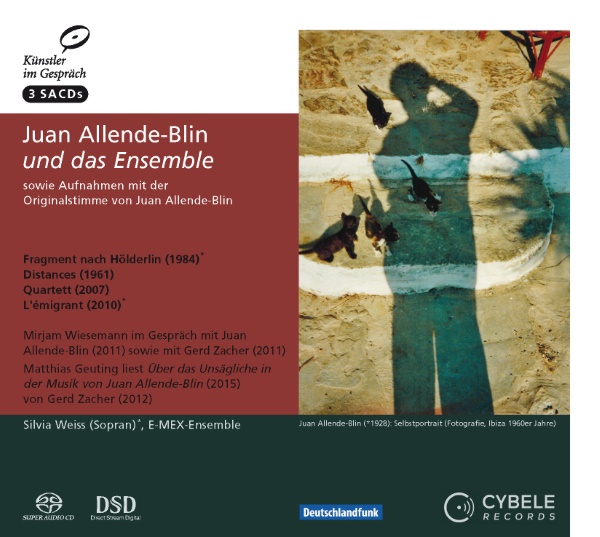
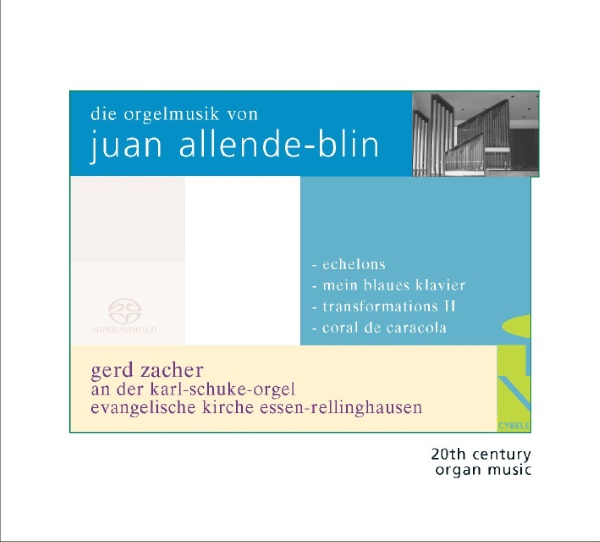
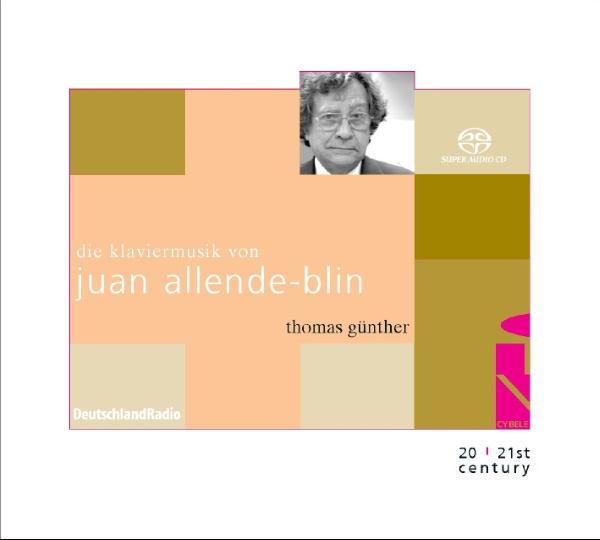
* 1928 in Santiago de Chile; studied composition in Chile with Fré Focke and in Europe with Olivier Messiaen; settled permanently in Germany in 1957; worked for radio as an author, director and producer of radiophonic works of art; championed the work of composers living in exile or persecuted by the Nazi regime; awarded the Karl-Sczuka-Preis and the Bundesverdienstkreuz. He comes from a Spanish-French family; he received his first composition lessons from his uncle Pedro Humberto Allende-Saron, afterwards from Fré Focke, a pupil of Anton Webern. At the Darmstädter Ferienkurse he attended the classes of Olivier Messiaen. From 1952 he wrote for Gerd Zacher a series of organ pieces that extend the technical possibilities of the instrument, among them “Transformations II” (1952), “Échelons” (1962–1968), “Mein blaues Klavier” for organ and barrel organ (1970) and “Coral de Caracola” (1985), commissioned by the Berliner Festwochen. His stage work “Des Landes verwiesen – Konzertante und szenische Aktionen”, a commission of the Berliner Festwochen, was premiered in 1978 at the Akademie der Künste Berlin and revived in 2009 at the Theater Bonn. He received the Karl-Sczuka-Preis in 1983 for “Rapport sonore / Relato sonoro / Klangbericht”. Four albums connect him with Cybele and form a portrait of his work in several steps. The Piano Music of Juan Allende-Blin (2003) is played by Thomas Günther on the Steinway D concert grand, while in one work the composer himself handles the piano strings; The Organ Music of Juan Allende-Blin (2005) is taken over by Gerd Zacher on the Karl-Schuke organ in Essen-Rellinghausen, with Allende-Blin himself on the barrel organ. In 2016 there followed Juan Allende-Blin and the Ensemble from the Edition Künstler im Gespräch, which appeared on the Longlist 3/2016 of the Preis der deutschen Schallplattenkritik. He is also represented with a composition on the audiobook production Weht ein Stadtspaziergang durch den Traum (2014).
Juan Allende-Blin
Composer / Organ