
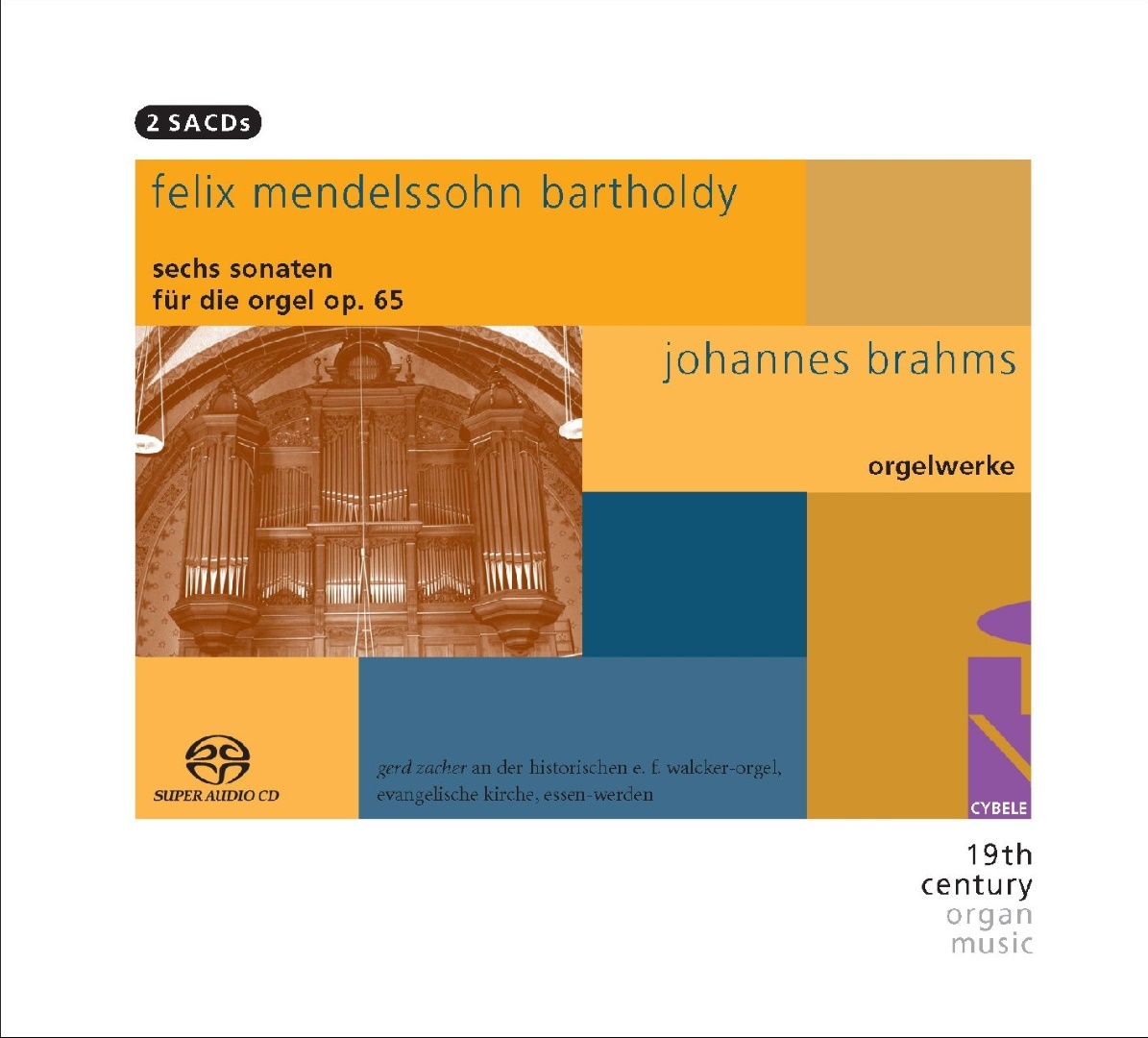
On 10 April 1845 Mendelssohn informed the publishers Breitkopf und Härtel of a work for organ that had “grown much larger than I had originally imagined”: six sonatas which were to be published as one work. In October 1845 Robert Schumann praised their “genuinely poetic new forms”. Gerd Zacher, who wrote the booklet texts, sees the cycle as a rare case of music stimulating organ building: the so-called romantic organs, he argues, arose partly in response to the many layers of these sonatas. The key sequence f–c–A–B flat–D–d (minor in lower case, major in upper case) deliberately departs from the order of composition.
In the Organ Sonata in F minor Op. 65 No. 1 the interplay of first and second subjects is replaced by the conflict between sonata and chorale; Mendelssohn notates the chorale, already 300 years old at the time, on a separate staff, as if from another world. The Organ Sonata in C minor Op. 65 No. 2 has no chorale, places two slow movements at the beginning, follows them with a march in triple time and ends with an earlier fugue that at the same time unfolds in sonata form. In the Organ Sonata in A major Op. 65 No. 3 a sketch of the wedding march Felix had written for his sister Fanny frames a dramatic fugue with the chorale “Aus tiefer Not schrei ich zu dir” in the bass.
The Organ Sonata in B flat major Op. 65 No. 4 follows the four-movement layout of a piano sonata, with an “Andante religioso” and a final fugue rich in modulation. The Organ Sonata in D major Op. 65 No. 5, the first to be written, begins with an invented chorale, which Zacher plays according to the practice of the time with long pauses for breath and echo, and ends with a rondo. The last to be written, the Organ Sonata in D minor Op. 65 No. 6, is based on Luther’s “Vater unser im Himmelreich”; the variations follow the declamation of the first six verses until, at “Gib uns heut unser täglich Brot”, the full organ unexpectedly breaks in.
Johannes Brahms had the Fugue in A flat minor WoO 8 published in a music journal in 1864; with its seven flats it goes beyond Bach’s “Well-Tempered Clavier”, and its theme, according to Zacher, anticipates Arnold Schönberg’s “Variations on a Recitative” Op. 40. The Eleven Chorale Preludes Op. 122, “composed in Ischl in May 1896” according to the first edition, were published posthumously; Zacher plays them in the order of the manuscript. In the tenth a steady pulse leads into an Adagio like a heart standing still, and in the eleventh each line takes its leave with a twofold echo.
E. F. Walcker of Ludwigsburg built the organ of the Evangelische Kirche Essen-Werden in 1900 with 37 stops on three manuals and pedal; it is a listed monument, and its colours blend, as was required at the time. Gerd Zacher, born in Meppen in 1929, headed the Protestant church music department of the Folkwang-Hochschule Essen from 1970 and gave the first performances of organ works by John Cage, Mauricio Kagel, György Ligeti and Isang Yun. The recordings were made from 20 to 24 June 2005.