
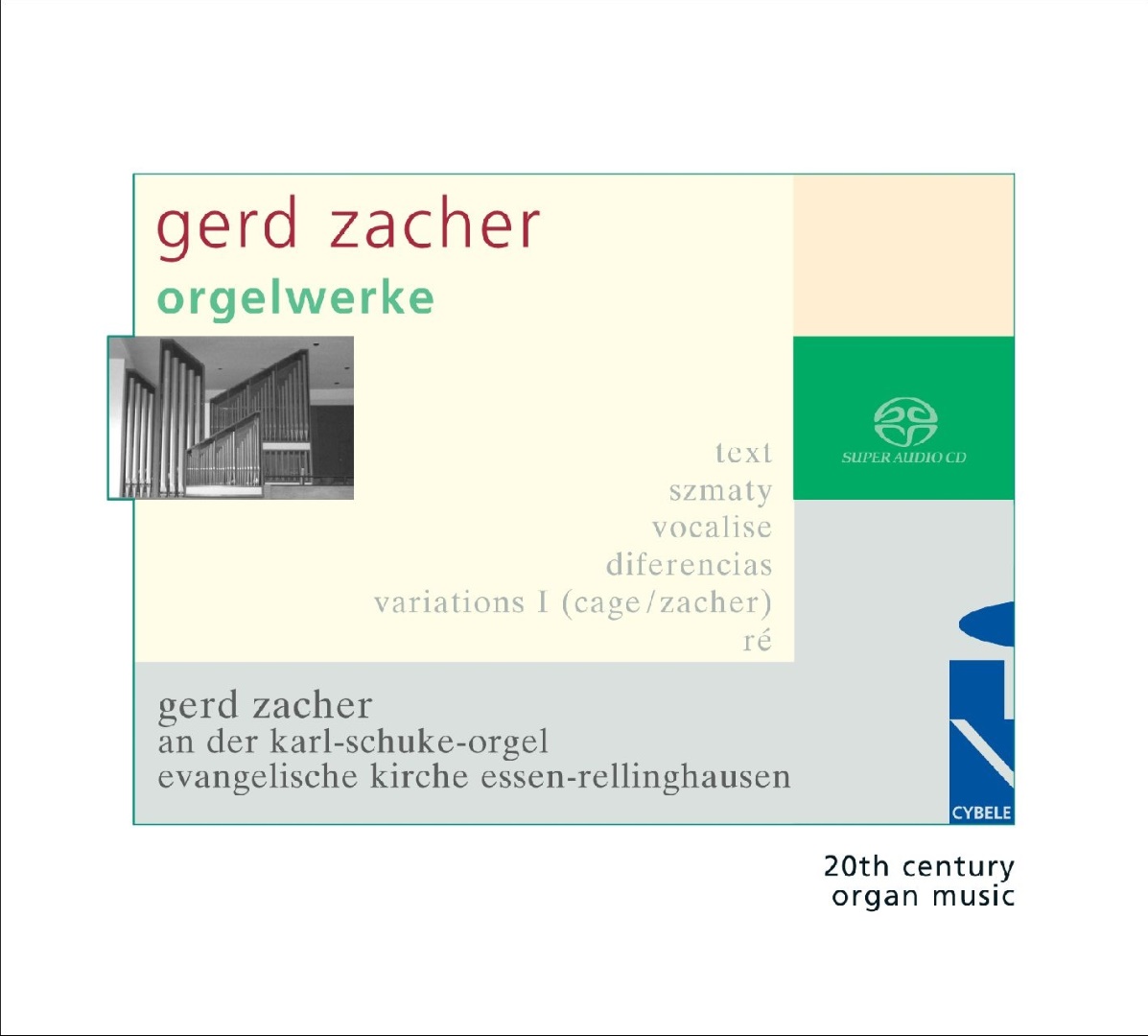
Text; Szmaty; Vocalise; Diferencias; Realisation über Cages Variations I; Ré. Zacher’s own works display the same spirit of enquiry that marked his interpretations of new music. Text translates the stations of Jeremiah 36 into changing musical procedures; Diferencias varies the very idea of variation. The realisation of Cage’s Variations I and Ré open work, interpretation and instrument to chance, language and shared action.
Here the organ appears not as a mere instrument of tradition but as a laboratory for sound, time and space. Registral colours, mechanical noises, spatially separated sound sources and the particular acoustics of the recording venue become compositional parameters. It is the combination of precise notation and improvisatory thinking that opens up perspectives reaching far beyond the customary organ repertoire.
The recording sets store by transparency and spatial differentiation. Fine individual voices remain as present as large-scale accumulations; abrupt gestures, long resonances and quiet transitions keep their dramaturgical function. The music can thus be experienced both as a sequence of characteristic sound images and as a carefully built formal process.
Historical formal models and present-day playing techniques meet here as equals. Chorale, passacaglia, fantasy and meditation are not quoted to create familiarity but carried on as open forms of thought. This makes the programmes accessible to listeners who wish to discover new music through concrete tone colours, recognisable gestures and the sensuous presence of the instrument.
Interpretation and instruments are decisive for this programme: Gerd Zacher – Karl Schuke organ, Essen-Rellinghausen; Ingo Vinck – voicer in Ré. The particular stops, playing techniques and spatial conditions shape articulation and dramaturgy. Historical instruments are treated not as museum pieces but as living sounding bodies whose particularities directly inspire new music and improvisation.
The extensive booklet places the works, the circumstances of their creation and the recording situation in context. The result is an album that works equally as a concentrated portrait in works and as an invitation to listen and discover. The careful production preserves dynamic extremes, reverberation and fine transitions of colour, and makes the interplay of composition, interpretation and space intelligible.