
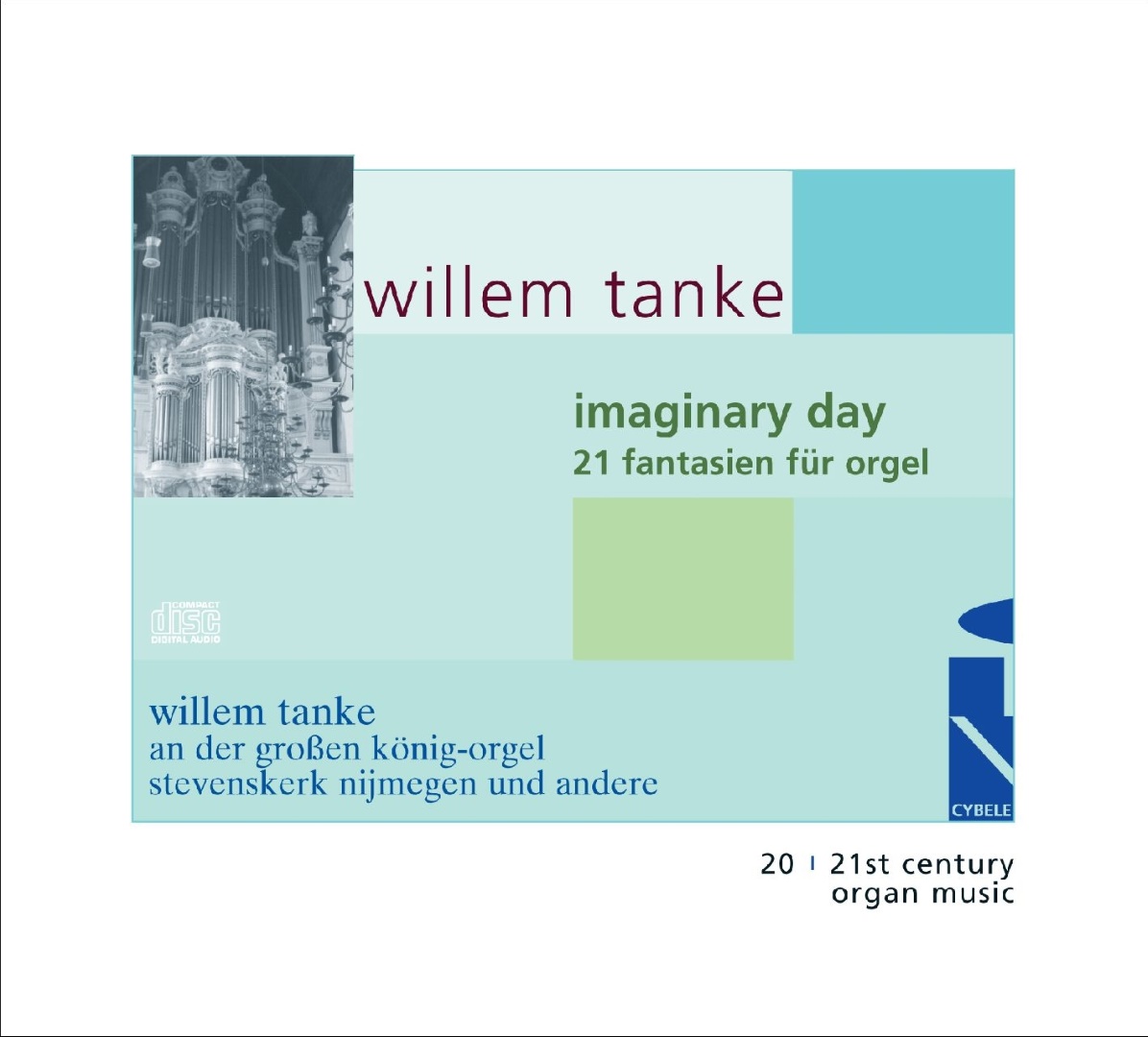
Willem Tanke, born in 1959, was organist of the Saint Willibrorduskerk in Berkel-Enschot from 1989 to 2003. There and in churches where he had given concerts, two series of organ pieces came into being between 1996 and 2001, Imaginary Day and Meditations. As he describes in the booklet, each piece starts from an “invention”, a usable idea emerging from improvisation; a second invention may be added for contrast. Out of repeated playing from the sketches the composition gradually crystallises — a process that can last weeks or years and that in the end allows fully written-out pieces as readily as pieces with open sections. Only For a Child and Bagpipes were composed from the start.
The difficulty lay in building a coherent collage from these pieces — not only because of the diversity of the organs, but also because of the differences in character, tonality, texture and colour brought about by each registration. The morning opens with Call of the Trumpet over an organ point whose keys are held down by two weights, leaving both hands free for the melody and its accompanying figures. In The Mixolydian Mode – Part One the vox humana produces strange cries of joy and anguish; how much of this is improvised becomes clear from a comparison with the afternoon version, Part Two. In the Pièce en trio I three chromatically related tonal centres run on top of one another, C in the bass, B in the soprano, C sharp in the middle voice; the wide spacing of the parts and the acoustics of the church nevertheless make the writing sound consonant.
The afternoon opens towards non-European material: Tanke came to know Yehowah Kpo Kpo from Ghana and Anyi Bialale from Cameroon while playing with African musicians between 1998 and 2000; the experience, he writes, thoroughly called his European notions of efficiency and professional conduct into question. The First Psalm was written for a performance by the actor Henk van Ulsen, as was Breakwave, which in his “Job” illustrated a terrible storm and the stillness before and after it. Jeux de fonds, Carillon and Bicycle Horn takes up the French practice of the seventeenth and eighteenth centuries of naming organ pieces after their registration: the bicycle horn sounds a major second corresponding to the A flat and B flat of the Nijmegen organ, which is why the piece stands in F minor.
In fantasias 11, 12, 16, 17 and 20 Tanke plays percussion with whichever hand is free: an African drum, the Ghanaian bell on a stick known as gosoeah, Indian bells, wine bottles, copper and tin jugs chosen for the way they sound in a large church. For Come and Dream, of the several recordings made the one was chosen in which bells and children’s voices can be heard from outside. The recordings were made on four instruments: the Chataîgne organ of 1782 in Vouziers, the König organ of 1773–1776 in the Stevenskerk in Nijmegen, the Bätz organ of 1831 in the Domkerk in Utrecht and the Loret organ of 1880 in Berkel-Enschot. Tanke studied organ with Jan Welmers, music theory with Joep Straesser and electronic music with Ton Bruynel at the Utrecht Conservatory, taught there from 1988 to 2000 and is professor of “The Art of Doing Nothing” at the Rotterdam Conservatory.