
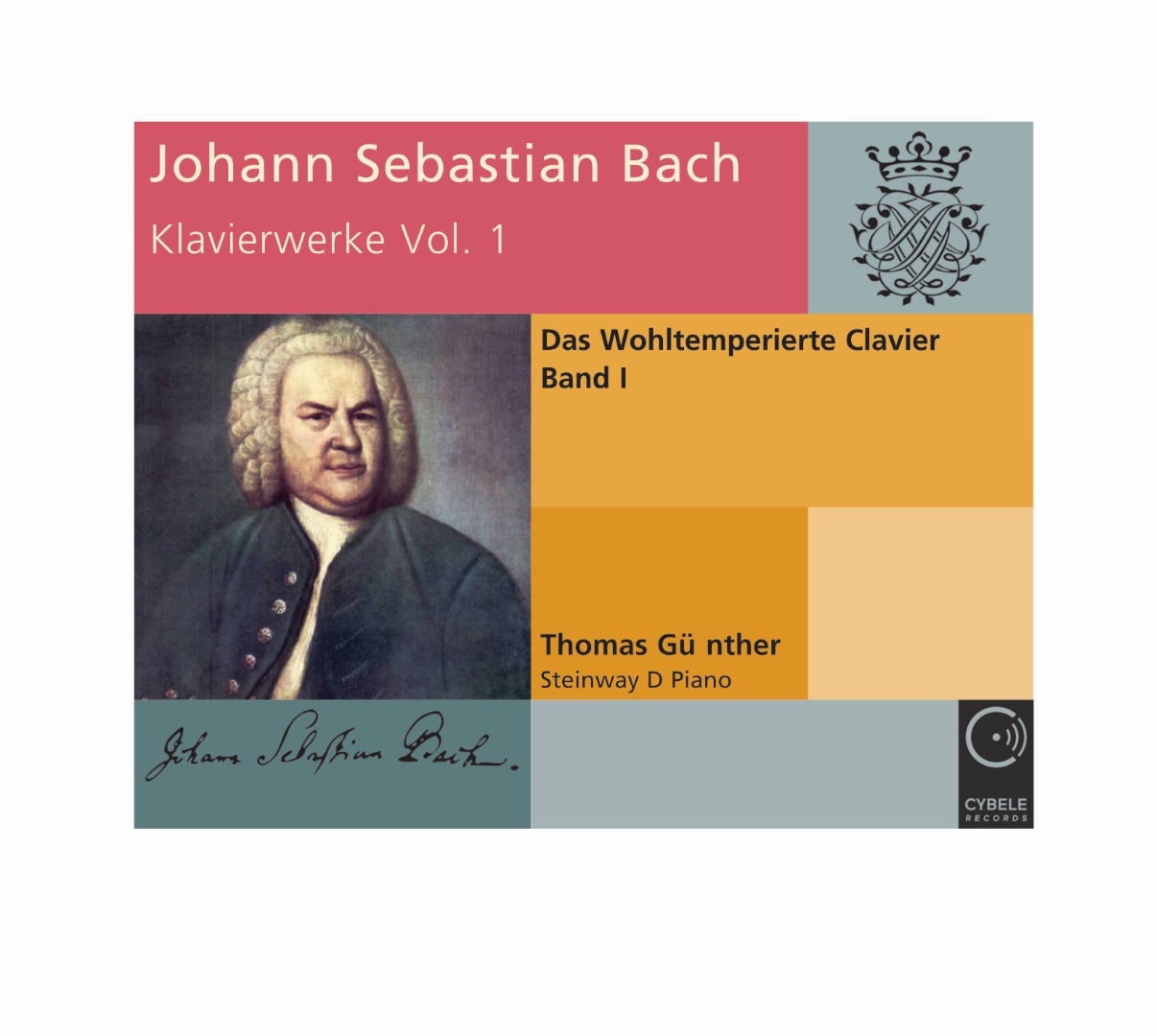
Das Wohltemperierte Clavier of 1722 is one of the most consequential summits in the history of music, the “Old Testament” of pianists, as Hans von Bülow called it. For Thomas Günther, who wrote the booklet text, its unique rank rests not only on its compositional substance and its standing as a compendium of the technical possibilities of its time, but above all on the new and until then largely theoretical use of all the keys, which produced an unprecedented variety of “temperaments”. It should not be forgotten that equal temperament was still the exception in Bach’s day, when “temperament” was audible as a sharpening or clouding of intervals. Countless uses have been made of the collection since: Bach’s own, as a “Clavierübung” for his sons and pupils; its role as a “school of musical thinking” (Christoph Hohlfeld) for later generations of composers; and the interpretative approaches of the “age of technical reproducibility” (Walter Benjamin).
The history of its interpretation begins about a hundred years after its composition with the edition of Beethoven’s pupil Carl Czerny, who claimed to have heard the work played just so by his master. Further “instructional” editions followed, among them one by Liszt’s pupil Carl Tausig; the edition Ferruccio Busoni began in the 1890s marks a high point and still offers valuable suggestions, particularly for performance on the modern piano. The history preserved on disc is no less remarkable: after the romantic pathos of the first half of the 20th century, the sober rigour of the 1950s and 1960s that accompanied the spread of urtext editions, and the rediscovery of historical performance practice, almost anything now seems possible in matters of style. Hardly anyone still questions whether the modern grand can serve as Bach’s “Clavier”; Günther recalls Glenn Gould and Rosalyn Tureck’s remark, “The medium is not the message.”
More important than a knowledge of contemporary treatises, Günther argues, is insight into the structure of the compositions. Three historical layers bear on any performance: the transmitted text in its contemporary diction, today’s piano as an inheritance of the 19th century, which obliges the player to shape the dynamics meaningfully, and our own present with its analytical methods and its long history of reception. The polyphonic writing demands above all “clarity”, together with a grasp of the architecture of the form and of the “affect” of each piece; the whole should be played, as Bach puts it in his “sincere instruction”, in “a cantabile manner” — which by no means implies unbroken legato. On the pedals Günther invokes the lute-like manner of playing described by Jean-Claude Zehnder, “une délicatesse de main”: in planar preludes built from broken chords the sustaining pedal is no breach of style but the adequate transfer of that technique to the piano. The una corda pedal is the instrument’s last remaining “stop”; the sostenuto pedal holds the long pedal points Bach requires, for instance at the end of the Prelude and Fugue No. 20 in A minor BWV 865.
The widest field, however, is articulation, which Bach rarely prescribes because he presumes the “expertise” of the player; only in recent years has musical rhetoric entered the consciousness of pianists as well. Already in the first prelude of the collection a “passus duriusculus” appears in the bass at the point of greatest harmonic density, a resistance the player must feel and convey to the listener. Whether Bach intended a cyclic performance remains an open question; that the work has cyclic qualities in the order he chose is, for Günther, beyond doubt. Most of the fugues are in three or four parts, one is in two and two are in five; these last stand in C sharp minor and in B flat minor and form, in Christoph Hohlfeld’s phrase, the “centres of gravity of the cycle”, flanked by lighter, scherzo-like pieces. A clear caesura after the twelfth fugue divides the book into two halves, each beginning with a naively charming prelude in broken triads and closing with an elaborately chromatic fugue. Eleven of the twelve preludes of the first half already appear, in various stages of development, in the Clavierbüchlein für Wilhelm Friedemann Bach of 1720, the seed of the collection; Günther has recorded five of these early versions as bonus tracks.
Thomas Günther received his artistic training at the Folkwang-Hochschule in Essen and the Universität der Künste in Berlin; he owes important impulses to the Schnabel pupils Maria Curcio in London and Konrad Wolff in New York. He was admitted to the Studienstiftung des deutschen Volkes in 1980, won the Folkwang competition in 1981, appeared for the first time at the Berliner Festwochen in 1983 and made his début the following year at the Philharmonie in Berlin with Beethoven’s fifth piano concerto. Since the late 1980s the keyboard music of Bach and the questions raised by playing it on the piano have been especially close to his heart; he has given complete performances of both books of the Wohltemperierte Clavier, of the Clavierübung II and of the Goldberg Variations in several large German cities. In 2004 he founded the International Rotary Piano Competition, and since 2007 he has been professor of piano at the Folkwang Universität der Künste in Essen. The recording was made in its Neue Aula.