
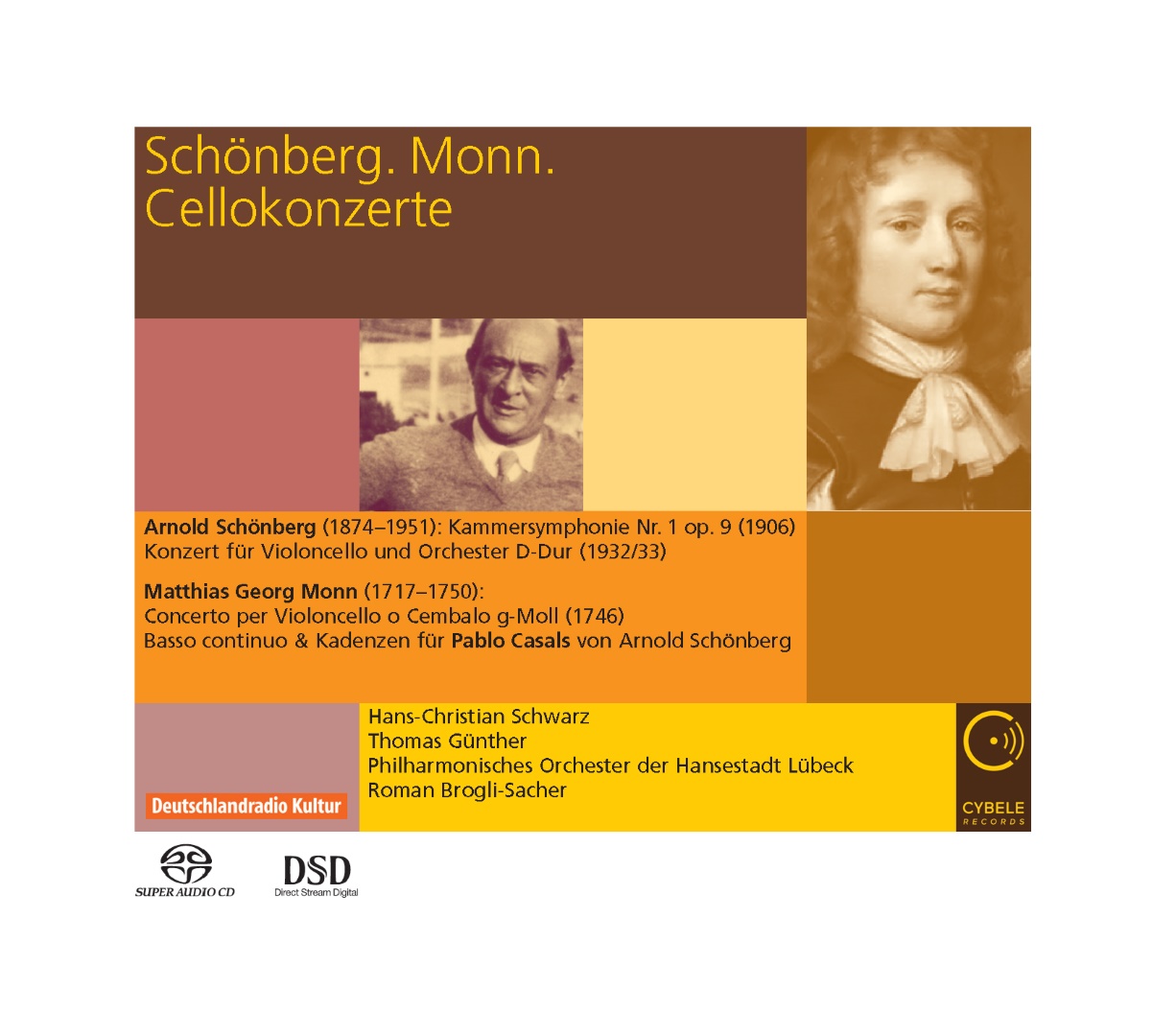
The Chamber Symphony No. 1 in E major Op. 9 for 15 solo instruments was written in 1906, the year in which Gustav Mahler completed his Eighth Symphony and Richard Strauss succeeded as an opera composer with “Salome”. Schönberg sought not to outdo the lavish orchestral sound of Wagner’s successors but to overcome it: reducing the scoring to 15 solo instruments makes the contrapuntal texture transparent. The single-movement form reflects exposition, development and recapitulation, yet themes and motifs react to one another in such complex ways that the work reveals itself only on repeated hearing. The premiere in Vienna on 8 February 1907 turned into a scandal; Schönberg, by contrast, believed he had now found his personal style.
Schönberg came to Matthias Georg Monn (1717–1750), organist in Klosterneuburg, Melk and at the Karlskirche in Vienna, through Guido Adler, the founding father of musicology in Vienna. For Adler’s Denkmäler der Tonkunst in Österreich he was to realise the figured bass of works by Monn, but he understood this as creative work that openly acknowledges the stylistic break – to the annoyance of some purists. For the Concerto per Violoncello o Cembalo in G minor he wrote extensive cadenzas for Pablo Casals in 1913, which start from the material of the main themes and lead into another musical cosmos. Casals played Monn’s concerto in Vienna on 19 November 1913 with the Wiener Philharmoniker under Franz Schalk; in Schönberg’s version it appears here on disc for the first time.
In the booklet Hans-Christian Schwarz describes the pitfalls of the cadenzas: their chains of double stops do not progress in manageable steps, and octaves in the high register suddenly stand beside sixths in the low register. Thomas Günther calls the harpsichord part “unhistorical”, overloaded and unwieldy, but also witty; accordingly, he plays a Neupert harpsichord, closer to the tradition of the 20th century than to the Baroque.
Some two decades later, in the winter of 1931/32, when Schönberg was treating his asthma in Barcelona, Casals asked him for a piece for cello; back in Berlin, Schönberg chose Monn’s Harpsichord Concerto in D major as its basis. The Concerto for Violoncello and Orchestra in D major is among the last works he completed in Berlin before emigrating in 1933. Like Mozart with Händel’s “Messiah”, he wrote to Casals, he had removed “whole handfuls of sequences” and brought the whole closer to the style of Haydn. In fact the ritornello form gives way to an interweaving of variation and thematic development, and the solo part is full of chromatic runs, double stops, arpeggios and harmonics. Casals studied the work intensively but never played it in public; Emanuel Feuermann gave the first performance in London on 7 November 1935 under Sir Thomas Beecham.
Schwarz has been principal cellist of the Philharmonisches Orchester der Hansestadt Lübeck since 1994 and here plays with “his” orchestra under Roman Brogli-Sacher, general music director in Lübeck from 2001 to 2013. The two concertos were recorded live at a symphony concert in the Großer Saal of the Musik- und Kongreßhalle on 28 June 2009, the Chamber Symphony in the same hall in October 2007. In the booklet Richard Erkens tells the story of the two concertos, illustrated with sketches, manuscripts and letters by Schönberg. The album is a co-production with Deutschlandradio Kultur.