
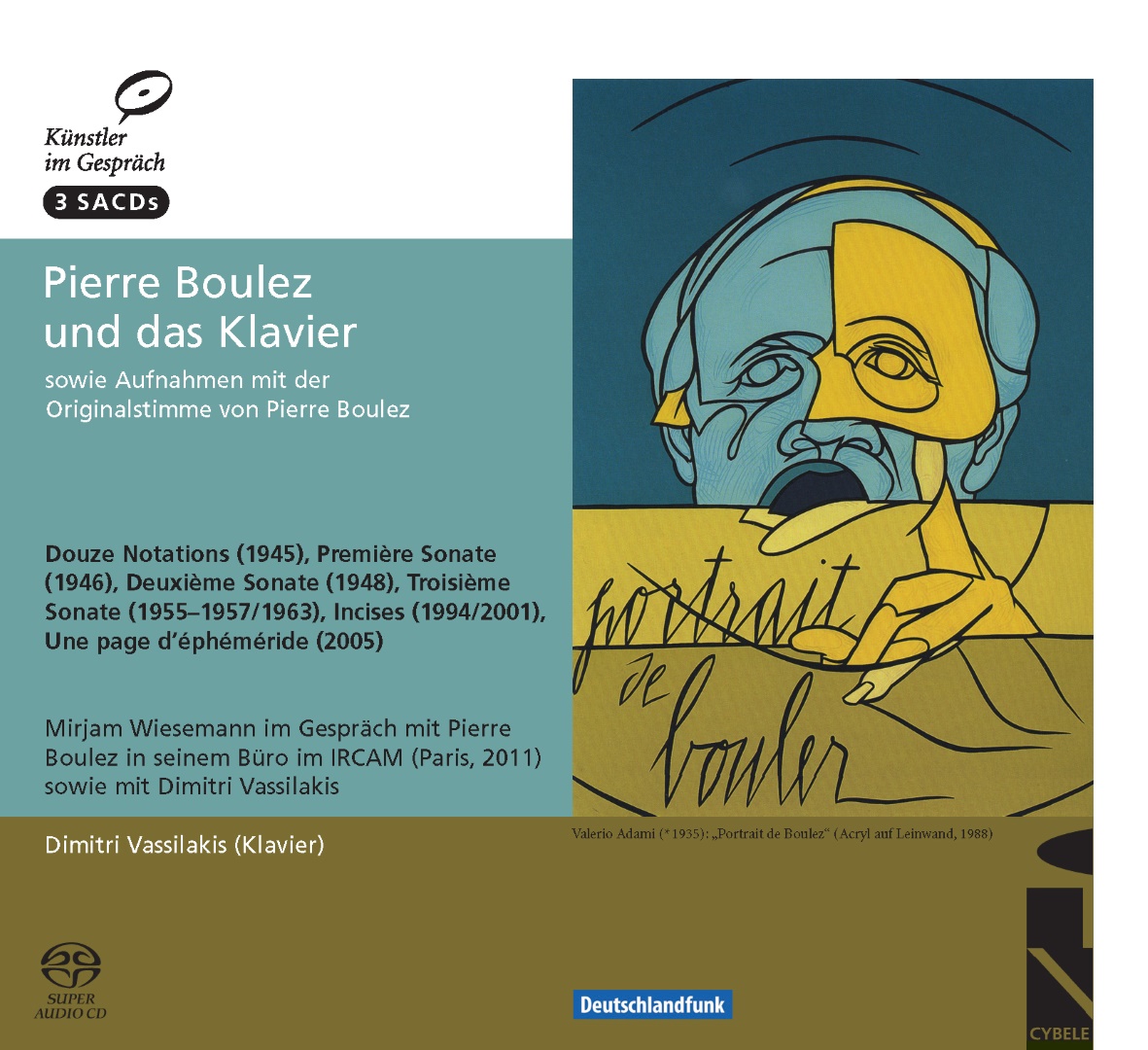
After its heyday in the 19th century, the piano seemed to lose importance in the 20th, but remained, as Robert Nemecek writes in the booklet, a laboratory for the new. The young Pierre Boulez took up this thread: between 1945 and 1957 he produced a body of piano music that reflects his path from the adoption of twelve-tone technique through serialism to the opening up of form. In the Douze Notations (1945), twelve pieces of twelve bars each written in twelve-tone technique, his personal style emerges for the first time; their rhythmic variety ranges from the percussive Très vif to the introverted Lointain, Calme.
The Première Sonate (1946) confines itself to two related movements; in the rhythmically liberated passages the piano becomes, in Boulez’s words, an “instrument of delirium”. The Deuxième Sonate (1948) takes up Beethoven’s sonata form in order to dissolve it: in the first movement B-A-C-H is heard in slightly altered form, the slow movement draws on the medieval trope, and after a brief scherzo the finale leads through a fugue and the instruction pulvériser le son to a restrained close that sounds like a farewell to the classical sonata.
In the Troisième Sonate (1955-1957/1963), modelled on Mallarmé’s Livre project, the formants are mobile and the performer chooses his own route; Boulez compared the form to a city, a labyrinth for which one needs a map. After the premiere in 1957 he withdrew three formants for revision. Vassilakis plays the sonata in the most complete version currently possible, including Sigle, a fragment of Antiphonie published in 1968. Only more than thirty years later did Boulez return to the piano: Incises (1994/2001, expanded version of 2001), commissioned by the Umberto Micheli piano competition, thrives on the joy of virtuosity; Une page d’éphéméride (2005) was written for a “Piano Project” of Universal Edition.
Mirjam Wiesemann met Boulez on 31 January 2011 in his office at IRCAM, the Paris institute for research into acoustics and music which he had founded in 1977. In the conversation, held in German, Boulez, who otherwise reveals nothing of his private life, talks about freedom of expression in serial music, control and chance in John Cage, his collaboration with Frank Zappa, Antonin Artaud and the theatre, Olivier Messiaen, his childhood and growing old. People are lazy, he exclaimed when asked about the difficulty of new music: everyone must find his own way into it.
Dimitri Vassilakis, born in Athens in 1967, studied at the Conservatoire National Supérieur de Musique in Paris. In the conversation on 17 May 2011 at the Cybele Studios in Düsseldorf he talks about his childhood in Greece, his teenage love of Chopin, his first encounters with Messiaen and Boulez, his audition for the Ensemble InterContemporain and working with the composer. He recorded the piano works in December 2010 and March 2011 in the Deutschlandfunk Kammermusiksaal in Cologne, as a co-production with the broadcaster. opushd.net gave the album its Opus d’Or award.