
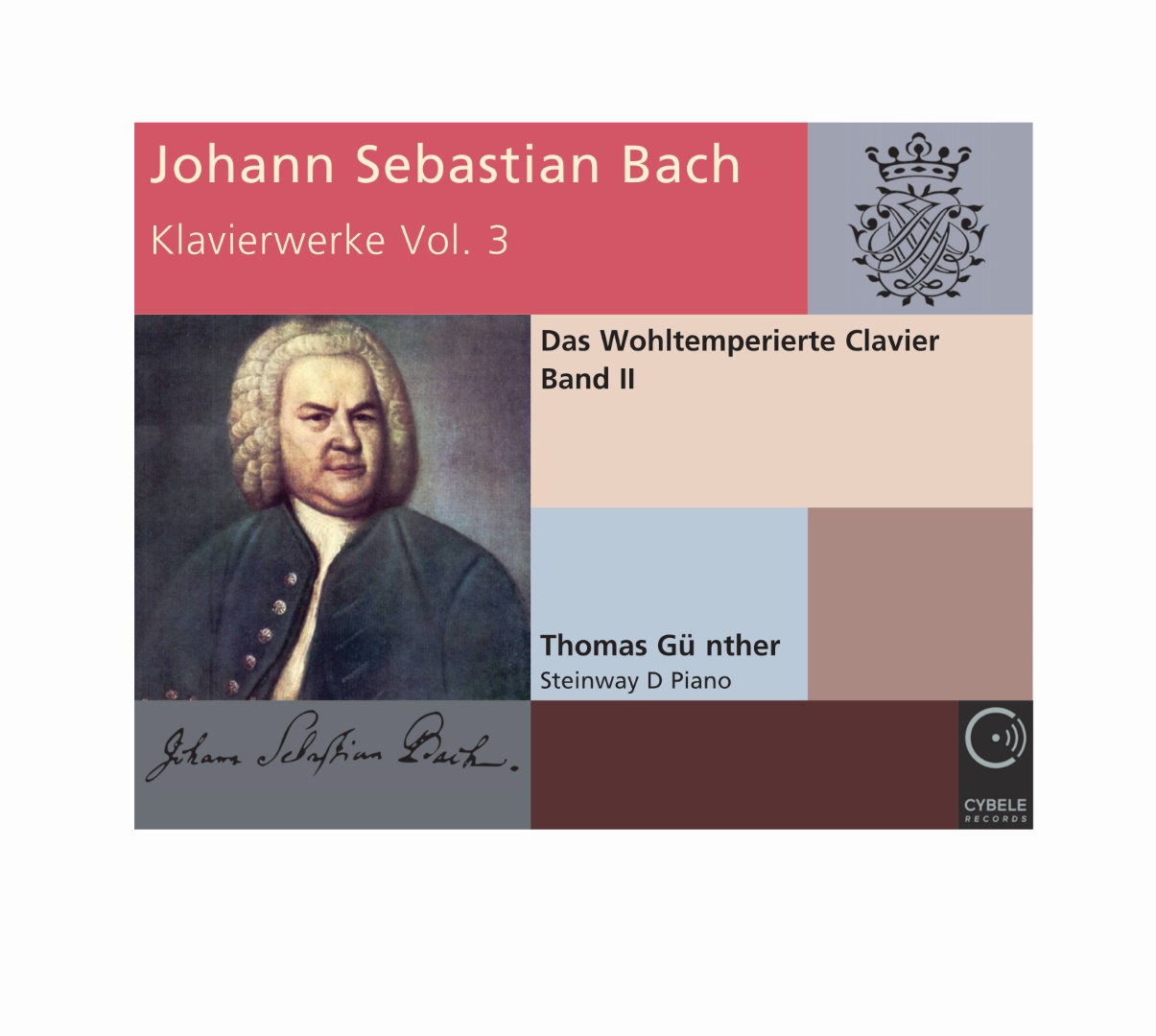
Cybele 3D-132502

Cybele 3D-132502 2025

3D binaural stereo 5.1 surround DSD Stereo Classical music Baroque music 2:21:31

To the description

Johann Sebastian Bach: Piano Works Vol. 3 – Das Wohltemperierte Clavier Band II BWV 870-893 (24 Preludes and Fugues)

Contributors

Thomas GüntherPiano

Composer

Johann Sebastian Bach

Short description

A good twenty years after Das Wohltemperierte Clavier of 1722, Johann Sebastian Bach assembled a second collection of 24 preludes and fugues in all the major and minor keys; the title “Des Wohltemperierten Claviers zweyter Theil” is not his own but that of his pupil Altnikol. Thomas Günther plays the book not in the ascending chromatic order of the print but in an arrangement of his own, developed on the model of the “new hang” at the Museum Folkwang in Essen from the descent from dominant to tonic and the constant alternation of major and minor: four sections of six pairs each, whose arc opens in C major and closes in C minor.

Details

Carrier format
Hybrid SACD

Resolution
DSD64 / 2.8224 MHz 1 bit

Total playing time
141:31

Channels
Stereo, 5.1 surround, 3D binaural stereo

Recording Producer: Ingo Schmidt-Lucas

Specifications

Catalogue number
Cybele 3D-132502
Year of release
2025
Genre
Classical music
Period
Baroque music
Instrumentation
Piano, Solo instrument
GTIN
4068992481685
Booklet (pages)
0

Track listing

48 tracks · 2:21:31

  1. 01 Prelude and Fugue No. 1 in C major BWV 870 – Prelude Composer: Johann Sebastian Bach (1685-1750) Performer: Thomas Günther 2:33
  2. 02 Prelude and Fugue No. 1 in C major BWV 870 – Fugue Composer: Johann Sebastian Bach (1685-1750) Performer: Thomas Günther 1:27
  3. 03 Prelude and Fugue No. 12 in F minor BWV 881 – Prelude Composer: Johann Sebastian Bach (1685-1750) Performer: Thomas Günther 4:45
  4. 04 Prelude and Fugue No. 12 in F minor BWV 881 – Fugue Composer: Johann Sebastian Bach (1685-1750) Performer: Thomas Günther 1:45
  5. 05 Prelude and Fugue No. 17 in A flat major BWV 886 – Prelude Composer: Johann Sebastian Bach (1685-1750) Performer: Thomas Günther 3:32
  6. 06 Prelude and Fugue No. 17 in A flat major BWV 886 – Fugue Composer: Johann Sebastian Bach (1685-1750) Performer: Thomas Günther 2:40
  7. 07 Prelude and Fugue No. 4 in C sharp minor BWV 873 – Prelude Composer: Johann Sebastian Bach (1685-1750) Performer: Thomas Günther 4:49
  8. 08 Prelude and Fugue No. 4 in C sharp minor BWV 873 – Fugue Composer: Johann Sebastian Bach (1685-1750) Performer: Thomas Günther 2:04
  9. 09 Prelude and Fugue No. 9 in E major BWV 878 – Prelude Composer: Johann Sebastian Bach (1685-1750) Performer: Thomas Günther 4:38
  10. 10 Prelude and Fugue No. 9 in E major BWV 878 – Fugue Composer: Johann Sebastian Bach (1685-1750) Performer: Thomas Günther 3:57
  11. 11 Prelude and Fugue No. 20 in A minor BWV 889 – Prelude Composer: Johann Sebastian Bach (1685-1750) Performer: Thomas Günther 5:11
  12. 12 Prelude and Fugue No. 20 in A minor BWV 889 – Fugue Composer: Johann Sebastian Bach (1685-1750) Performer: Thomas Günther 1:42
  13. 13 Prelude and Fugue No. 3 in C sharp major BWV 872 – Prelude Composer: Johann Sebastian Bach (1685-1750) Performer: Thomas Günther 2:06
  14. 14 Prelude and Fugue No. 3 in C sharp major BWV 872 – Fugue Composer: Johann Sebastian Bach (1685-1750) Performer: Thomas Günther 2:06
  15. 15 Prelude and Fugue No. 14 in F sharp minor BWV 883 – Prelude Composer: Johann Sebastian Bach (1685-1750) Performer: Thomas Günther 3:20
  16. 16 Prelude and Fugue No. 14 in F sharp minor BWV 883 – Fugue Composer: Johann Sebastian Bach (1685-1750) Performer: Thomas Günther 4:02
  17. 17 Prelude and Fugue No. 19 in A major BWV 888 – Prelude Composer: Johann Sebastian Bach (1685-1750) Performer: Thomas Günther 1:37
  18. 18 Prelude and Fugue No. 19 in A major BWV 888 – Fugue Composer: Johann Sebastian Bach (1685-1750) Performer: Thomas Günther 1:17
  19. 19 Prelude and Fugue No. 6 in D minor BWV 875 – Prelude Composer: Johann Sebastian Bach (1685-1750) Performer: Thomas Günther 1:33
  20. 20 Prelude and Fugue No. 6 in D minor BWV 875 – Fugue Composer: Johann Sebastian Bach (1685-1750) Performer: Thomas Günther 1:56
  21. 21 Prelude and Fugue No. 11 in F major BWV 880 – Prelude Composer: Johann Sebastian Bach (1685-1750) Performer: Thomas Günther 2:53
  22. 22 Prelude and Fugue No. 11 in F major BWV 880 – Fugue Composer: Johann Sebastian Bach (1685-1750) Performer: Thomas Günther 1:42
  23. 23 Prelude and Fugue No. 22 in B flat minor BWV 891 – Prelude Composer: Johann Sebastian Bach (1685-1750) Performer: Thomas Günther 2:47
  24. 24 Prelude and Fugue No. 22 in B flat minor BWV 891 – Fugue Composer: Johann Sebastian Bach (1685-1750) Performer: Thomas Günther 3:44
  25. 25 Prelude and Fugue No. 5 in D major BWV 874 – Prelude Composer: Johann Sebastian Bach (1685-1750) Performer: Thomas Günther 5:16
  26. 26 Prelude and Fugue No. 5 in D major BWV 874 – Fugue Composer: Johann Sebastian Bach (1685-1750) Performer: Thomas Günther 2:23
  27. 27 Prelude and Fugue No. 16 in G minor BWV 885 – Prelude Composer: Johann Sebastian Bach (1685-1750) Performer: Thomas Günther 2:43
  28. 28 Prelude and Fugue No. 16 in G minor BWV 885 – Fugue Composer: Johann Sebastian Bach (1685-1750) Performer: Thomas Günther 3:02
  29. 29 Prelude and Fugue No. 21 in B flat major BWV 890 – Prelude Composer: Johann Sebastian Bach (1685-1750) Performer: Thomas Günther 6:21
  30. 30 Prelude and Fugue No. 21 in B flat major BWV 890 – Fugue Composer: Johann Sebastian Bach (1685-1750) Performer: Thomas Günther 2:13
  31. 31 Prelude and Fugue No. 8 in D sharp minor BWV 877 – Prelude Composer: Johann Sebastian Bach (1685-1750) Performer: Thomas Günther 4:06
  32. 32 Prelude and Fugue No. 8 in D sharp minor BWV 877 – Fugue Composer: Johann Sebastian Bach (1685-1750) Performer: Thomas Günther 4:14
  33. 33 Prelude and Fugue No. 13 in F sharp major BWV 882 – Prelude Composer: Johann Sebastian Bach (1685-1750) Performer: Thomas Günther 3:00
  34. 34 Prelude and Fugue No. 13 in F sharp major BWV 882 – Fugue Composer: Johann Sebastian Bach (1685-1750) Performer: Thomas Günther 2:22
  35. 35 Prelude and Fugue No. 24 in B minor BWV 893 – Prelude Composer: Johann Sebastian Bach (1685-1750) Performer: Thomas Günther 2:09
  36. 36 Prelude and Fugue No. 24 in B minor BWV 893 – Fugue Composer: Johann Sebastian Bach (1685-1750) Performer: Thomas Günther 1:50
  37. 37 Prelude and Fugue No. 7 in E flat major BWV 876 – Prelude Composer: Johann Sebastian Bach (1685-1750) Performer: Thomas Günther 2:25
  38. 38 Prelude and Fugue No. 7 in E flat major BWV 876 – Fugue Composer: Johann Sebastian Bach (1685-1750) Performer: Thomas Günther 1:51
  39. 39 Prelude and Fugue No. 18 in G sharp minor BWV 887 – Prelude Composer: Johann Sebastian Bach (1685-1750) Performer: Thomas Günther 4:14
  40. 40 Prelude and Fugue No. 18 in G sharp minor BWV 887 – Fugue Composer: Johann Sebastian Bach (1685-1750) Performer: Thomas Günther 5:10
  41. 41 Prelude and Fugue No. 23 in B major BWV 892 – Prelude Composer: Johann Sebastian Bach (1685-1750) Performer: Thomas Günther 1:41
  42. 42 Prelude and Fugue No. 23 in B major BWV 892 – Fugue Composer: Johann Sebastian Bach (1685-1750) Performer: Thomas Günther 3:22
  43. 43 Prelude and Fugue No. 10 in E minor BWV 879 – Prelude Composer: Johann Sebastian Bach (1685-1750) Performer: Thomas Günther 3:41
  44. 44 Prelude and Fugue No. 10 in E minor BWV 879 – Fugue Composer: Johann Sebastian Bach (1685-1750) Performer: Thomas Günther 2:43
  45. 45 Prelude and Fugue No. 15 in G major BWV 884 – Prelude Composer: Johann Sebastian Bach (1685-1750) Performer: Thomas Günther 2:31
  46. 46 Prelude and Fugue No. 15 in G major BWV 884 – Fugue Composer: Johann Sebastian Bach (1685-1750) Performer: Thomas Günther 1:21
  47. 47 Prelude and Fugue No. 2 in C minor BWV 871 – Prelude Composer: Johann Sebastian Bach (1685-1750) Performer: Thomas Günther 2:06
  48. 48 Prelude and Fugue No. 2 in C minor BWV 871 – Fugue Composer: Johann Sebastian Bach (1685-1750) Performer: Thomas Günther 2:41

Description

A good twenty years after Das Wohltemperierte Clavier of 1722, Bach presented a collection of exactly the same kind: 24 preludes and fugues in all the major and minor keys. The title “Des Wohltemperierten Claviers zweyter Theil” is not his own but that of his pupil Altnikol; the book survives in two main sources, an autograph complete but for three pairs of movements, the so-called London autograph, and a copy by Altnikol, besides copies from the circle of his pupils. Unlike the first book, written in a short time and all of a piece, the second draws in part on older works, which Bach adapted to the demands of the new collection by expanding or transposing them, and sets beside them newly invented pieces: the learned stile antico as much as the fashionable galant manner and early forms of the classical sonata movement. The result, as Thomas Günther writes in the booklet, is an almost encyclopaedic compendium of old and new technical, compositional and aesthetic possibilities of keyboard music, in which the cyclic character recedes in comparison with the first book. While the fugues — in the second book only in three and four parts — look back, the preludes, with their variety of forms and moods, point forward.

Must such a book be played in the ascending chromatic order of the print? Günther thinks not. He invokes an essay by Herbert Henck of 1992 which argued for a rearrangement and made it audible in an unpublished recording: Henck separated a major from a minor half and ordered each in descending fifths. A second model came in 2019 from the Museum Folkwang in Essen, whose collection was then shown in a thematically and associatively ordered “new hang” that produced unfamiliar cross-references. Günther’s own arrangement, tried out since the late 1990s, keeps the descent from dominant to tonic but preserves the constant alternation of major and minor, rising a minor third from each minor key to its relative major. This yields four sections of six pairs each; the keynotes of every group of three form a triad, and the last piece of a group stands in the relative minor of the first. The arc opens in C major and closes in C minor — in place of the fugue in B minor, which Günther hears as an appendix rather than a finale, there is now a weightier ending. That other solutions are possible he demonstrates by citing Evgeni Koroliov, whom he heard in 2021 performing the work in three programme sections of eight pairs each, and Piotr Anderszewski’s selection of twelve preludes and fugues from the same year.

In the booklet Günther adds what needs particular thought in the more advanced, galant pieces of the second book. Unlike in the first part, many preludes are in binary form with repeat marks. Observing them not only lengthens the playing time considerably but also invites the performer to vary dynamics, articulation and ornamentation; where the sources offer divergent readings, the alternative can be played the second time round. Dynamic markings occur only once: the f and p in the prelude in G sharp minor may point to a two-manual harpsichord. The music needs no great contrasts, but does not forbid them either — a pianoforte, Günther observes, cannot be played without differences of volume at all, and too monochrome a rendering tires the listener. As for trills, he considers an appeal to Bach’s ornament table in the Clavierbüchlein für Wilhelm Friedemann insufficient on its own and the principle of beginning every trill on the beat with the upper auxiliary refuted; in the frequent sighing figures of the galant pieces the wavy line often stands rather for a Praller or a half trill. Conversely, the unusual opening of the fugue in F sharp major must be made audible, its subject trill beginning on the leading note.

The individual pieces cover a wide field. The prelude in C major, organ-like in its full chords, forms the festive entrance portal, in compositional terms a toccata di durezze e ligature whose dissonant texture almost disappears beneath the fullness of sound. The prelude in F minor, by contrast, is a sensitive, galant keyboard piece in the style of the generation of Bach’s sons, with sighing figures in parallel thirds and sixths and a binary form with reprise that approaches the early classical sonata. In the prelude in F sharp minor, which Günther counts among the finest in the collection, Ferruccio Busoni heard “a poetry of counterpoint recalling César Franck”; the accompanying fugue can be read as a triple fugue in three parts — apart from Contrapunctus 8 of Die Kunst der Fuge the only one in Bach. The Prelude and Fugue No. 22 in B flat minor BWV 891 is widely held to be the summit of the book and here closes the first half; the festive prelude in D major, probably the most advanced forerunner of the early classical sonata movement in the whole work, opens the second, much as the sixteenth of the Goldberg Variations does there. At the end stands the fugue in C minor, in which Bach layers the subject in its basic shape, in augmentation and in varied inversion, and piles up the strettos so densely that the individual entries can scarcely be followed.

Thomas Günther wrote the booklet text himself; it refers explicitly to his commentary on the Cybele recording of the first book, where the basic questions of playing Bach’s keyboard music on the modern piano — tempo, dynamics, phrasing and articulation, ornamentation, pedalling — are already set out. With the second book he continues his Bach series for the label, which previously brought the first book and the Clavier-Übung II and III.

Cybele 3D-132502