
Cybele 021409 1997

16bit 44.1kHz Stereo Classical music Baroque music 1:16:46

To the description

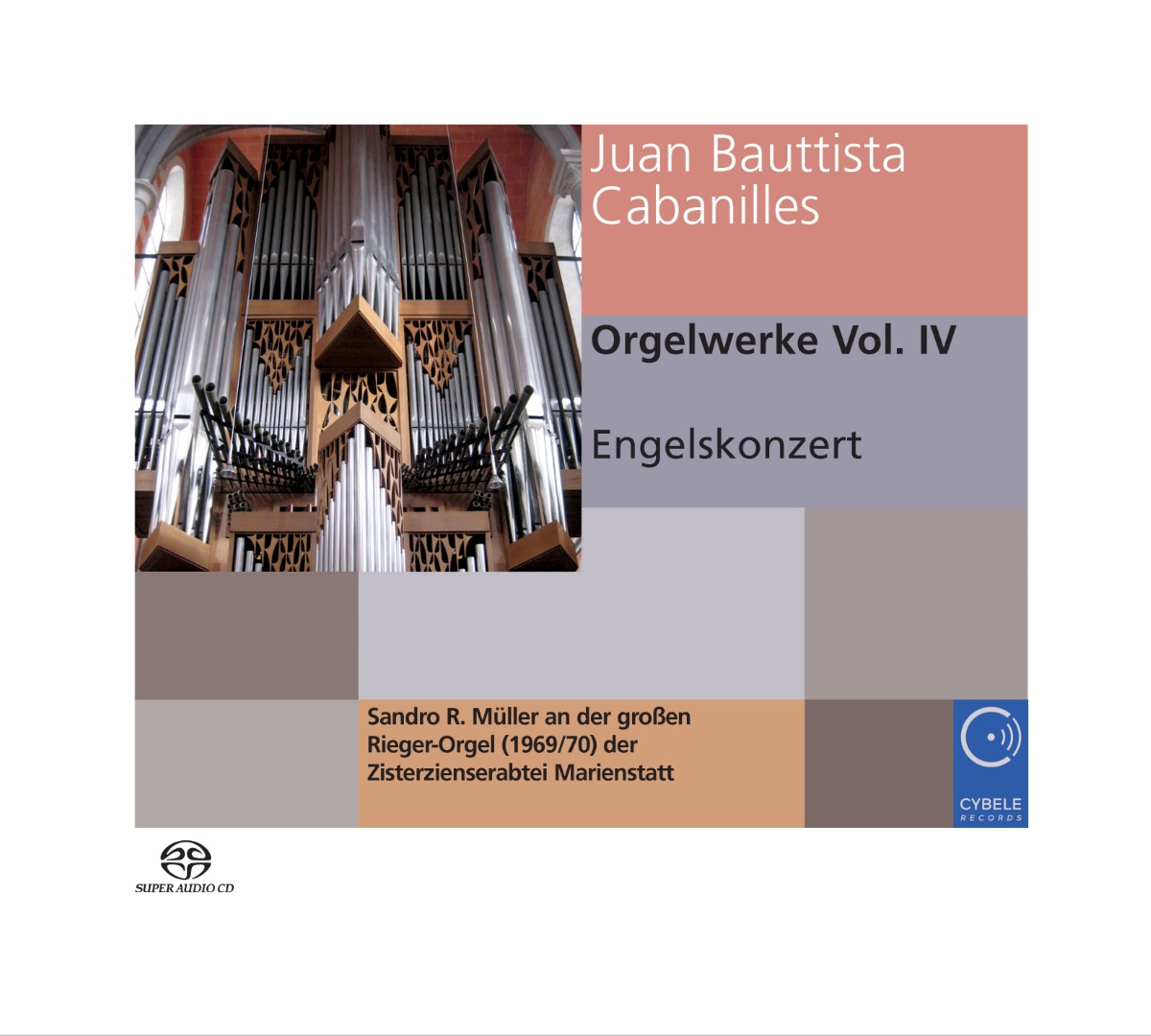
Juan Bautista Cabanilles: Organ Works Vol. IV, Engelskonzert

Contributors

Sandro R. MüllerOrgan

Composer

Juan Bautista Cabanilles

Short description

“Engelskonzert” is the fourth of the four “books” into which the organist Sandro R. Müller gathered organ works by Juan Bautista Cabanilles. It falls into three parts: the vision of the heavenly Jerusalem, a Mass for the feast of Corpus Christi followed by a procession of ships, and the visions of angels from the first and last books of the Bible, Jacob’s ladder and the seven trumpets of the Apocalypse. Müller plays the great Rieger organ of Marienstatt Abbey with its historic Spanish trompeteria.

Details

Carrier format
CD

Resolution
PCM 44,1 kHz / 16 bit

Total playing time
76:46

Channels
Stereo

Organ
Large Rieger organ (1969/70), Marienstatt Abbey Church

Recording
10/11 July and 13/14 November 1995

Booklet
German, English and French, 32 pages

Recording Producer: Ingo Schmidt-Lucas

Specifications

Catalogue number
Cybele 021409
Year of release
1997
Genre
Classical music
Period
Baroque music
Instrumentation
Organ
Label
Cybele Records
Barcode
809548001322
GTIN
4099885252464
Booklet (pages)
32

Track listing

11 tracks · 1:16:46

  1. 01 Tiento de Contras de 4° tono Composer: Juan Bautista Cabanilles (1644-1712) Performer: Sandro R. Müller 13:28
  2. 02 Tiento de falsas 6° tono Composer: Juan Bautista Cabanilles (1644-1712) Performer: Sandro R. Müller 1:39
  3. 03 Tiento Partido de Mano Izquierda de 7° tono Composer: Juan Bautista Cabanilles (1644-1712) Performer: Sandro R. Müller 7:43
  4. 04 Tiento 2° tono Composer: Juan Bautista Cabanilles (1644-1712) Performer: Sandro R. Müller 9:00
  5. 05 Pasacalles de 1° tono Composer: Juan Bautista Cabanilles (1644-1712) Performer: Sandro R. Müller 3:30
  6. 06 Paseos Composer: Juan Bautista Cabanilles (1644-1712) Performer: Sandro R. Müller 2:12
  7. 07 Tiento de falsas 4° tono Composer: Juan Bautista Cabanilles (1644-1712) Performer: Sandro R. Müller 4:03
  8. 08 Tiento lleno 5° tono Punto alto Sobre el Pange Lingua Composer: Juan Bautista Cabanilles (1644-1712) Performer: Sandro R. Müller 5:00
  9. 09 Tiento lleno 8° tono Composer: Juan Bautista Cabanilles (1644-1712) Performer: Sandro R. Müller 7:17
  10. 10 Tiento lleno sobre ut, re, mi, fa, sol, la, 5° tono Composer: Juan Bautista Cabanilles (1644-1712) Performer: Sandro R. Müller 15:13
  11. 11 Tiento de 5° tono Partido de Mano Derecha Composer: Juan Bautista Cabanilles (1644-1712) Performer: Sandro R. Müller 7:41

Description

From the organ works of Juan Bautista Cabanilles (1644–1712) the organist Sandro R. Müller formed a cycle of four “books” intended to reflect the theological cosmos of Spanish Catholicism and to do justice to Cabanilles as priest and organist. Because the surviving works contain virtually no indications of tone colour or articulation, Müller transferred the religious and mystical imagery of Spanish art of the 16th to 18th centuries to the stops of the organ. He gave each book one of the symbolic figures of the four Evangelists as a motto – man, lion, ox and eagle; the fourth book stands under the eagle of St John. Each piece is paired with a text, mostly from the Bible.

“Engelskonzert” has three parts. The first, “The Architecture of Heaven”, is devoted to the vision of the heavenly Jerusalem in the Revelation of St John: the Tiento de Contras de 4° tono, a study on slowly changing pedal points in the bass, sounds on two combined mixture choruses (llenos) of the main and echo divisions. The second part is a Mass for the feast of Corpus Christi – Introit, Epistle, Gospel, Offertory, Elevation, Communion and a hymn on Thomas Aquinas’s “Pange Lingua” –, followed by a mighty procession of ships, for which trompeteria, trompeta real and echo trumpets represent the sea trumpets. Müller assigns roles to the stops: in the Offertory, a Pasacalles de 1° tono, the crumhorns sing together and in alternation; the Elevation is a dialogue between nazard and crumhorn; in the Communion, voix céleste and vox humana unite as heaven and earth.

The third part, “The Boundaries of the Mind”, links the visions of angels from the first and last books of the Bible. Jacob’s ladder is represented by the Tiento lleno sobre ut, re, mi, fa, sol, la, 5° tono: over the hexachord a huge mixture plenum builds up step by step; when God speaks to Jacob, trompeteria and carillon interrupt the build-up. Müller interprets the closing Tiento de 5° tono Partido de Mano Derecha as a “Dance of Wrath for the Seven Trumpets”: the organ’s trompeteria leads a great crescendo, at the end of which all the reed stops join in the pedal.

In search of a suitable instrument, Müller and the producer Ingo Schmidt-Lucas came upon the great Rieger organ (1969/70) of the Cistercian abbey of Marienstatt in the Westerwald. It has a historic Spanish trompeteria with pipes dating from 1732, according to the booklet the only one outside the Iberian Peninsula. The recording was made in July and November 1995; the album was released in 1997.