
Alongside his collections of romantic character pieces, Max Reger wrote the cycle Fifty-two Easily Playable Preludes to the Most Common Protestant Chorales for Organ Op. 67 between 1900 and 1902. After the chorale fantasies, as Martin Schmeding explains in the booklet, he now wanted to provide chorale settings for “everyday use” in the Protestant service; he asked organist friends which chorales were most frequently used in practice. The collection appeared in the spring of 1903. Reger recommended it to the publisher with the remark that no such collection had been published since Johann Sebastian Bach, and assured him that the preludes were at least equal in quality to all his previous organ works, only technically easier.
The second book contains Nos. 16 to 35, among them widely sung hymns such as “Nun danket alle Gott”, “Lobe den Herren, den mächtigen König der Ehren”, “Jesu, meine Freude” and “Nun komm, der Heiden Heiland”. As with Bach in the Orgelbüchlein and the Leipzig chorales, each prelude is given its own profile: “Mach’s mit mir, Gott, nach deiner Güt” follows the model of the “coloured” chorale with an ornamented upper voice over richly harmonised lower parts, while “O Lamm Gottes, unschuldig” is shaped by descending chromaticism. Karl Straube, shortly before his appointment as Thomaskantor, was enthusiastic; even so, the pieces did not circulate widely at first because of their high technical demands despite their brevity.
Reger counted the cycle Five Easily Playable Preludes and Fugues for Organ Op. 56 among his minor works. He wrote to Straube that Op. 56 was to be understood as a bridge that would ease many an organist’s path to the real Reger; to the organist Walter Fischer he remarked: “I believe that these things are good.” The opus number is misleading, for the pieces were not completed until 1903, in parallel with the Gesang der Verklärten, Op. 71, among other works; owing to an earlier contract with the Munich publisher Joseph Aibl they received the lower number reserved for them. In length and form the pairs, like those of the sister work Op. 85, recall Bach’s Well-Tempered Clavier.
Prelude and Fugue No. 1 in E major opens with a song-like trio texture, interrupted by an agitated, recitative-like middle section; the fugue flows evenly. In Prelude and Fugue No. 2 in D minor Reger shows his cheerful, ironic side. The fugue, which the reviewer Alexander Wilhelm Gottschalg counted among the finest fugues of his time, stands out for its extreme articulation and chromatic lines, and in this resembles Robert Schumann’s fifth Fugue on B–A–C–H. In No. 3 a pastoral prelude is followed by a fugue in the stile antico modelled on Palestrina; No. 4 offers a prelude in the manner of Bach and, as its fugue, a lively trio. Prelude and Fugue No. 5 in B minor closes with the brooding Reger inclined to melancholy.
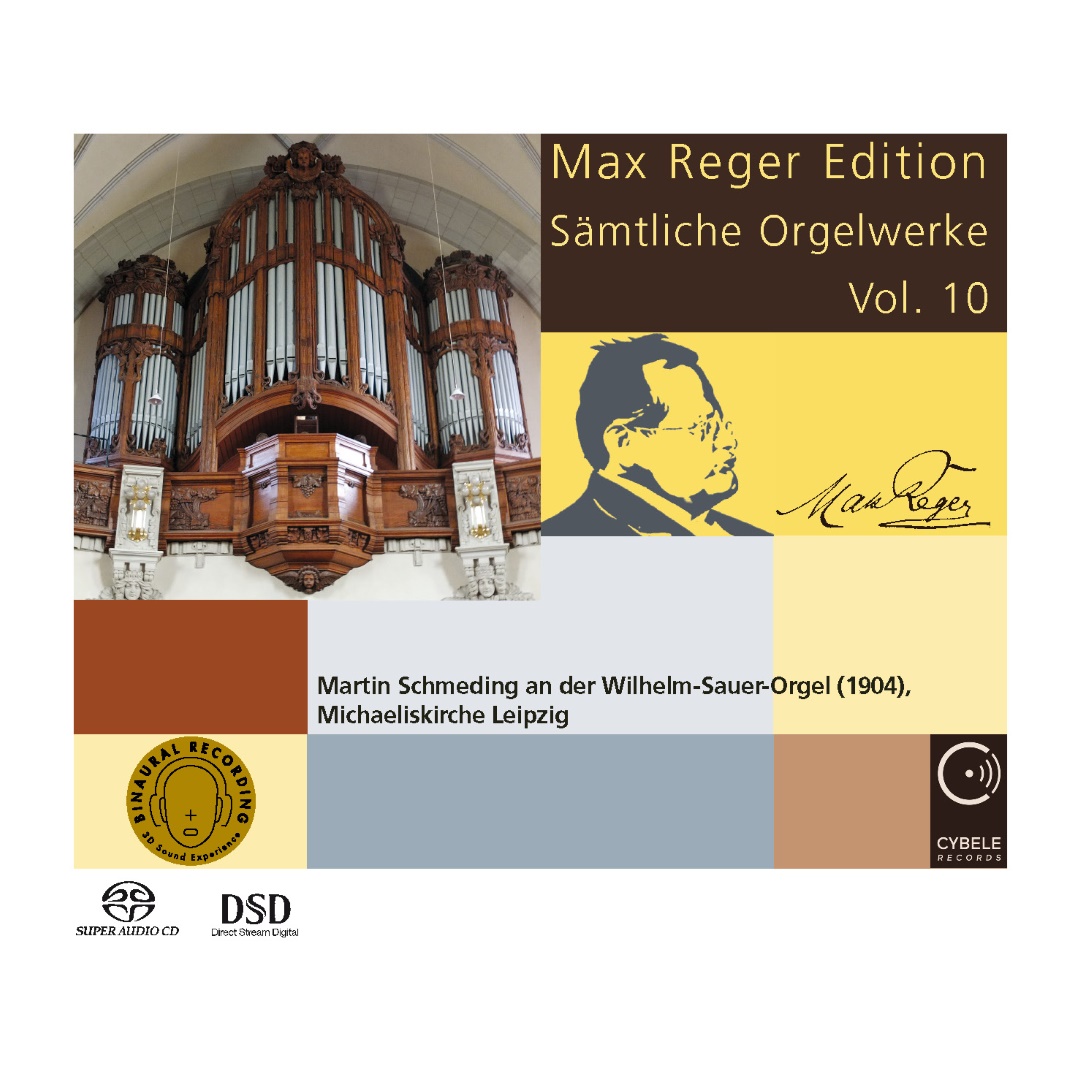
Church and organ of the Michaeliskirche in Leipzig were built together and completed in 1904; with its carved rose bushes and motifs from nature, the case of the Wilhelm Sauer organ, Op. 902, takes up the Art Nouveau style of the building. The instrument, with three manuals and pneumatic cone chests, was comprehensively restored by Christian Scheffler (Sieversdorf) in 1996–1999; Schmeding singles out its wide variety of chamber-music colours. After the destruction of Dresden, Hanns Ander-Donath, organist of the Frauenkirche and a leading interpreter of Bach and Reger, worked here. The recording was made on 30 and 31 May 2015 as part of the complete edition, for which Schmeding and the balance engineer Ingo Schmidt-Lucas visited historic Sauer and Walcker organs throughout Germany between 2014 and 2016.