
Max Reger repeatedly found himself caught between his artistic credo and the wishes of his publishers and patrons. The Twelve Pieces for Organ Op. 65 are one example. After the success of the Twelve Pieces Op. 59, Henri Hinrichsen, head of the publisher C. F. Peters, had responded to Reger’s enquiry by expressing interest in a second book of twelve organ pieces “entirely in the style” of Op. 59, on condition that they were easy to play. Since that first cycle, however, Reger had gone through an enormous inner development and numerous crises, and so Op. 65 follows rather on from the Monologues Op. 63, written immediately before. He himself described the new pieces as “romantic pieces”; many movements, writes Martin Schmeding in the booklet, are more reminiscent of the great organ works and should be judged by their standards.
Reger insisted that the pieces were no harder than Op. 59, but faced vehement criticism from the publisher and had to reduce the fifteen pieces he had planned to twelve; the Fughetta, Intermezzo and Gigue later appeared in Op. 80. The genesis also shows Reger as a shrewd businessman: to the Swiss publisher Hug, to whom he had first promised the work, he sent the finished pieces with an excessively high fee demand, thus provoking their return, only to offer them shortly afterwards to his new main publisher, Lauterbach & Kuhn in Leipzig, for a reasonable sum. Reviewers praised the emotional depth while being bewildered by the technical and musical difficulty; one English critic missed the great art of saying things simply, finding the composer still in his storm-and-stress phase.
The opening Rhapsody grows out of a unison theme with the falling sequence of second and third so typical of Reger and piles up veritable masses of sound in breathless succession. The Capriccio (No. 2) enriches its ABA form with developmental elements, while the Pastorale (No. 3) and the Canzone (No. 9) unfold broad, sweeping cantilenas. With the Fugue No. 6 in A minor, a strict double fugue on a chromatic, lyrical theme, and the Fugue No. 8 in D major, a “scherzo” fugue with repeated notes and finely articulated passagework, Reger sets two concepts side by side. The Prelude in D minor (No. 7), with two contrasting themes framing a lyrical third, is related to the first movement of the Second Sonata in D minor Op. 60. Schmeding calls the Scherzo (No. 10), whose accents oscillate between duple and triple patterns, a masterpiece of Regerian humour seasoned with subtle irony.
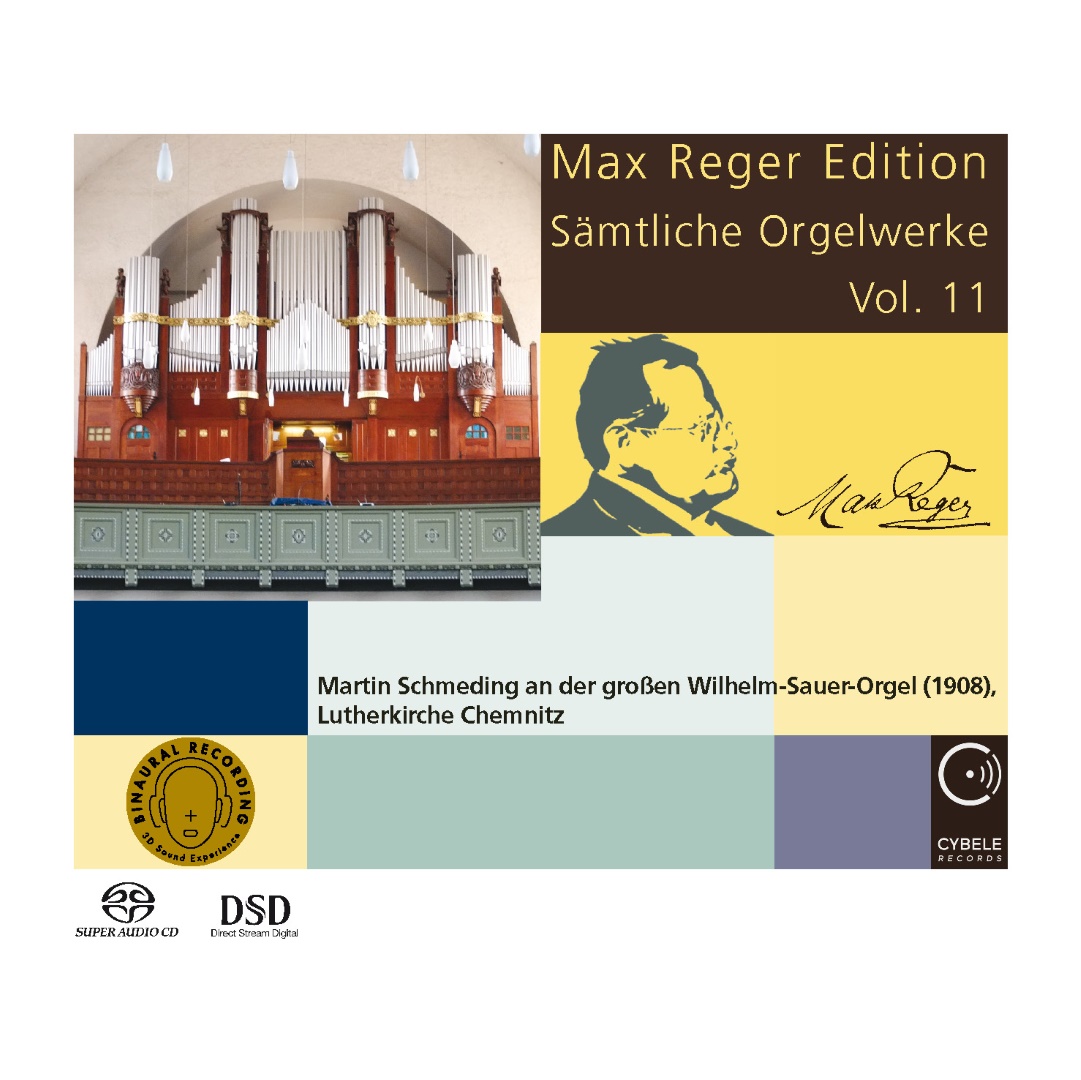
Church and organ of the Lutherkirche in Chemnitz were designed as a single entity. The neo-Romanesque building with its 64-metre crossing tower, conceived in the spirit of Luther’s “Ein feste Burg” and painted with Art Nouveau elements, houses the pipes of the 1908 Wilhelm Sauer organ, Op. 1011, in the rear wall of the westwork behind a case typical of the period. Like many instruments from the turn of the century, it had later been altered to suit changing tastes; in the 2006/07 restoration Christian Scheffler (Sieversdorf) reconstructed ten of its 50 stops after historical models and scalings. Schmeding recorded Op. 65 in September 2015, together with the programme of the twelfth volume. As throughout the edition, the recording is based on the new Reger edition published by Carus-Verlag.