
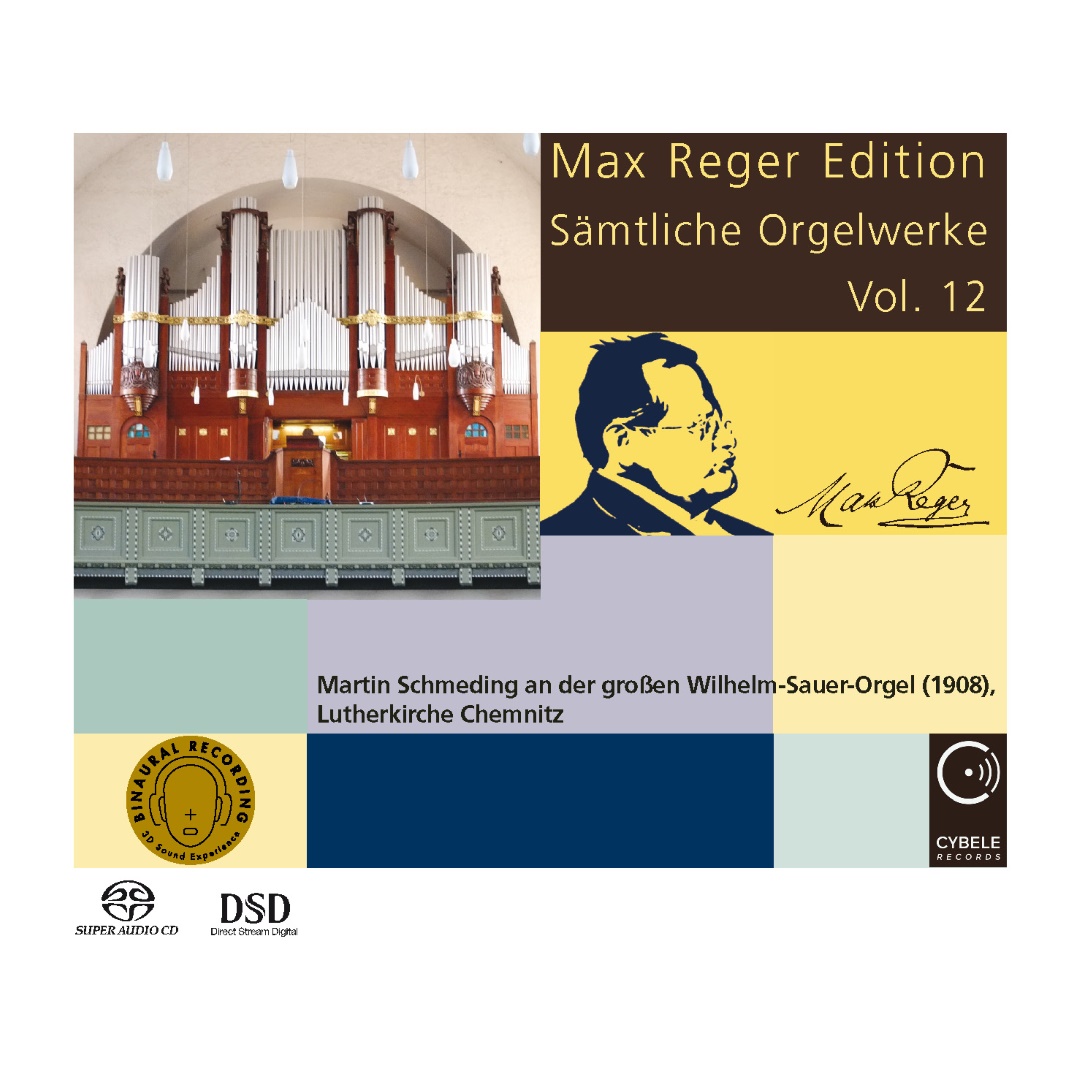
When Max Reger began another collection for organ in the autumn of 1902, half a year after Op. 65, both his personal situation and his style had changed. His impending marriage to Elsa and his work on the chorale preludes Op. 67, which bound him more closely to Johann Sebastian Bach again, had transformed him, writes Martin Schmeding in the booklet. Unlike the preceding collections, the Ten Pieces for Organ Op. 69 were very well received by organists and reviewers; some considered them the best Reger had written so far, while others recognised in them his transformation from composer into an artist of moods.
Some saw the high points in lyrical, at times melancholy movements such as the elegiac Moment musical (No. 4) and the profound Romance (No. 8), while others praised the compelling build-up of the Basso ostinato (No. 3) or the light, virtuoso writing of fast movements such as the Capriccio (No. 5) and the Toccata and Fugue in D major (Nos. 6 and 7). As so often, Karl Straube had a hand in the printed version: the publisher gave him the engraver’s copy for review, and Reger adopted some, but not all, of the changes the two had discussed.
The Six Chorale Preludes for Organ span the years 1893 to 1909. Ever since he had come to know Bach’s chorale preludes as a student of Hugo Riemann, Reger remained under their spell until his death, as his biographer Fritz Stein wrote. “O Traurigkeit, o Herzeleid” and “Komm, süßer Tod” were written in Wiesbaden in 1893/94. The first, extremely polyphonic, heedless of false relations and with the cantus firmus in the upper voice of the double pedal, was conceived for publication in the Allgemeine Musikzeitung as a deliberate declaration of war on the New German School, whose principles the circle around Riemann and Reger called into question. In “Komm, süßer Tod”, with its melismatic upper voices, Reger applies Riemann’s performance markings to his own music in detail.
The other four were written for occasional publications: “Christ ist erstanden von dem Tod”, with the cantus firmus in the bass, and “Es kommt ein Schiff geladen”, with the cantus firmus in the tenor, appeared in 1901 and 1905 in the Monatsschrift für Gottesdienst und kirchliche Kunst; “O Haupt voll Blut und Wunden”, with expressive inner voices, in an anthology of 1905; and the simple “Wie schön leucht’ uns der Morgenstern”, in the style of Bach’s Orgelbüchlein, in the Präludienbuch zu den Chorälen der christlichen Kirche of 1909. The Prelude and Fugue in G sharp minor WoO IV/15 of 1906 is the last organ work of the Munich years; not until 1913 did another follow, the Introduction, Passacaglia and Fugue in E minor Op. 127, for the Centennial Hall in Breslau. The three-part prelude, with its chromatic upper voice and rapid changes of manual, is set against a linear, flowing fugue in the spirit of the stile antico, far removed from any outward virtuosity.
The Sauer organ of the Lutherkirche in Chemnitz, built in 1908 as Op. 1011, has three manuals and a pedal division reaching down to a 32’ Untersatz. Among the ten stops that Christian Scheffler (Sieversdorf) reconstructed after historical models during the 2006/07 restoration are colour stops such as the Schalmey and Clarinette on the second manual and the Soloflöte and Viola on the third. The recording was made on 14 and 15 September 2015, immediately after the sessions for the eleventh volume.