
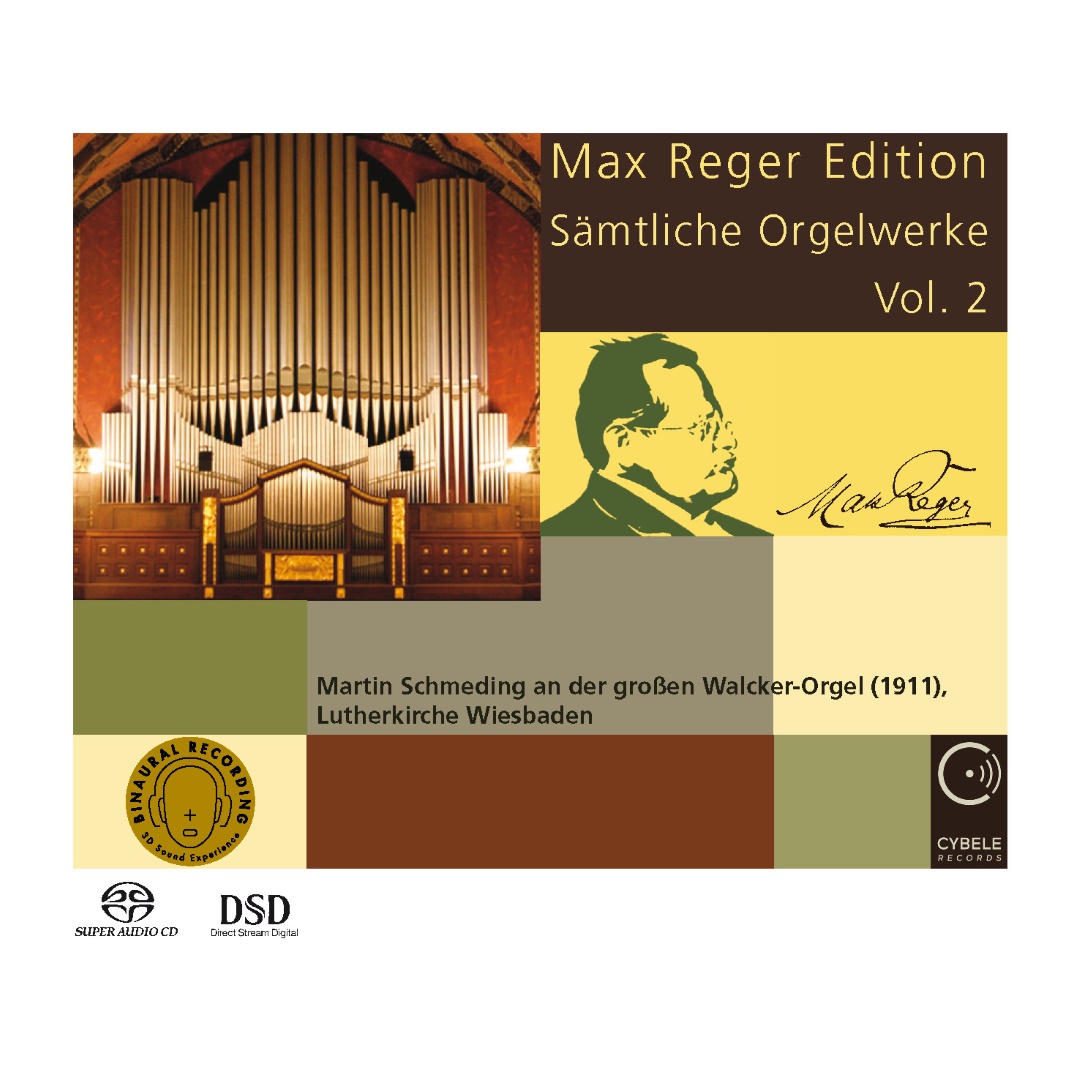
How does Reger’s organ idiom change when it unfolds the same idea over half an hour, or in a few minutes? The second volume of the Max Reger Edition sets two works of 1913 side by side: the Introduction, Passacaglia und Fuge in e-Moll op. 127 and the Neun Stücke op. 129. Martin Schmeding plays both at the Walcker organ of 1911 in the Lutherkirche Wiesbaden. The juxtaposition draws the ear to proportions, recurring figures and the supple distribution of tone colour.
Opus 127 was written for the inauguration of the Sauer organ in the Jahrhunderthalle in Breslau. Its extended form joins a short, strongly contrasted introduction to passacaglia and fugue. The opening already alternates between blocks of chords, virtuoso runs and quiet octave leaps. The music begins energetically, draws back its force and lets the next climax grow out of that renewed gathering.
The bass subject of the passacaglia joins tonal firmness to chromatic movement. Out of its repetitions grows a series of ever more animated variations; voices answer one another on different manuals, while ornaments and changing registral colours loosen the texture. Reger’s thinking in orchestral colours becomes tangible here within a single solo instrument. The fugue that follows articulates its wide span into clearly distinguished sections and leads the main subject, together with a lyrical countersubject, to a shared conclusion.
The Neun Stücke op. 129 take up many of these procedures on a smaller scale. A Toccata und Fuge in d-Moll opens the collection, a Präludium und Fuge in h-Moll closes it. Between them stand Kanon and Melodia, the Capriccio — playful at first, increasingly lyrical — and Basso ostinato and Intermezzo. In the Basso ostinato a bass figure of only two bars carries a short climax which quickly subsides once it has peaked. The Intermezzo takes its suspended, melancholy movement from the alternation of quadruple and triple metre and from chromatically falling lines.
The Wiesbaden Walcker organ joins the foundation stops of German late Romanticism to a brighter specification in the spirit of the Alsatian organ reform. Reeds that blend readily, repeating mixtures and a powerful swell division with French-influenced stops extend its expressive means. This combination suits a music that calls equally for great climaxes and for voices clearly set apart from one another.
The juxtaposition leads from the long developments of op. 127 to the fine changes of character in the shorter pieces. Fullness of sound, articulation and the balance within the church belong together here. The recording, produced in DSD, can be heard in stereo and 5.1 surround as well as in a 3D binaural version for headphones. The relationship between musical line, registral colour and spatial expansion can thus be followed from different listening perspectives.