
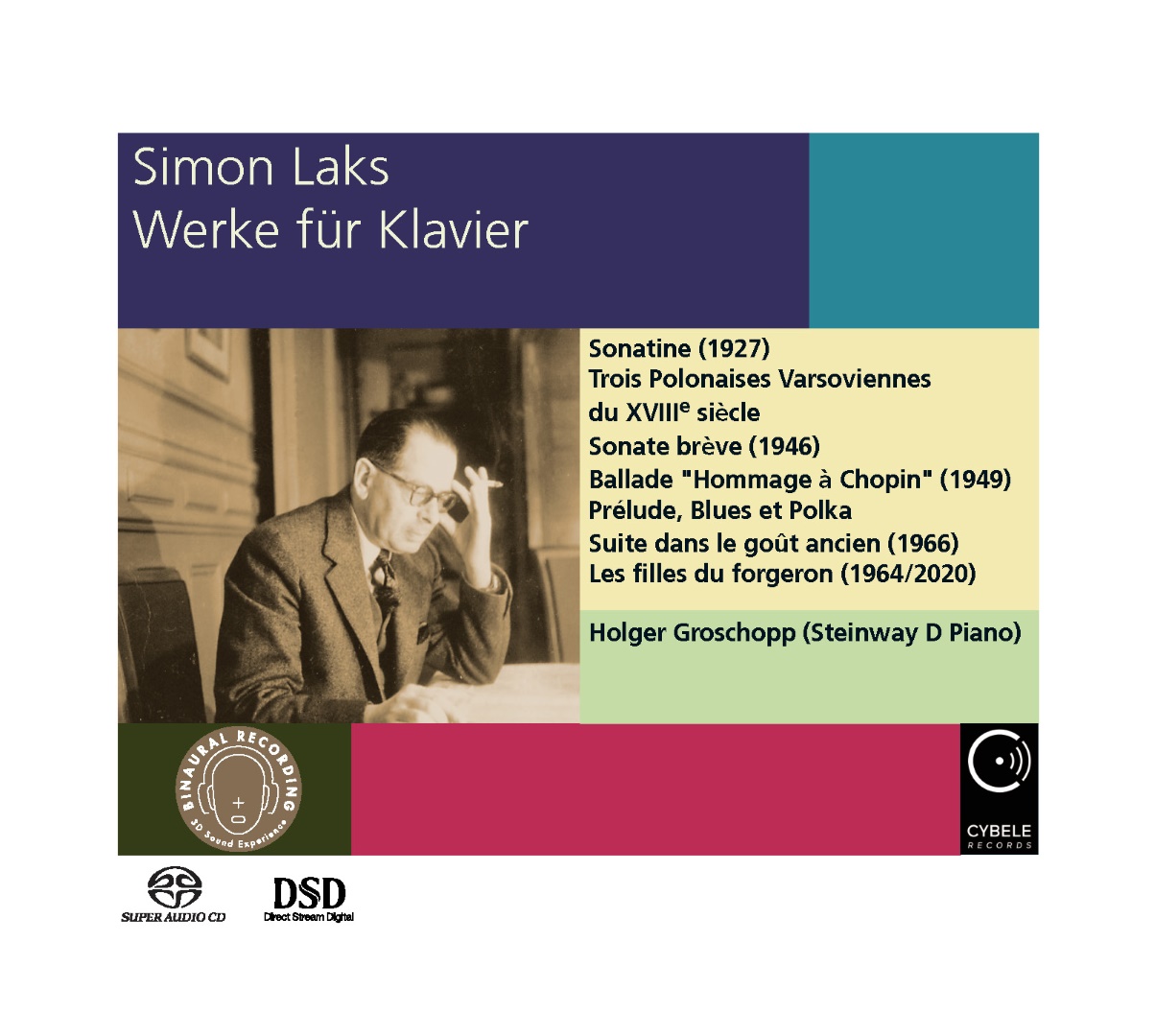
It began with a commission: in 2008 Holger Groschopp was asked to prepare a piano reduction of Simon Laks’s one-act opera L’Hirondelle inattendue. The name meant little to him at the time; the work soon revealed itself, though, as a piece of music theatre that he ranks in colourfulness, richness of allusion and timing beside Ravel’s L’Enfant et les sortilèges and Poulenc’s Les Mamelles de Tirésias. After 108 pages of piano reduction it was clear that this would not remain a single encounter. That the centre of the Laks rediscovery — Frank Harders-Wuthenow and the publishing house Boosey & Hawkes — lies in Groschopp’s home city of Berlin, and that he came to know André Laks, the composer’s son, made the further work easier. At almost the same time as the album Simon Laks: Works for Cello, this first complete recording of the works for solo piano was made.
Laks’s piano works form no monolithic block: no series of sonatas, no collection of préludes or concert études, but pieces from quite different phases of his life and quite different contexts, most of which remained unpublished or even unperformed in his lifetime. Precisely there lies the strength of the collection, for all the facets of his output are represented: Parisian styles of the 1920s in the Sonatina, neo-classicism and neo-baroque in the Sonate brève and the Suite dans le goût ancien, echoes of impressionism in the Prélude, impulses from light music in Blues and Polka, an affinity with Chopin in the Ballade, with the eighteenth century in the Trois Polonaises and with Yiddish folklore in Les filles du forgeron.
Born in Warsaw in 1901, Laks studied mathematics in Vilnius and music in Warsaw and Paris, where he lived permanently from 1926 and turned his first name Szymon into the French Simon. The Sonatina of 1927 is the only surviving work of those years; it captivates through bitonal combinations and demands more virtuosity than its modest title suggests. In 1941 Laks was interned because of his Jewish origins and in 1942 deported to Auschwitz-Birkenau; he survived because he was given charge of the camp orchestra. The Trois Polonaises Varsoviennes du XVIIIe siècle have a biographical, not a musical connection with that place: the melodies, of unknown authorship, were brought to him in the camp, where he arranged them for small orchestra, and in 1947 he reconstructed the lost version. In the booklet Groschopp warns of the trap of the memorial-day performance — music of this quality belongs in ordinary concert life.
There is no stylistic break between the works written before and after 1945. The Sonate brève of 1946 was written for harpsichord; behind its historicising façade stands a melancholy attitude, the second movement stretches the ends of its bars into 7/8 time, the last follows the model of a baroque gigue. The Ballade “Hommage à Chopin” was written in 1949 for the centenary of his compatriot’s death and won a prize in the competition of the Polish Composers Union: a slow introduction in F sharp major, dramatic episodes, a mazurka, and a coda modelled on the endings of Chopin’s first and fourth ballades. Prélude, Blues et Polka are bagatelles written independently of one another and published as a triptych in 2021; the Polka, the finale of the Petite Suite légère for orchestra, is a piece that Groschopp says would not be out of place in a circus either. The Suite dans le goût ancien of 1966 makes five baroque dances, in a peculiar, melancholically dissonant harmony, appear as a distant memory of Ravel’s Le Tombeau de Couperin.
A discovery closes the disc. For a production of the Yiddish play Dem Schmids Techter / Les filles du forgeron by Peretz Hirschbein, Laks wrote incidental music in 1964 for voice, clarinet, cello and piano, drawing on the texts and melodies of Yiddish folk songs; where folklore ends and Laks begins cannot always be decided. So that this music would not have to wait for the play’s rare revivals, Groschopp and Adele Bitter first distilled a five-movement suite for cello and piano from it in 2020; the remaining numbers could be assembled almost complete into a second suite of seven miniatures for solo piano. The recording received the 2023 OPUS KLASSIK award for the editorial achievement of the year.