
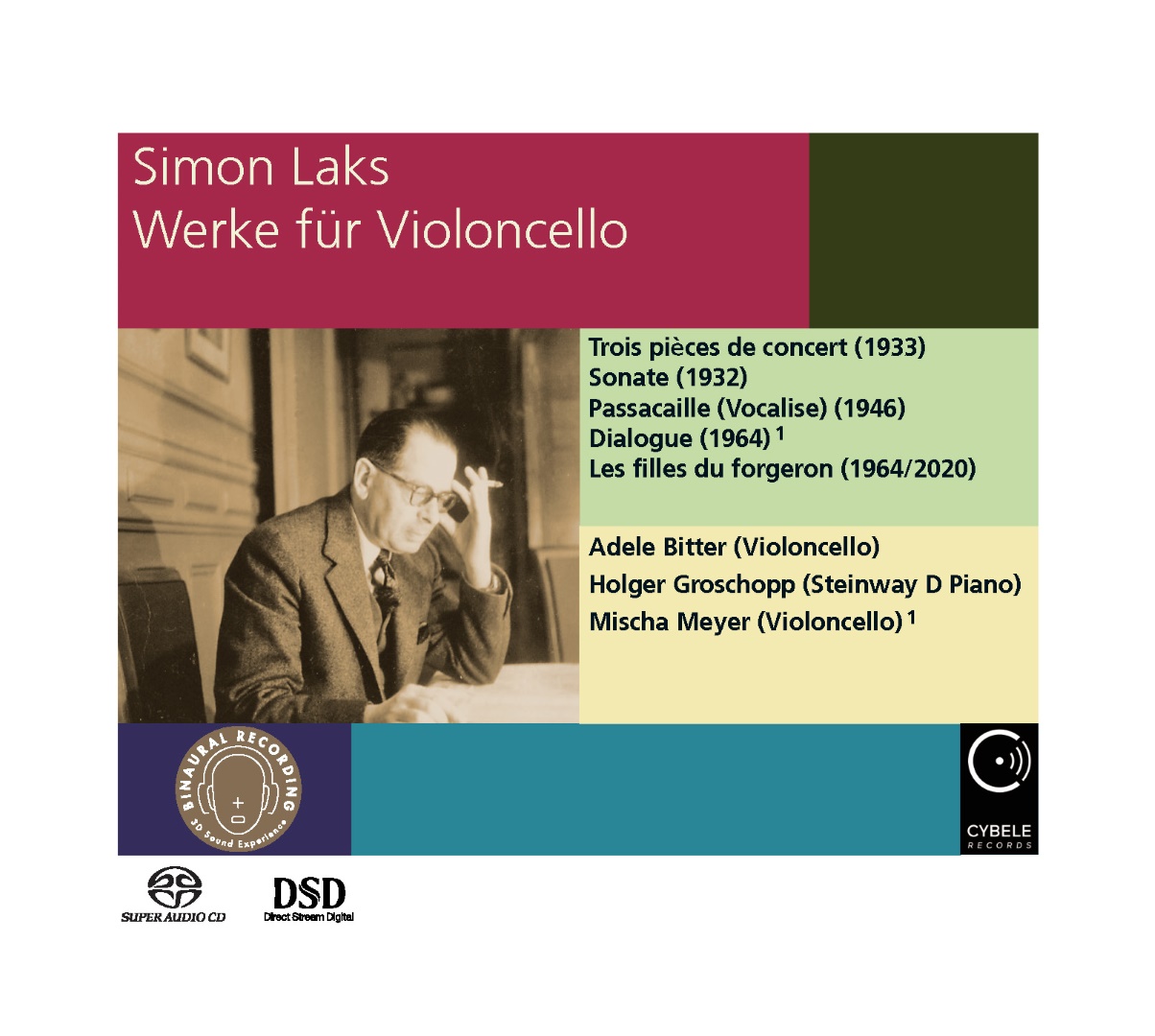
Simon Laks was born into an assimilated Jewish family in Warsaw, one in which religious traditions survived only in musical heritage. His mother took charge of the children’s musical education; after beginning to study mathematics in Vilnius, Szymon — who later wrote his name “Simon” in France — earned a place to study conducting and composition at the Warsaw conservatory. Rising antisemitism in Poland and the dim prospects for artistic development took him first to Vienna and soon to Paris, where he completed his studies at the Conservatoire with Henri Rabaud and Pierre Vidal. At first he earned his living playing in cafés and on ocean voyages; gradually he carved out creative space in Parisian musical life, above all through the Association des jeunes musiciens polonais. His extensive network is documented — and yet a characteristic modesty seems never to have allowed him to step into the front row.
The Trois pièces de concert of 1933 lead from the first note into the Paris of the early 1930s, marked by “néoclassicisme”, by the influence of jazz and by the national traditions that the many young émigré composers from Central and Eastern Europe brought with them. In the first movement a gavotte theme is varied with contemporary sophistication while observing all the rules of baroque art; the Romance hints at blues harmonies while remaining intimate and introspective; the closing Mouvement perpétuel is a nod to Ravel’s second violin sonata and, with its unexpected changes of direction, creates the impression that there is no way back. The dedicatee and first performer was André Hekking, solo cellist of the Concertgebouw Orkest and professor at the Paris Conservatoire.
A year earlier, in 1932, Laks had written the Sonata for cello and piano for Maurice Maréchal, who premiered it with Laks’s compatriot Vlado Perlemuter. Every phrase of the first movement harbours a narrative; impressionist harmonies recalling Debussy meet rhythmic asymmetries and melodic turns drawn from Polish folklore. The second movement is a blues, the third lives on rhythmic patterns that would only much later become characteristic of cool jazz; the brilliant close in D minor confirms the essentially serious nature of the work.
What Laks was to undergo a quarter of a century later was unimaginable when the sonata was written. While his two brothers, likewise based in France, escaped arrest with forged papers, in the summer of 1941 he obeyed a summons to report as a Jewish foreigner to the authorities of the Vichy regime, was interned in the Beaune-la-Rolande camp and in 1942 deported from the Pithiviers camp to Auschwitz-Birkenau. He survived as a musician in the camp orchestra and was among the first to write about it: the first version of his account Musiques d’un autre monde appeared in 1948, and he later revised it in favour of a higher degree of objectivity. “This is not a book about music,” it says there, “this is a book about music in the concentration camp.” The Passacaille (Vocalise) of 1946 stands at the threshold of the time that followed.
From the late works come the three-movement Dialogue for two cellos of 1964, in which Mischa Meyer takes the second part, and the suite Les filles du forgeron of the same year, which Holger Groschopp arranged for cello and piano in 2020; its movements carry Yiddish song titles such as Laig ich main Kepele and Hei di Wintl. The recording was made from 6 to 8 March 2020 and on 22 February 2022 at the Erholungshaus of BAYER AG in Leverkusen, in stereo, 5.0 surround and 3D binaural stereo. Together with the complete recording of the piano works released at the same time (Cybele SACD 162202), the album documents years of engagement with this composer; the series received the OPUS KLASSIK 2023 as editorial achievement of the year.