
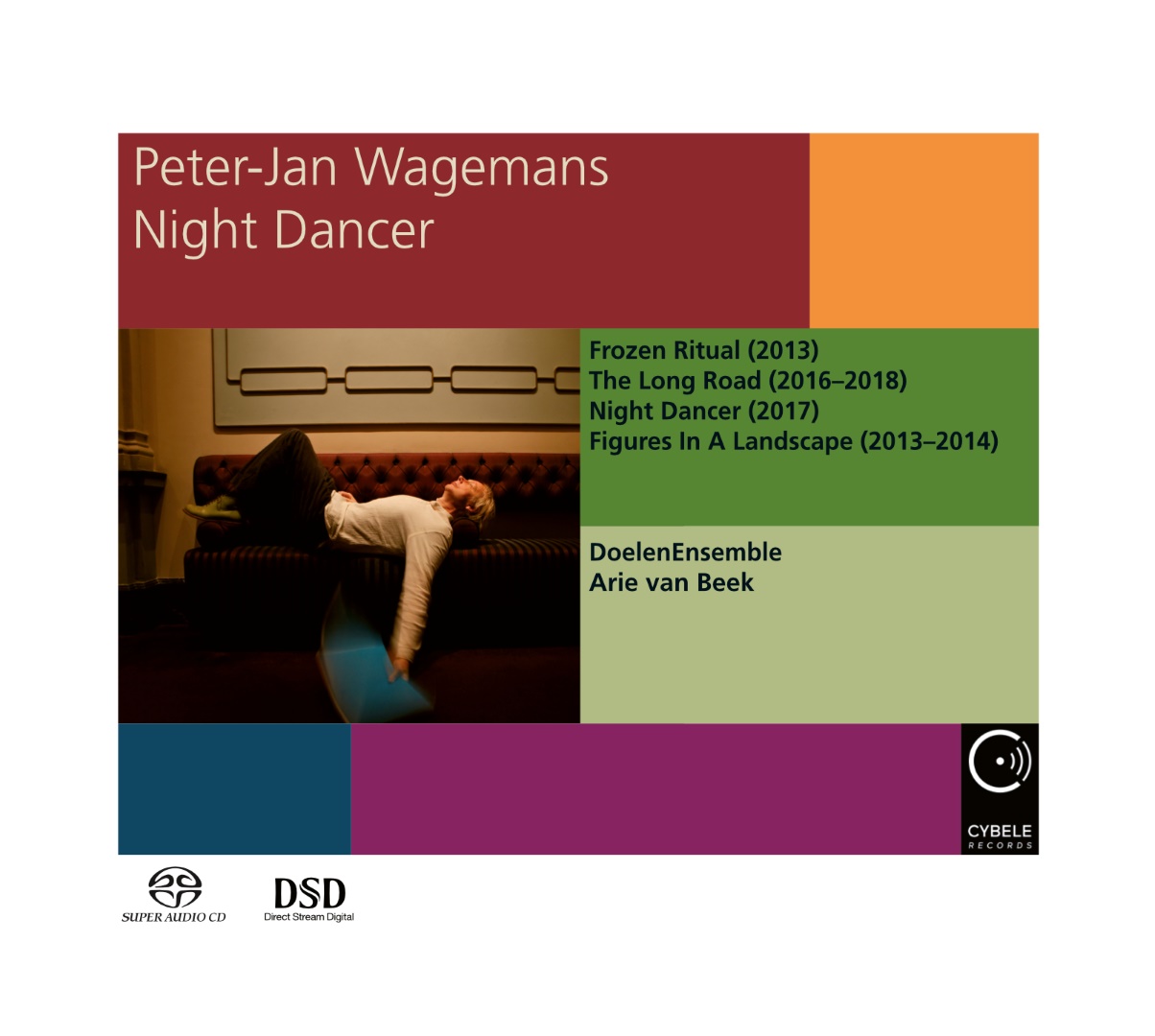
Peter-Jan Wagemans, born in 1952, studied organ, composition and music theory at the Royal Conservatory in The Hague and for some time with Klaus Huber in Freiburg im Breisgau. His aim of developing and renewing the European tradition brought him into conflict with both the avant-garde and minimalism in the Netherlands; at the same time he became one of the most frequently performed composers in the country. Until 2018 he headed the composition department of the Rotterdam Conservatory. Mirjam Wiesemann, who met him for a conversation in Dordrecht in 2021, describes in the booklet how theatrical, cinematic, dance and literary impressions flow into his works.
Since 2013 Wagemans has relied increasingly on electronics, because the orchestras were hardly playing new music any more and the ensembles had been cut back so far that they could only work in small formations. He knew the medium from years of work in the electronic studio in The Hague as a student, but tape recorders and endless splicing had since given way to working with computer programs. He calls his guiding principle “subjectified electronics”: he starts from what he wants to hear as an acoustic composer and uses, alongside synthetic sounds, sounds from his own works or from his biography – until it no longer matters whether a sound comes from an acoustic or an electronic source.
“Figures In A Landscape” (2013–2014), commissioned by the ASKO/Schönberg Ensemble, is built from small to large: three soloists on flugelhorn, clarinet and soprano saxophone form a “club of vagabonds”, behind them synthesiser, electric guitar and percussion make up a kind of avant-garde pop group, and behind that lies a four-channel electronic layer of processed analogue sounds. “Frozen Ritual” (2013), written for the New European Ensemble, by contrast has no electronics and is scored almost like chamber music, for alto flute, basset clarinet, harp, piano, percussion and double bass. It was prompted by a memorial service in a Paris church for a father and daughter killed in a traffic accident: behind the coffin, utterly alone, walked the widow in a long white dress.
“The Long Road” (2016–2018), written for the E-MEX Ensemble in Essen, stretches the last five seconds in the life of the English cyclist Tommy Simpson, who died on Mont Ventoux in blistering heat, to 18 minutes. The four-channel electronic layer consists largely of a minor triad that rises for twelve minutes in an extremely slow glissando from very low to very high; Simpson’s last words, “put me back on my bike”, recorded by two Englishmen, are processed electronically. Wagemans wrote “Night Dancer” (2017) as a farewell to the Rotterdam Conservatory, for the largest formation of the AKOM Ensemble that grew out of it. The virtuosic piece strictly follows the mosaic form from the tradition of Strawinsky and Messiaen and revolves around the poses of a dancer who conjures up evil spirits at night in the African jungle; above it all shines the red moon.
The DoelenEnsemble was founded in 1990 by Wagemans and Frank de Groot as the ensemble in residence of the Rotterdam concert hall De Doelen; its chief conductor is Arie van Beek. The soloists in “Figures In A Landscape” are Floris Onstwedder, Lars Wouters and Erik Jan de With. The recording was made at a live production in November 2019 in the Grote Zaal of De Doelen; Wagemans himself controlled the electronics from the mixing desk.