
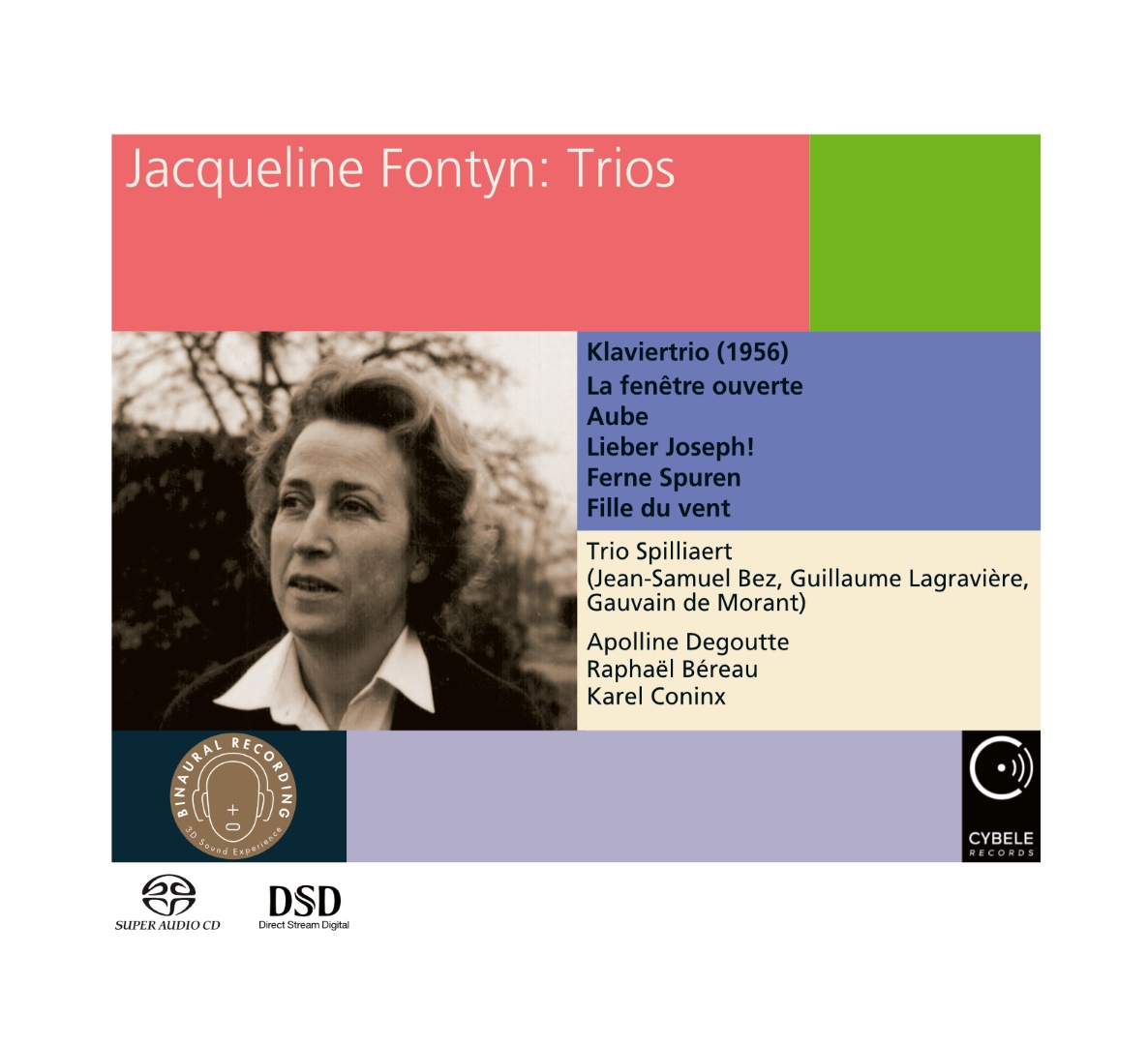
The Piano Trio of 1956 stands at the beginning and apart. Fontyn wrote it immediately after finishing her studies in composition technique, and it is, as she writes in the booklet, the last time she used classical forms: the first movement begins with a short introduction and follows sonata form with first and second themes, coda, development, recapitulation and final coda — “everything is there and will be recognized as such by the listener”. The second movement has the three-part song form, the third is a fugue in strict form with exposition, episodes and a dominant pedal, its theme built on a twelve-note row plus a thirteenth note and yet light and scherzando throughout; the finale is a rondo, “as it should be”. The language of this work, the composer says, reflects the start of a constant evolution.
Four decades later came La fenêtre ouverte (1997) for flute, cello and piano. Fontyn wanted to associate the piece with the memory of the painter Pierre Bonnard and took the title of one of his paintings; the headings of the movements are inspired by François Couperin, and the second alludes to Bonnard’s L’Indolente. She quotes a sentence of the painter’s that can easily be transferred to music: whoever covers a surface with colours has to renew the nature of that undertaking indefinitely, constantly finding new combinations of shapes and colours to meet the demands of emotion.
Aube (1998) is an homage to the Belgian poet Carlo Masoni (1921–2010). The ensemble A Piacere had commissioned it for flute, guitar and piano; the premiere took place in Rouen in 1999, and the version recorded here, for violin, guitar and piano, appeared soon afterwards. Lieber Joseph! (2007) belongs to a project for the 200th anniversary of Joseph Haydn’s death in which eighteen composers took part; each was asked to allude to the master’s life or work, and the generally lively, cheerful mood of the three movements recalls his music — “said in all modesty, of course”, Fontyn adds.
Ferne Spuren was written in 2009 on a commission from Christel Nies for her series “Composers and their Works”, for the Spohr year: from the letters of the name Louis Spohr, Fontyn derives a sequence of notes that is clearly audible above all at the beginning and the end — hence the subtitle “Spohr-Spur”. Fille du vent for flute, viola and piano was commissioned in 2013 by Damien Top for the Festival International Albert Roussel; it was prompted by a poem from the collection of the same name by his mother, the poet Andrée Brunin (1937–1993).
The Trio Spilliaert — Jean-Samuel Bez (violin), Guillaume Lagravière (cello) and Gauvain de Morant (piano) — forms the core of the recording; for the works with other scorings they are joined by Apolline Degoutte (flute), Raphaël Béreau (guitar) and Karel Coninx (viola). The recording was made from 12 to 15 March 2021 at the Dada Studios in Brussels, in stereo, 5.1 surround and 3D binaural stereo. The 60-page booklet contains Fontyn’s own commentaries on every work in three languages.