
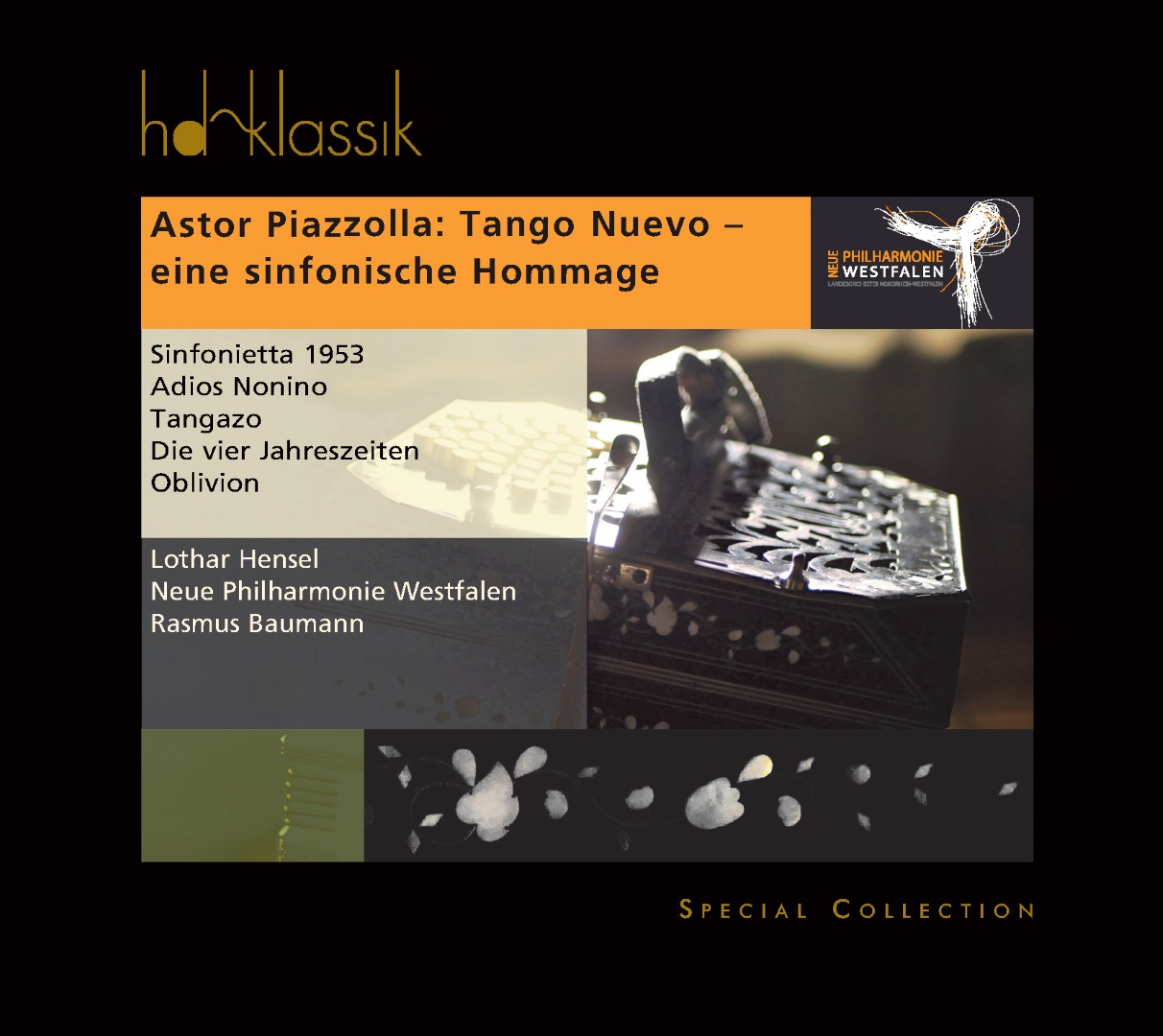
The bandoneon, which embodies the typical Piazzolla sound like no other instrument, originated not in Argentina but in the Lower Rhine region: in 1850 the Krefeld instrument maker Heinrich Band advertised a bellows instrument with buttons instead of keys. Having become popular among German working-class families, it emigrated with its owners to South America and became the symbol of the tango, above all in Buenos Aires. Piazzolla’s roots, too, lay in Europe: the son of an Italian barber who had emigrated to Argentina learned the bandoneon rather reluctantly, caught the tango bug only at 15 and still dreamed of a career as a serious composer. With Alberto Ginastera he studied the fusion of South American and European music, and so the Sinfonietta 1953 for Chamber Orchestra still clearly bears the stamp of Béla Bartok and Igor Strawinsky: a driving ostinato governs the first movement, a long-drawn, dark melody the middle movement, and the finale races motorically towards its goal. The Sinfonietta earned the 32-year-old a national critics’ award.
This success encouraged him to seek further polish with Nadia Boulanger in Paris – for Kerstin Schüssler-Bach, author of the booklet text, the birth of the real Piazzolla. At first he was ashamed to tell her about his work as a tango musician in brothels and cabarets, but Boulanger advised him to stop denying his inner voice: “Your tango is the new music, and it is honest.” In 1955 he founded his own ensemble in Buenos Aires and created the Tango Nuevo, which fused classical music, jazz, pop, contemporary music and traditional elements. “Tangazo – Variations on Buenos Aires” is another declaration of love for the Argentine capital: after an opening that recalls the serious passages of the Sinfonietta and a mysterious chromatic murmuring in the basses, an intense melody, grandiose in its sadness, soars up before angular, tattered rhythms lead into the tango bars of the port city. At the premiere in Washington in 1970, Piazzolla missed the salt and pepper in the classically trained musicians from his homeland – he refused to accept the old divide between the classical and the popular.
“The Four Seasons of Buenos Aires for Bandoneon and String Orchestra” is a monument to the many cultural influences of the port and immigrant city. The title alludes to Vivaldi, and baroque elements such as fugues and motoric figures mingle with the tango melodies. Piazzolla did not originally conceive a cycle; the four movements were first performed with his quintet on separate occasions between 1965 and 1970. Lothar Hensel’s version, recorded here for the first time, comes closer to the original than many an arrangement for the classical repertoire. “Adios Nonino”, too, is a first recording in this form: Piazzolla’s friend José Bragato, cellist and copyist of his works, left a version for bandoneon and string orchestra, a copy of whose manuscript Hensel owned and turned into a performing version. Piazzolla wrote the piece immediately after the death of his father Vicente, whom the family called Nonino (grandfather) and who had once put a bandoneon into the eight-year-old’s hands. “Oblivion” was written as film music for “Enrico IV” with Marcello Mastroianni and Claudia Cardinale, after Luigi Pirandello; Rasmus Baumann chose an arrangement by the Venezuelan conductor Eduardo Marturet.
Lothar Hensel studied the bandoneon with well-known tango musicians in Buenos Aires and Paris and has played with the Berliner Philharmoniker several times; arranging led him to composition, and he has written works for large orchestra, operas, incidental music and a bandoneon concerto for himself. Rasmus Baumann became general music director of the Neue Philharmonie Westfalen in the 2014/15 season; while still a student he worked as an organist, choral director and jazz pianist, and in 2015 he conducted the orchestra in the premiere of a tango double concerto for bandoneon, cello and orchestra that he had commissioned from the Argentine Daniel Binelli, a pupil of Piazzolla. The Neue Philharmonie Westfalen, opera orchestra of the Musiktheater im Revier in Gelsenkirchen, also plays as the Landesorchester of North Rhine-Westphalia in towns without a symphony orchestra of their own. The recording was made in March and April 2021 in the Großer Saal of the Neue Philharmonie Westfalen in Recklinghausen.