
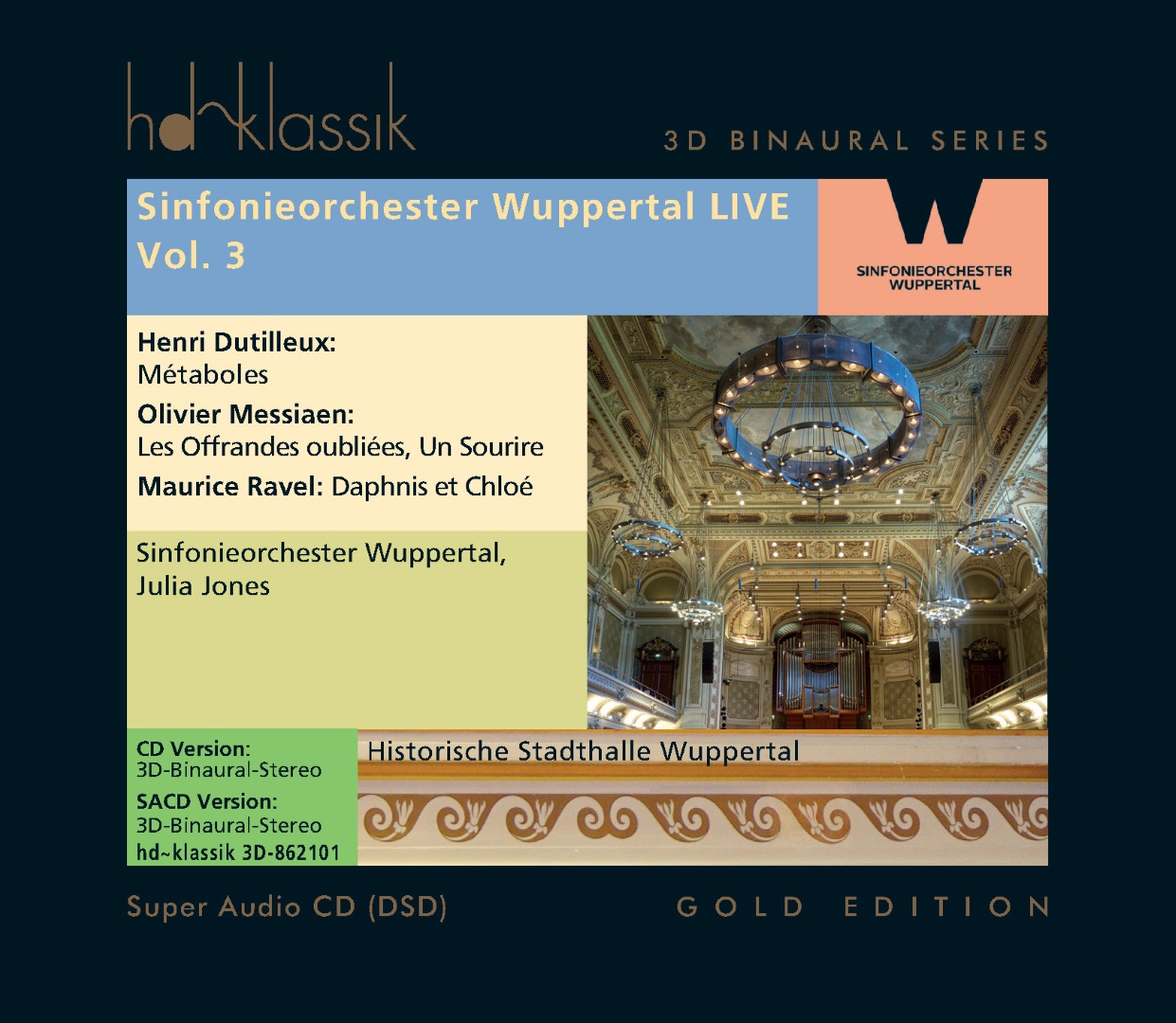
hd-klassik 3D-862101

hd-klassik 3D-862101 2021

3D binaural stereo DSD Classical music Contemporary music 54:03

To the description

Sinfonieorchester Wuppertal LIVE (Vol. 3)

Contributors

Sinfonieorchester WuppertalOrchestraJulia JonesConductor

Composers

Henri Dutilleux · Maurice Ravel · Olivier Messiaen

Short description

The third volume of the Wuppertal live series is devoted entirely to French music – and asks what remains of proverbial French lightness. Henri Dutilleux, who resisted being assigned to any school, wrote “Métaboles” for the 40th anniversary of the Cleveland Orchestra; its five uninterrupted movements each grow out of the one before. Olivier Messiaen is represented by his first orchestral work, “Les Offrandes oubliées”, premiered in 1931, and by the late “Un Sourire”, a homage to Mozart on the 200th anniversary of his death in 1991. Maurice Ravel’s “Daphnis et Chloé, Fragments Symphoniques, 2e Série” concludes the programme. Julia Jones conducts the Sinfonieorchester Wuppertal in live recordings made in 2018 and 2019 in the Historische Stadthalle Wuppertal.

Details

Carrier format
Hybrid SACD

Resolution
DSD64 / 2.8224 MHz 1 bit

Total playing time
54:04

Channels
3D binaural stereo

Recording
18 February 2018 (“Un Sourire”) and 20 January 2019, Historische Stadthalle, Wuppertal (live recordings)

Booklet
German and English, 20 pages, digipak

Recording Producer: Ingo Schmidt-Lucas

Press reviews

Specifications

Catalogue number
hd-klassik 3D-862101
Year of release
2021
Genre
Classical music
Period
Contemporary music
Instrumentation
Live concert, Orchestral music
Label
hd-klassik
Barcode
809548020323
GTIN
4099885250798
Booklet (pages)
20

Track listing

9 tracks · 54:03

  1. 01 3D-Binaural-Stereo Trailer Performer: Mirjam Wiesemann 0:38
  2. 02 Métaboles – I. Incantatoire Composer: Henri Dutilleux (1916-2013) Performers: Sinfonieorchester Wuppertal, Julia Jones 3:31
  3. 03 Métaboles – II. Lineaire Composer: Henri Dutilleux (1916-2013) Performers: Sinfonieorchester Wuppertal, Julia Jones 2:50
  4. 04 Métaboles – III. Obsessionnel Composer: Henri Dutilleux (1916-2013) Performers: Sinfonieorchester Wuppertal, Julia Jones 3:13
  5. 05 Métaboles – IV. Torpide Composer: Henri Dutilleux (1916-2013) Performers: Sinfonieorchester Wuppertal, Julia Jones 2:44
  6. 06 Métaboles – V. Flamboyant Composer: Henri Dutilleux (1916-2013) Performers: Sinfonieorchester Wuppertal, Julia Jones 4:28
  7. 07 Les Offrandes oubliées Composer: Olivier Messiaen (1908-1992) Performers: Sinfonieorchester Wuppertal, Julia Jones 10:37
  8. 08 Un Sourire Composer: Olivier Messiaen (1908-1992) Performers: Sinfonieorchester Wuppertal, Julia Jones 9:29
  9. 09 Daphnis et Chloé, Fragments Symphoniques, 2e Série Composer: Maurice Ravel (1875-1937) Performers: Sinfonieorchester Wuppertal, Julia Jones 16:33

Description

Judith Schor opens her booklet text by asking whether French music means “enchanting lightness, ever-changing colourfulness, charming irony”. Henri Dutilleux wanted nothing to do with French lightness. He was his own greatest critic and fought vehemently against being assigned to any school, tendency or group; however much he admired Claude Debussy, Maurice Ravel and Darius Milhaud, he felt far removed from their lightness. For him composing was “a kind of ceremony”, to be undertaken seriously, “a bit like love”. He wrote “Métaboles” at the height of his powers for the 40th anniversary of the Cleveland Orchestra, which gave the premiere under George Szell in January 1965. The five movements, running without a break from Incantatoire to Flamboyant, follow the principle of metamorphosis in nature: each is developed from elements of the one before and subjects what has already been “said” to analytical reflection.

Olivier Messiaen, the son of an English professor and Shakespeare specialist and of a poet, combined Gregorian chant with the sound of the Javanese gamelan and the metres of Greek verse with the scales of Indian ragas; on his travels he recorded birdsong and, precisely notated, made it the basis of his compositions. To this were added a deep Catholic faith and his synaesthesia: Messiaen associated sounds with colours. “Les Offrandes oubliées”, a symphonic meditation of about eleven minutes, was premiered in Paris in 1931 as his first orchestral work. The 22-year-old described it as an altar triptych: “The Cross”, a lament of the strings “pierced by deep grey and mauve-coloured sighs”, is followed after a sharp transition by “Sin”, a run into the abyss at an almost mechanical speed; in the “Eucharist” a shimmer and glitter grows into a spherical melody. Messiaen interpreted sin as the forgetting of God, the Cross and the Eucharist as divine offerings.

Mozart was Messiaen’s favourite composer; what delighted him above all was the colour and lightness of his music. The analysis of Mozart’s works played a prominent role in Messiaen’s composition teaching at the Paris Conservatoire, and in 1990 he published the results in the book “Les 22 concertos pour piano de Mozart”. For the 200th anniversary of Mozart’s death in 1991 he paid him a personal tribute with “Un Sourire”: Mozart had gone hungry and cold and lost almost all his children, “and despite it all he always smiled”; so he, too, had tried to smile, with a little piece lasting nine minutes. It was premiered on 5 December 1991, shortly before Messiaen’s death. Rhythm, the assignment of colours to sounds and birdsong shape this late orchestral work; it ends in A major, a sound to which Messiaen assigned the colour blue.

Ravel is another matter entirely: in 1909 Sergei Diaghilev commissioned from him a ballet score for his Ballets russes, based on the late antique story of Daphnis and Chloé. “Daphnis et Chloé, Fragments Symphoniques, 2e Série” (1913) draws on the final part of the ballet: the sunrise of the “Lever du jour”, the Pantomime, in which a flute solo evokes the song of Syrinx and Daphnis is united with Chloé, and the feverish “Danse générale”. Everything that is absent from Dutilleux’s “Métaboles”, Judith Schor writes, Ravel lets bubble forth here. As general music director from 2016 to 2021, Julia Jones shaped the artistic direction of the Sinfonieorchester Wuppertal with new concert and outreach formats; in January 2020 the orchestra returned to a sold-out Concertgebouw in Amsterdam. “Un Sourire” was recorded on 18 February 2018, the other works on 20 January 2019, both in the Historische Stadthalle Wuppertal.

Concert calendar

26. Oct 2026

19:30

2nd Chamber Concert – Sons de la Soirée(opens in a new tab)

Mitglieder des Sinfonieorchesters Wuppertal, Selina Lohmüller (Clarinet), Georg Sarkisjan (Violin), Francesco Punturo (Violin), Florian Glocker (Viola), Joël Wöpke (Cello)
Historische Stadthalle Wuppertal, Mendelssohn Saal, Wuppertal(map, opens in a new tab)

01. Feb 2027

19:30

3rd Chamber Concert – Spiritus Feminae(opens in a new tab)

Mitglieder des Sinfonieorchesters Wuppertal, Ulrike Siebler (Flute), Eva Högel (Violin), Anne Yumino Weber (Cello), Rayle Ernest Bligh (Double bass), Jee-Young Phillips (Piano)
Historische Stadthalle Wuppertal, Mendelssohn Saal, Wuppertal(map, opens in a new tab)

08. Mar 2027

19:30

4th Chamber Concert – Cantos y Danzas(opens in a new tab)

Mitglieder des Sinfonieorchesters Wuppertal, Liviu Neagu-Gruber (Violin), Axel Heß (Violin), Ayane Koga (Viola), Joël Wöpke (Cello), Manuela Randlinger (Harp), Sören Alexander Golz (Guitar)
Historische Stadthalle Wuppertal, Mendelssohn Saal, Wuppertal(map, opens in a new tab)

14. Mar 2027

11:00

8th Symphony Concert – Mahler Drei(opens in a new tab)

Sinfonieorchester Wuppertal, Remy Ballot (Direction), Anna Lucia Richter (Mezzo-soprano), Essener Domsingknaben, Elberfelder Mädchenkurrende
Historische Stadthalle Wuppertal, Wuppertal(map, opens in a new tab)

15. Mar 2027

19:30

8th Symphony Concert – Mahler Drei(opens in a new tab)

Sinfonieorchester Wuppertal, Remy Ballot (Direction), Anna Lucia Richter (Mezzo-soprano), Essener Domsingknaben, Elberfelder Mädchenkurrende
Historische Stadthalle Wuppertal, Wuppertal(map, opens in a new tab)

31. May 2027

19:30

5th Chamber Concert – Musik.Leben.Überleben(opens in a new tab)

Mitglieder des Sinfonieorchesters Wuppertal, Carola Seibt-Oberschelp (Violin), Seoran Kim (Violin), Jens Brockmann (Viola), Karin Nijssen-Neumeister (Cello), James Maddox (Piano)
Historische Stadthalle Wuppertal, Mendelssohn Saal, Wuppertal(map, opens in a new tab)

06. Jun 2027

11:00

11th Symphony Concert – La Mer(opens in a new tab)

Sinfonieorchester Wuppertal, Gregor Meyer (Direction), Susanne Bernhard (Soprano), Thomas Laske (Baritone), Chor der Konzertgesellschaft Wuppertal, Opernchor der Wuppertaler Bühnen
Historische Stadthalle Wuppertal, Wuppertal(map, opens in a new tab)

07. Jun 2027

19:30

11th Symphony Concert – La Mer(opens in a new tab)

Sinfonieorchester Wuppertal, Gregor Meyer (Direction), Susanne Bernhard (Soprano), Thomas Laske (Baritone), Chor der Konzertgesellschaft Wuppertal, Opernchor der Wuppertaler Bühnen
Historische Stadthalle Wuppertal, Wuppertal(map, opens in a new tab)

14. Jun 2027

19:30

6th Chamber Concert – Messieurs Dames(opens in a new tab)

Mitglieder des Sinfonieorchesters Wuppertal, Jaha Lee (Violin), Anne Yumino Weber (Cello), Udo Mertens (Flute), Bonnie Wagner (Piano), Alexander Puliaev (Harpsichord)
Historische Stadthalle Wuppertal, Mendelssohn Saal, Wuppertal(map, opens in a new tab)

15. Jul 2027

19:30

Uptown Classics /4 – Vivaldi Vokal(opens in a new tab)

Sinfonieorchester Wuppertal, Lukas Baumann (Direction), Ina Yoshikawa (Soprano), Jonathan Mayenschein (Countertenor), Wuppertaler Kurrende
Friedhofskirche Wuppertal, Wuppertal(map, opens in a new tab)

16. Jul 2027

19:30

Uptown Classics /4 – Vivaldi Vokal(opens in a new tab)

Sinfonieorchester Wuppertal, Lukas Baumann (Direction), Ina Yoshikawa (Soprano), Jonathan Mayenschein (Countertenor), Wuppertaler Kurrende
Immanuelskirche Wuppertal, Wuppertal(map, opens in a new tab)

hd-klassik 3D-862101