
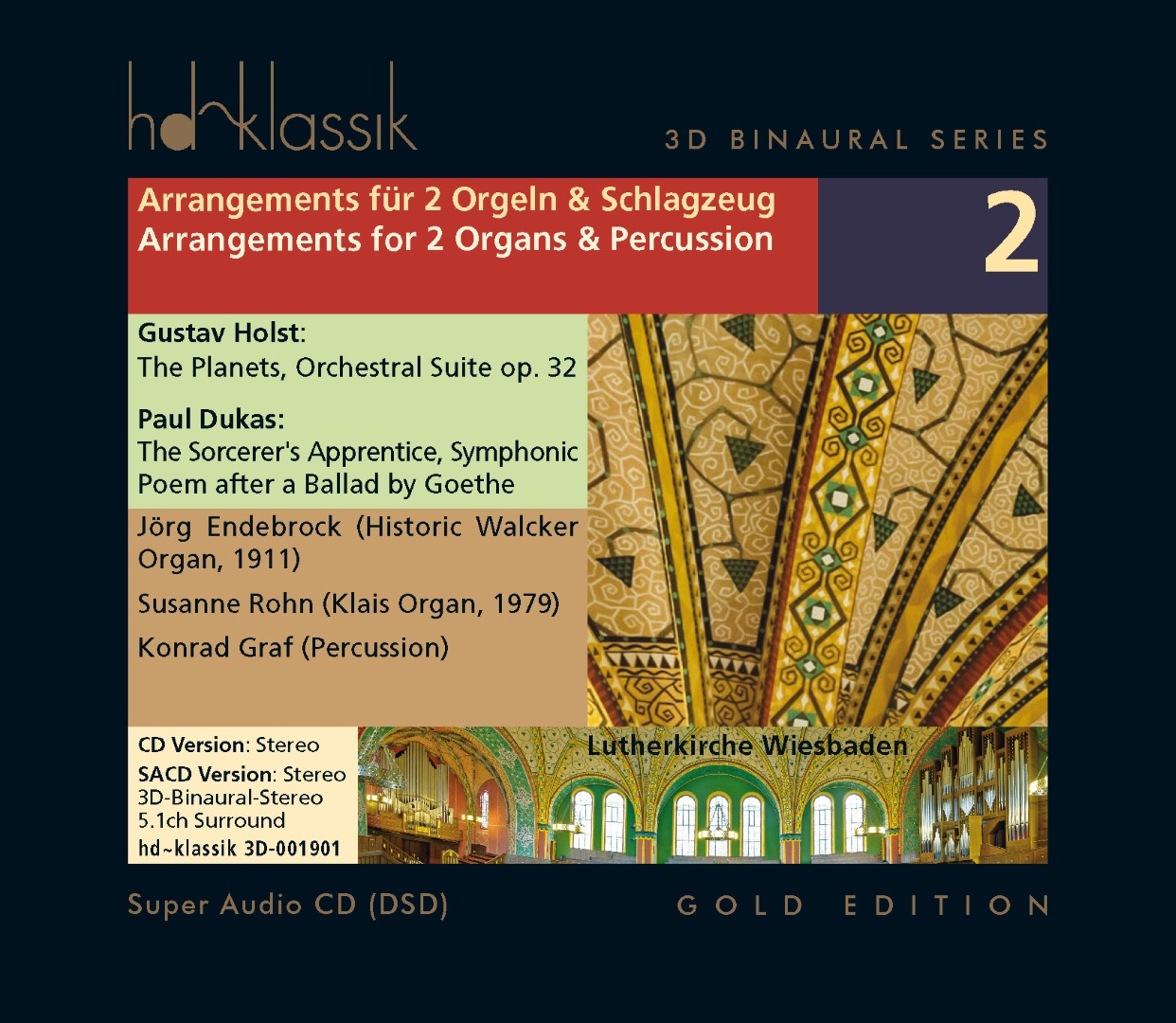
Gustav Holst’s orchestral suite “The Planets” remains his most successful composition. In it Holst fuses the most varied influences of his time into an unmistakable personal style – echoes of early Strawinsky, of Vaughan Williams, Dukas and Debussy, but also of Elgar and English folk music – and achieves the feat of being at once sophisticated and popular. It is documented that at the dress rehearsal for the premiere the cleaning ladies in the concert hall began to dance to Jupiter; a whole generation of film composers, especially in science fiction, was shaped by this style. The cycle is astrological rather than astronomical: Holst characterises the attributes that astrology ascribes to the planets. This is why Earth is missing and why the planets are ordered by their distance from Earth rather than from the sun.
“Mars, the Bringer of War” sketches a terrifying vision of mechanised warfare; contrary to a widespread assumption, Holst began the movement months before the outbreak of the First World War, albeit in anticipation of the conflict. The lovely character of “Venus, the Bringer of Peace” bears the imprint of Strawinsky’s “Firebird” and Vaughan Williams’ “Sea Symphony”, while “Mercury, the Winged Messenger” is a kind of scherzo with constantly shifting rhythms. “Jupiter, the Bringer of Jollity” combines rustic dance elements with a hymn-like middle section whose melody found its way into English hymnals as well as into the chants of rugby supporters. “Saturn, the Bringer of Old Age” traces the relentless passing of time and the fear of death with a constant pendulum motion and ends peacefully. “Uranus, the Magician” is no menacing sorcerer but a grotesquely exaggerated charlatan, with echoes of Dukas’ “The Sorcerer’s Apprentice” and Richard Strauss’ “Till Eulenspiegel”. In “Neptune, the Mystic”, with its bitonal sound surfaces and mysterious arpeggios, the sound fades out gradually at the end, as if leaving the bounds of the known universe.
Some of the best-known Goethe settings come from France, among them dramatic works by Berlioz, Gounod and Massenet. Paul Dukas’ “The Sorcerer’s Apprentice” of 1897 is not a setting but a scherzo for orchestra inspired by Goethe’s ballad, as brilliant as it is malicious and frequently played, particularly in the USA. This has to do with Walt Disney’s animated film “Fantasia” of 1940, in which Dukas’ tone poem stood at the centre alongside Beethoven’s Pastoral Symphony and Strawinsky’s “Rite of Spring”: to the music, played by Leopold Stokowski and the Philadelphia Orchestra, Mickey Mouse dons the magic hat and lets the broom do his work. That hardly any other work by Dukas is remembered today is partly the fault of the radically self-critical composer himself: he published only a dozen works.
Jörg Endebrock plays the historic Walcker organ on the singers’ stage of the Lutherkirche, Susanne Rohn the Klais organ on the gallery opposite. Rohn studied in Freiburg im Breisgau, Toulouse, Lyon and Basel and completed postgraduate studies in conducting and organ in 1997; she is a prizewinner of the organ competitions in Toulouse and Calgary, has been cantor of the Erlöserkirche parish in Bad Homburg since 1997 and teaches choral conducting, from 2006 to 2009 at the Robert Schumann Hochschule in Düsseldorf and since 2011 at the Gutenberg University in Mainz. Konrad Graf, who studied with Bernhard Wulff in Freiburg and is solo percussionist and deputy solo timpanist of the hr-Sinfonieorchester Frankfurt, has played with her in duo and trio for many years. Endebrock, a pupil of Susan Landale in Paris and a prizewinner at the organ competitions in Haarlem and Paris, moved to the Hauptkirche St. Michaelis in Hamburg as Kirchenmusikdirektor in January 2020.