
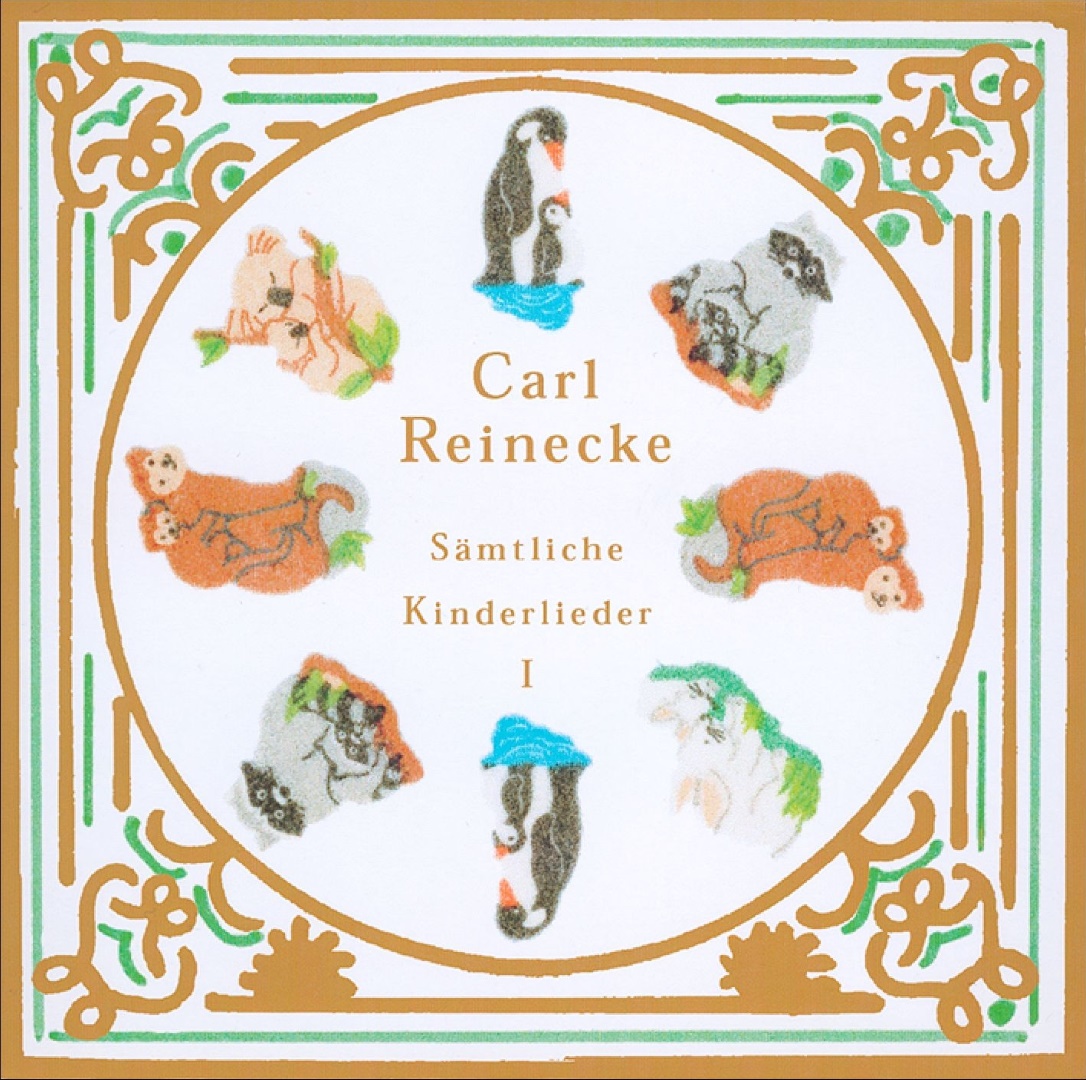
Today we speak of children’s songs mainly when children sing songs of their own or trill melodies written for them by adults in a suitably “childlike” way. We scarcely think any more of another form: the art song that parents sing for their children or make music with them. This genre, cultivated above all in the nineteenth century, has gone entirely out of fashion, Stefan Fricke writes in the booklet, and has had to give way to other kinds of children’s entertainment. All the more urgent, then, to recall undertakings that were far ahead of the present.
Reinecke’s biographer Wilhelm Joseph von Wasielewski wrote that in no branch of art had the composer developed such manifold and numerically considerable productivity as in vocal composition: his songs for one and two voices far exceeded two hundred — and of these the children’s songs make up a good half. In his surmise about the “lasting place” of these songs, however, Wasielewski was not proved right: beyond his own time Reinecke has hardly become lastingly known, and where works of his have been heard again in recent years, this concerns almost only the instrumental compositions. The vocal works still have to win back their place.
Carl Reinecke, born on 23 June 1824 in Altona, had a lifelong interest in music education — which is probably where his fondness for this genre lies. His Rathschläge und Winke für Clavier-Schüler of 1890 contain the remarkable lines: “Practise no cult of persons in art. When you are to hear music, ask rather what you will hear than whom.” By the time he published this advice he had long been a highly respected figure of musical life — after posts as teacher of piano and composition at the Rheinische Musikschule in Cologne from 1851 to 1854 and as municipal music director in Barmen from 1854 to 1859, he had headed the Leipzig Gewandhaus Orchestra since 1860.
The songs quote Goethe, offer consolation, tell anecdotes and useful things, are birthday serenades, admonish, seek to instruct and at times to educate religiously. The texts come from the most varied poets — Hoffmann von Fallersleben, Robert Reinick, Heinrich Seidel, Julius Sturm, Luise Hensel and others — and partly from Reinecke himself, who often used the pseudonym Heinrich Carsten for them. Some are set simply and catchily, so that parents can make music together with their children; the more difficult ones are for adults to perform to their offspring, as though reading them a story. They are songs for listening and for reflection — and schooled on these narratives, the listener may one day become a thoughtful narrator himself.
The recording has a particular occasion: Caroline Merz and Thomas Leander wanted to support the children’s cancer and infection ward of the Düsseldorf university clinics with this cycle, and won over Kammersängerin Martha Marquez of the Deutsche Oper am Rhein for the project. Behind it stand the Elterninitiative Kinderkrebsklinik e. V., founded in 1979 by affected parents, nurses and doctors, and the initiative “Alle Im Dienst Solidarisch”, which is devoted to the children’s infection ward. The recording was made in February 2001 in the Erholungshaus of Bayer AG in Leverkusen; the CD runs to 60:59, and the booklet has 36 pages in German, English and French and prints the song texts.