
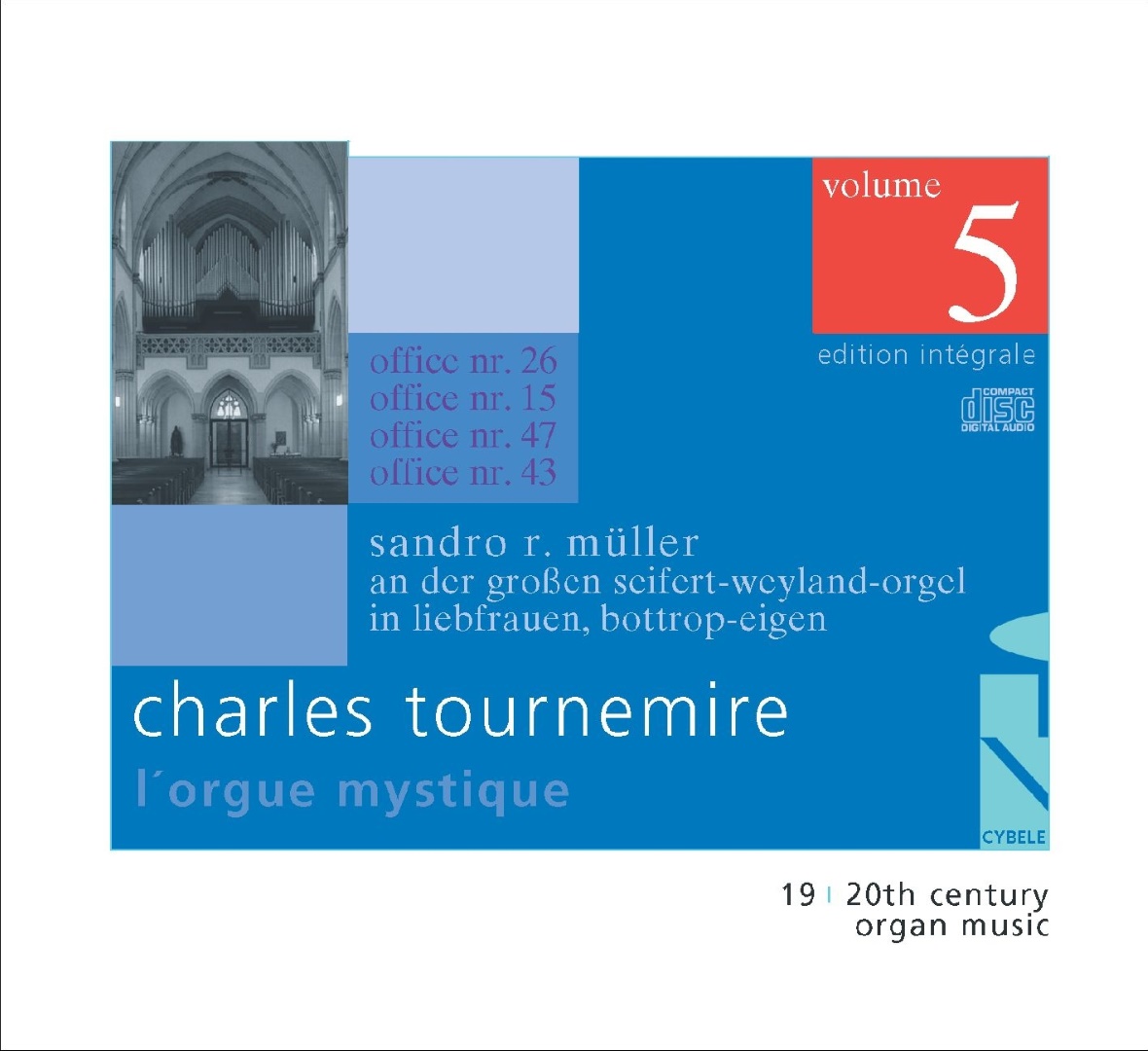
Cybele 050105 1997

16bit 44.1kHz Stereo New music Romantic music 1:18:28

To the description

Charles Tournemire: L’Orgue Mystique (Vol. 5)

Contributors

Sandro R. MüllerOrganist

Composer

Charles Tournemire

Short description

Vol. 5 of Charles Tournemire’s L’Orgue Mystique contains No. 26 (Trinity), No. 15 (Laetare), No. 47 and No. 43. The large concluding movements are Triptyque, Postlude-Fantaisie and two Chorals Alléluiatiques. Sandro R. Müller plays the large Seifert-Weyland organ (1929/1933), Liebfrauenkirche Bottrop-Eigen. His finely graded registration brings together Gregorian lines, late-Romantic fullness of sound and that modal, visionary harmony which made Tournemire a forerunner of Messiaen.

Details

Format
CD

Resolution
16 bit / 44,1 kHz

Total playing time
78:29

Channels
Stereo

Performer and instrument
Sandro R. Müller – large Seifert-Weyland organ (1929/1933), Liebfrauenkirche Bottrop-Eigen

Programme
No. 26 (Trinity), No. 15 (Laetare), No. 47 and No. 43

Specifications

Catalogue number
Cybele 050105
Year of release
1997
Genre
New music
Period
Romantic music
Instrumentation
Organ
Label
Cybele Records
Barcode
809548001520
GTIN
4068992486765
Booklet (pages)
32

Track listing

20 tracks · 1:18:28

  1. 01 Office No. 26 – La Sainte Trinité – Prélude à l´Introït Composer: Charles Tournemire (1870-1939) Performer: Sandro R. Müller 2:35
  2. 02 Office No. 26 – La Sainte Trinité – Offertoire Composer: Charles Tournemire (1870-1939) Performer: Sandro R. Müller 5:30
  3. 03 Office No. 26 – La Sainte Trinité – Elévation Composer: Charles Tournemire (1870-1939) Performer: Sandro R. Müller 2:23
  4. 04 Office No. 26 – La Sainte Trinité – Communion Composer: Charles Tournemire (1870-1939) Performer: Sandro R. Müller 3:35
  5. 05 Office No. 26 – La Sainte Trinité – Pièce terminale, Triptyque Composer: Charles Tournemire (1870-1939) Performer: Sandro R. Müller 9:23
  6. 06 Office No. 15 – Laetare – Prélude à l´Introït Composer: Charles Tournemire (1870-1939) Performer: Sandro R. Müller 1:45
  7. 07 Office No. 15 – Laetare – Offertoire Composer: Charles Tournemire (1870-1939) Performer: Sandro R. Müller 3:31
  8. 08 Office No. 15 – Laetare – Elévation Composer: Charles Tournemire (1870-1939) Performer: Sandro R. Müller 1:41
  9. 09 Office No. 15 – Laetare – Communion Composer: Charles Tournemire (1870-1939) Performer: Sandro R. Müller 3:50
  10. 10 Office No. 15 – Laetare – Pièce terminale, Postlude Fantaisie Composer: Charles Tournemire (1870-1939) Performer: Sandro R. Müller 7:41
  11. 11 Office No. 47 – XXe Dimanche après la Pentecôte – Prélude à l´Introït Composer: Charles Tournemire (1870-1939) Performer: Sandro R. Müller 1:58
  12. 12 Office No. 47 – XXe Dimanche après la Pentecôte – Offertoire Composer: Charles Tournemire (1870-1939) Performer: Sandro R. Müller 5:10
  13. 13 Office No. 47 – XXe Dimanche après la Pentecôte – Elévation Composer: Charles Tournemire (1870-1939) Performer: Sandro R. Müller 1:47
  14. 14 Office No. 47 – XXe Dimanche après la Pentecôte – Communion Composer: Charles Tournemire (1870-1939) Performer: Sandro R. Müller 3:13
  15. 15 Office No. 47 – XXe Dimanche après la Pentecôte – Pièce terminale, Choral Alléluiatique N°. 5 Composer: Charles Tournemire (1870-1939) Performer: Sandro R. Müller 6:47
  16. 16 Office No. 43 – XVIe Dimanche après la Pentecôte – Prélude à l´Introït Composer: Charles Tournemire (1870-1939) Performer: Sandro R. Müller 1:35
  17. 17 Office No. 43 – XVIe Dimanche après la Pentecôte – Offertoire Composer: Charles Tournemire (1870-1939) Performer: Sandro R. Müller 4:28
  18. 18 Office No. 43 – XVIe Dimanche après la Pentecôte – Elévation Composer: Charles Tournemire (1870-1939) Performer: Sandro R. Müller 1:25
  19. 19 Office No. 43 – XVIe Dimanche après la Pentecôte – Communion Composer: Charles Tournemire (1870-1939) Performer: Sandro R. Müller 3:06
  20. 20 Office No. 43 – XVIe Dimanche après la Pentecôte – Pièce terminale, Choral Alléluiatique N°. 1 Composer: Charles Tournemire (1870-1939) Performer: Sandro R. Müller 7:05

Description

Charles Tournemire’s L’Orgue Mystique is a singular monument of twentieth-century organ music. Between 1927 and 1932 the organist of Sainte-Clotilde in Paris wrote 51 Offices for the Sundays and feast days of the Catholic church year. The collection falls into a Christmas, an Easter and a Whitsun cycle. With its Prélude à l’Introït, Offertoire, Elévation, Communion and Pièce terminale, each Office follows the course of the Mass.

Gregorian melodies are the load-bearing material. Yet Tournemire does not merely quote them; he paraphrases their lines freely, so that modal turns, suspended planes of sound, highly chromatic concentrations and transitions that sound improvised grow an unmistakably modern language out of the old chant. The terse middle movements often retain an intimate liturgical character, while the closing pieces unfold chorale, fantasy, toccata or fugue into great architectural arcs.

The festive Triptyque of the Trinity Mass stands beside the inward Laetare Office. The two Whitsun sequences close with Choral Alléluiatique No. 5 and No. 1, showing how Tournemire draws entirely different arcs of tension from related liturgical material.

The fixed five-movement plan gives orientation without making the individual Offices uniform. Tournemire responds to the content of the feast, the chant model and the liturgical function with changing proportions and sound characters. Often the strongest effect arises from contrast: a barely moving Elevation may be followed by a Communion rich in colour, and a line that seems monophonic may develop in the closing piece into a many-voiced web. This dramaturgy turns each Office into a small sacred symphony.

Sandro R. Müller shapes the music with clear phrasing and a pronounced feeling for colour. At the large Seifert-Weyland organ (1929/1933), Liebfrauenkirche Bottrop-Eigen, even dense fields of chords become transparent; flutes, strings and reeds trace the differing liturgical moods. For all the variety of instruments used, the cycle remains coherent as interpretation: meditation and ecstasy appear as two poles of the same spiritual movement.

This recording is part of the Cybele complete edition, assembled over more than two decades. It documents not only one of the most extensive organ cycles ever written but also Tournemire’s historical position between César Franck and Olivier Messiaen. The album therefore works equally as a programme in its own right and as one chapter of a musical journey through the whole church year.