
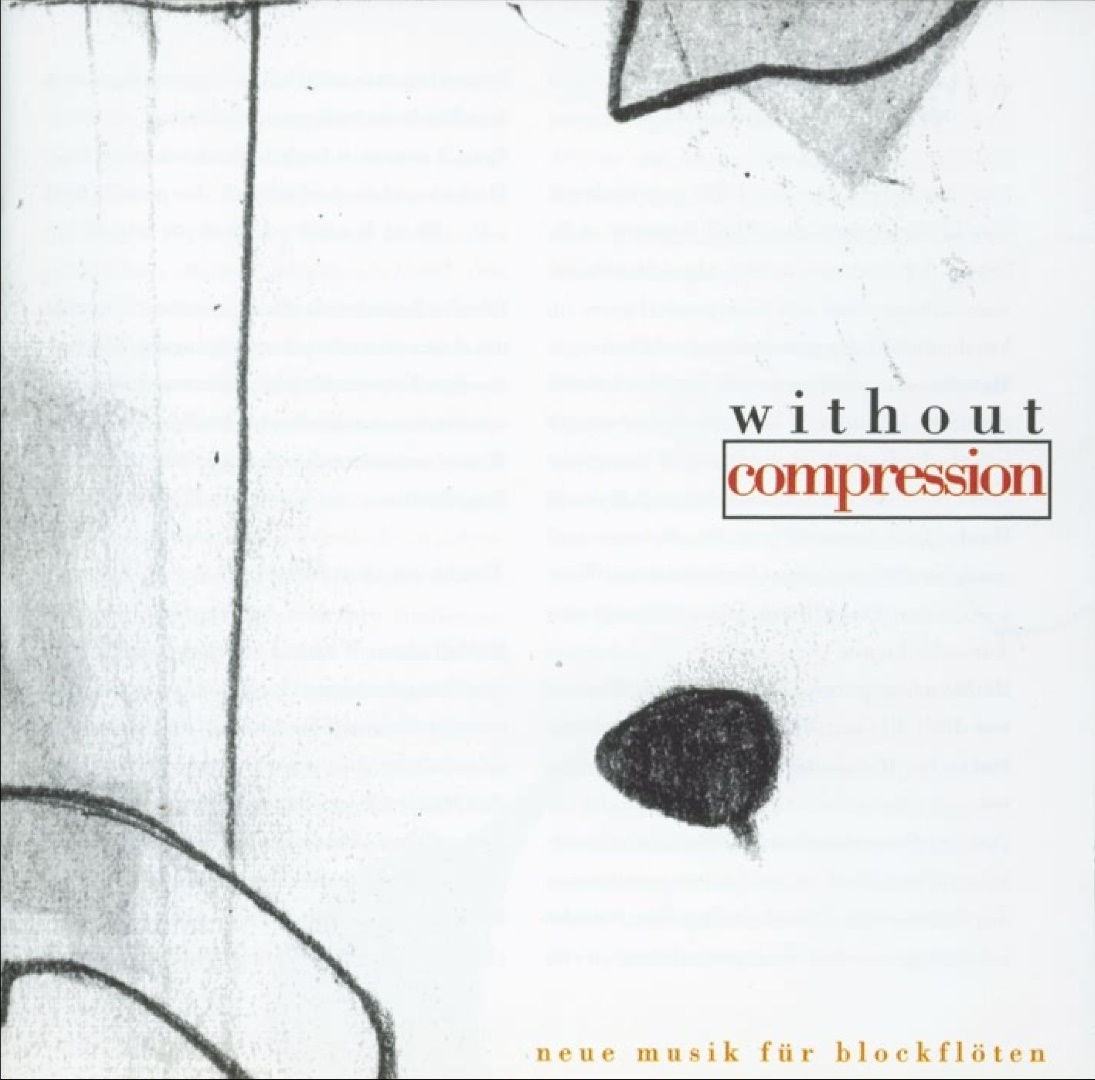
Alongside early music, working with composers is at the heart of the Trio Diritto’s activity. In 1992 the ensemble won a first prize at the International Recorder Competition in Calw with a recital of contemporary and early music – a prize that had never before been awarded there. Its contact with Violeta Dinescu led to the collaboration with Myriam Marbe and Anatol Vieru; in this way a repertoire for three recorders came into being, from which this CD presents a selection. The trio does not aim at a uniform sound ideal but at making the composers’ intentions as clear as possible – without the “compression” which in electronic amplification reduces extreme differences in volume.
In Rolf Riehm’s “Without Compression” (1997) the sound is produced almost entirely by underblowing. The tones are not only very quiet but, for lack of breath support, have no firm core; with an unchanged fingering and the weakest breath pressure, a microcosm of rhythms, changes of sound and interruptions opens up. Without amplification the piece could not be performed. Myriam Marbe’s “Renaissance” (1997) is the last work she completed; a few days later, shortly before Christmas 1997, she died in Bucharest. Marbe combines ensemble recorders of early Baroque design with solo instruments of high Baroque bore and developed a special intonation system from their differences in colour and intonation.
In “Et in Arcadia Ego” (1996) Anatol Vieru refers to a painting by Nicolas Poussin in the Louvre in which four figures bend over a tombstone bearing this inscription – spoken, as Erwin Panofsky explains, by Death himself. Violeta Dinescu took the title of “au coeur du silence …” (1995) from Albert Camus’ novel “L’Étranger”; the piece seeks to mirror states of mind, a drama in the silence. Georg Kröll’s “Round of Talks” (1994), written for the Trio Diritto and premiered at the 3rd International Recorder Symposium in Karlsruhe in 1995, combines the medieval rondellus principle of voice exchange with the image of a round of conversation. In Stefan Thomas’ “Veränderungen” (1993) for three bass recorders a three-note motif is altered again and again, almost imperceptibly; the sound recalls a soft organ stop in a reverberant church.
Malcolm Goldstein’s “in the beginning … so also, the end”, completed in May 1997 for Jeremias Schwarzer and the Trio Diritto, transforms Guillaume de Machaut’s “ma fin est mon commencement et mon commencement est ma fin” and combines it with text fragments of the Kato, an account of the beginning of the world that can equally be read as its end. During the performance the players improvise changes between instrumental playing, singing, whistling and out-breath sounds. “Without Compression” was recorded in December 1997 at the SWF’s Hans Rosbaud Studio in Baden-Baden, the other works in spring 1998 in Duisburg; Riehm, Kröll, Thomas and Goldstein attended the recordings.